Let's get one thing straight: when we talk about blueprint printing today, we're not talking about those old-school, curly-edged papers with white lines on a bright blue background. That's a relic of the past. Modern blueprint printing is all about producing incredibly precise, large-format documents for architecture, engineering, and construction (AEC).
Think of it as the critical link that translates a complex digital design into a physical, workable plan that people can use out in the real world.
What Modern Blueprint Printing Really Means
While the name "blueprint" has stuck around, the technology behind it has completely changed. It’s like comparing an old tube TV to a brand-new 4K screen. Both show you an image, but the detail, clarity, and what you can do with the modern version are on a totally different level.
The original cyanotype process was patented way back in 1842, but the industry has come a long way since then. Today's global market for blueprint machines is valued at USD 1.2 billion and is projected to more than double by 2033. It's a testament to just how essential these documents still are. You can dig into more insights on this growing market over at Verified Market Reports.
The Core Components of a Project
Every building or engineering project really boils down to two key sets of documents. You need both to get the job done right, and each one has a very specific role.
- Plan Sets: These are the drawings themselves—what most people think of as "the blueprints." They contain all the visual information: floor plans, elevations, electrical schematics, and structural diagrams. In short, they show what to build and where.
- Spec Books: Sometimes called specification manuals, these are the written instructions. This is where you'll find all the details on which materials to use, what quality standards to follow, and the exact methods for installation. The spec book tells you how to build it.
Having one without the other is like having a map without a legend. Together, they create the complete instruction manual for the entire project.
Why Absolute Accuracy Is Non-Negotiable
When it comes to printing plans, there is simply no margin for error. Every single line, symbol, and measurement has to be crystal clear and printed exactly to scale. A fuzzy line or a number that's hard to read isn't just a small hiccup—it can cause huge, expensive mistakes once construction starts.
A tiny error on paper can snowball into a massive, costly problem on the job site. Precise plans are the bedrock of any successful build, making sure that architects, contractors, and city inspectors are all on the same page.
This is exactly why professionals turn to specialized printing services. From getting the right permits from the city to guiding the crew pouring concrete, accurate plans serve as the single source of truth that keeps a project moving forward—on schedule, within budget, and up to code.
Choosing the Right Blueprint Sizes and Materials
Picking the right size and paper for your blueprints is just as critical as the design itself. Think of it like a builder selecting tools—you wouldn't use a sledgehammer for finish work. The right format ensures your plans are actually useful. Get it wrong, and you could end up with illegible details or prints that fall apart on a muddy job site.
This decision isn't just about looks; it directly impacts readability, durability, and even your project budget. A small, cramped plan is a recipe for mistakes, while an oversized one can be a nightmare to handle in the field. The first step is getting familiar with the standard formats everyone in the industry uses.
Understanding Standard Blueprint Sizes
In the architecture, engineering, and construction (AEC) world, we rely on standardized plan sizes to keep everyone on the same page. You'll primarily run into two systems: Architectural (ARCH) and Engineering (ANSI). Each is tailored for different kinds of projects to make sure scales and details are always clear and consistent.
A complete set of construction documents isn't just the drawings; it also includes the project manual, often called the "spec book." Both are essential, working together to tell the full story of the project.
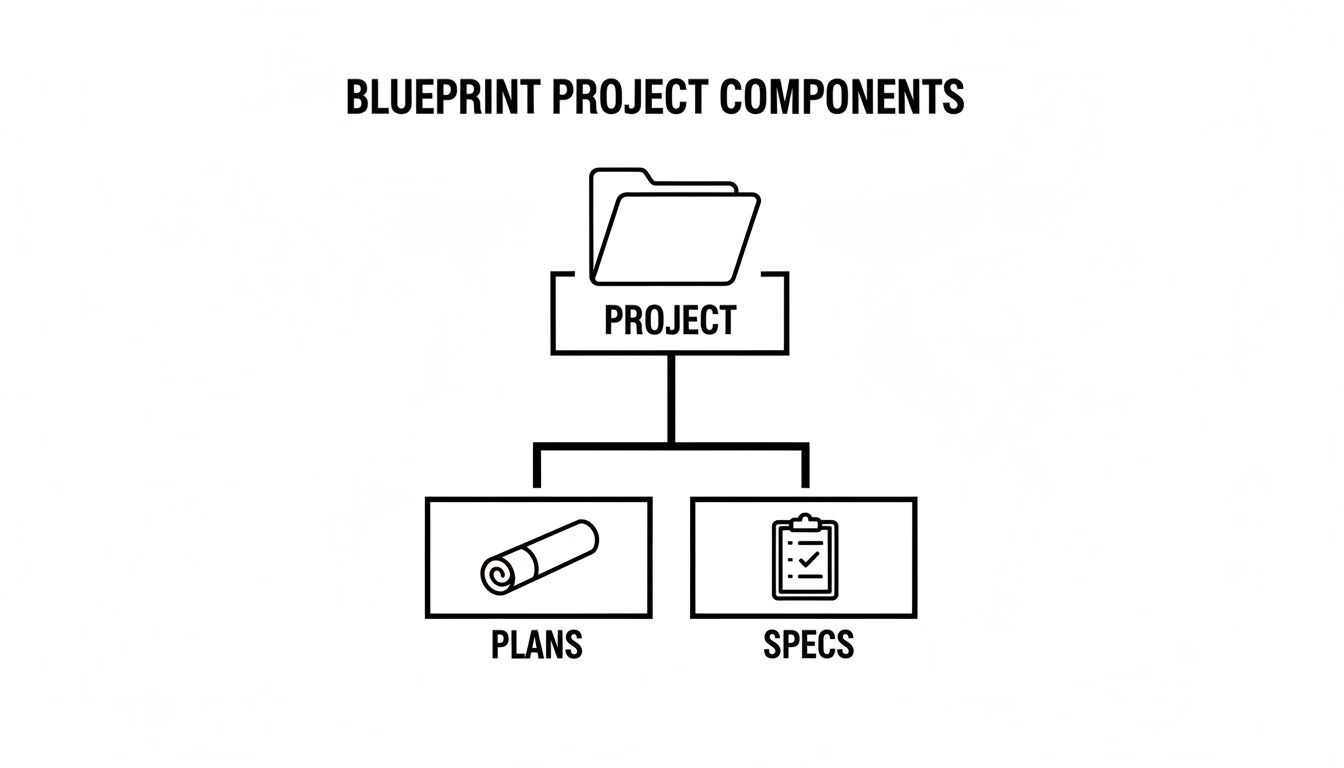
The plans show the "what" and "where," while the specifications detail the "how" and "with what." To get a better sense of the most common plan sizes and where they fit in, here’s a quick breakdown.
Standard Blueprint Sizes and Common Uses
| Standard Size (ARCH) | Dimensions | Standard Size (ANSI) | Dimensions | Common Use Case |
|---|
| ARCH A | 9" x 12" | ANSI A | 8.5" x 11" | Small drawings, addendums, or spec books. |
| ARCH B | 12" x 18" | ANSI B | 11" x 17" | Suitable for smaller projects or detail sheets. |
| ARCH C | 18" x 24" | ANSI C | 17" x 22" | A versatile size for many residential and small commercial plans. |
| ARCH D | 24" x 36" | ANSI D | 22" x 34" | The most common size for full construction drawing sets. |
| ARCH E | 36" x 48" | ANSI E | 34" x 44" | Used for large-scale projects and complex site plans. |
As you can see, ARCH D (24" x 36") is the workhorse of the industry for full-size plan sets. It’s large enough to show complex details clearly without being too unwieldy on-site.
Selecting the Best Material for the Job
Beyond size, the paper you print on determines how long your plans will last and how well they can be used. Standard 20 lb. bond paper is the go-to for office review sets or permit submissions—it’s cost-effective and gets the job done. But it’s definitely not tough enough for the field.
Think of your plan's material as its protective gear. A standard paper print on a rainy, muddy construction site is like wearing dress shoes to pour concrete—it simply won't hold up.
For plans that have to survive the real world, you need something more resilient.
- Tyvek or Vinyl: These synthetic options are your best bet for durability. They are waterproof and tear-resistant, making them perfect for job site copies that will get rained on, stepped on, and generally beat up.
- Vellum: A more traditional choice, this translucent paper is great for archival sets or creating overlays where you might need to trace or layer drawings.
Choosing the right combination of size and material from the start ensures your plans are not only clear and accurate but also tough enough to see the project through from groundbreaking to final inspection. It’s a small decision that protects the integrity of your hard work where it matters most.
How to Prepare Your Files for Flawless Printing
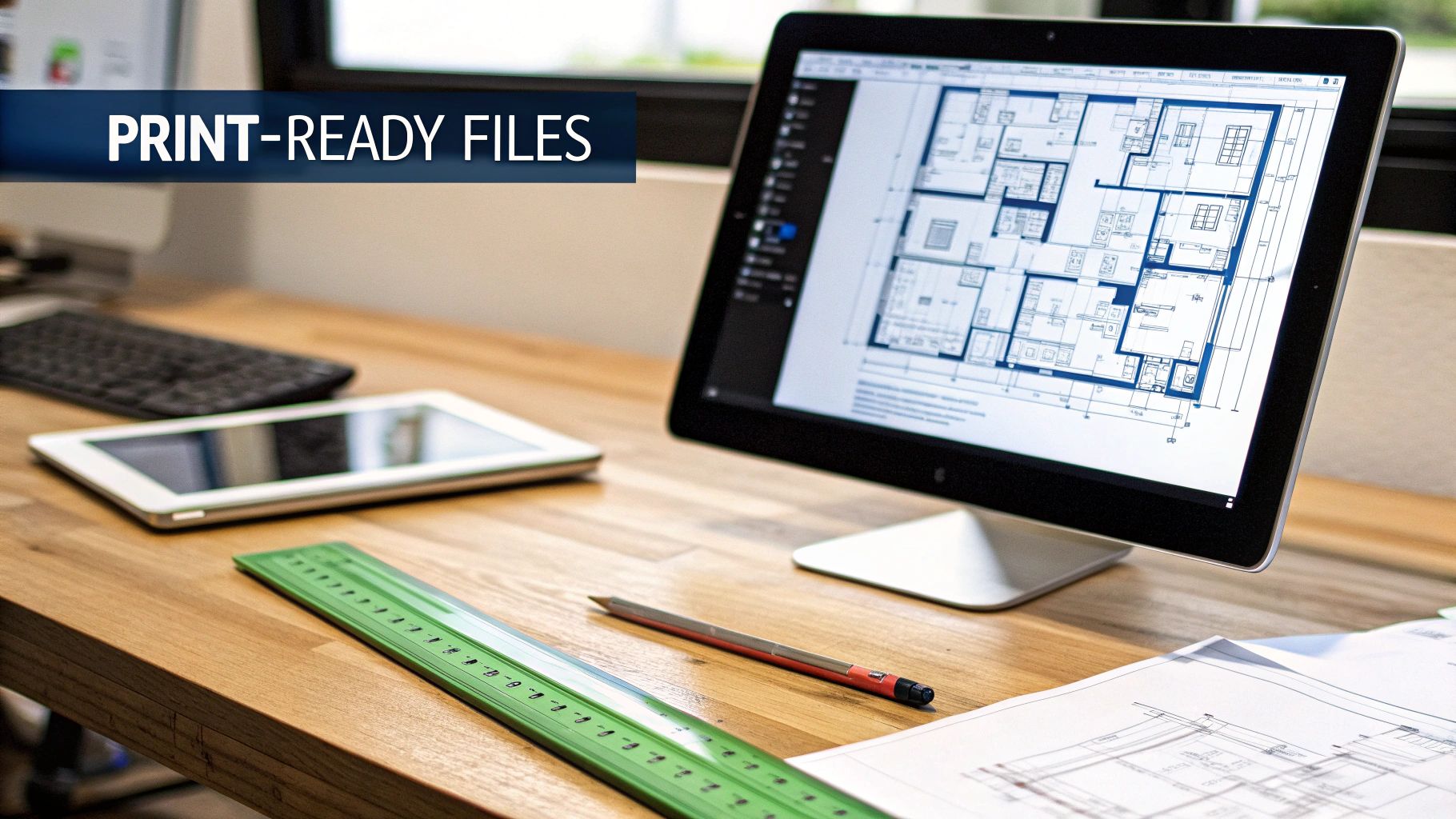
The secret to a perfect print job is all in the prep work. Honestly, what you do before you even think about hitting 'send' is the most important part of the entire process. It’s the difference between a crisp, accurate set of plans and a costly, project-derailing mistake.
Think of it as the "measure twice, cut once" mantra of printing. A few extra minutes spent getting your files in order will save you headaches, time, and money down the line. It guarantees the vision on your screen is exactly what gets built on-site.
Submitting the Right File Type
When it comes to professional printing, there's one clear winner: the high-resolution PDF (Portable Document Format). PDFs are the industry standard for a reason—they are completely self-contained, locking in every font, line weight, and layer of your design.
This means you don't have to worry about things shifting around or fonts going missing when we open the file on our end. Sending over raw design files like a DWG or a simple image file is a recipe for trouble, often leading to scaling errors or misplaced elements.
Think of a well-made PDF as a sealed envelope for your design. It protects everything inside, ensuring it arrives at the printer exactly as you intended.
Your best defense against common print problems is to always export your final drawings as a press-quality PDF. It's a simple step that makes all the difference.
Vector vs. Raster Images Explained
To get those razor-sharp lines your technical drawings demand, you need to understand the difference between vector and raster files.
- Vector Files: Built from mathematical formulas, vector graphics are all about lines and shapes. You can blow them up to the size of a billboard, and they will never lose a drop of quality. This is exactly what you want for the precise linework in architectural plans.
- Raster Files: These are pixel-based, like a digital photograph. They have a fixed number of pixels, so when you try to enlarge them, they get blurry and "pixelated." This just doesn't work for detailed blueprints where every line matters.
Your CAD software already works in vector. The key is to make sure those vector properties are preserved when you export to PDF. That’s how you maintain maximum clarity and precision.
Ensuring Your Plans Are Printed to Scale
This is the big one. Printing to scale is absolutely non-negotiable. It’s the foundation of a usable plan, ensuring that a measurement on the page, like 1/4" = 1'-0", directly corresponds to the real world. If the scale is off, the plan is worthless.
Before you send anything over, pop open your document settings for a final check. Make sure the page size in your file (e.g., 24" x 36") is the same as the size you want printed. Most importantly, ensure that any "fit to page" or "scale to print" boxes are unchecked. Those seemingly harmless settings are notorious for accidentally resizing your drawing and throwing every single measurement off.
Deciding Between Color and Black and White Prints
Choosing between color and black and white for your blueprints isn't just about looks. It's a practical decision that hits your project's bottom line, clarity, and how well your team communicates on the job site. Making the right call here means you're investing in accuracy right where it counts.
The classic black and white (monochrome) blueprint is still the industry standard, and for good reason. It's the most cost-effective way to print and delivers sharp, clean lines perfect for most construction drawings. For foundational plans, framing, or basic structural layouts, you can't beat the crisp contrast of black ink on white paper for pure legibility.
But when you get into complex, multi-layered plans, the rules change. That's when color printing goes from a nice-to-have to an essential tool.
When Color Printing Is a Necessity
Imagine staring at a dense mechanical plan where plumbing, electrical, HVAC, and fire suppression systems are all crisscrossing in the same tight space. On a black and white drawing, it’s a tangled mess. Trying to follow one system through that web of lines is a surefire way to cause confusion and expensive mistakes during installation.
This is where color-coding saves the day, making each system instantly identifiable.
- Red for Fire Protection
- Blue for Plumbing
- Green for HVAC Ductwork
- Orange for Data and Communications
This simple visual separation can cut down on job site mistakes by up to 80%, which means real savings in time, materials, and rework. It turns a confusing jumble of lines into a clear, easy-to-follow map that the entire crew—from the foreman to the newest subcontractor—can understand immediately.
Color isn't a luxury; it's a communication tool. For complex plans, it acts as a universal language that minimizes ambiguity and prevents critical errors before they happen.
Thanks to modern digital printing, high-quality color is more affordable and accessible than ever. This shift supports an industry that’s constantly advancing. As the global Blueprint-to-Building market is projected to reach $350 billion in 2025, the need for precise documentation is only getting more critical. The technology driving this growth, fueled by massive ink and toner consumption worldwide, handles everything from simple monochrome to sophisticated color prints. You can dig deeper into the evolution of the blueprint printing market to see where things are headed.
Architects rely on color renderings to bring a project to life for clients and get those all-important approvals. For contractors, color-coded plans are a lifesaver, helping coordinate the work between different trade teams on-site.
In the end, it really just comes down to complexity. If your plans are straightforward, black and white is the smart, economical choice. But for any intricate, multi-system project, spending a little extra on color is a direct investment in clarity and the success of your build.
Blueprint Printing Solutions for Every Industry
When you hear "blueprint," you probably picture an architect on a construction site. While that’s where it all started, the power of large-format printing—its incredible precision, scale, and clarity—has found a home in a surprising number of fields.
Think of it less as a tool for building structures and more as a powerful way to communicate complex visual information. Anytime you need to show the big picture without losing the critical details, this is the tool for the job.
More Than Just a Blueprint: Applications Across Key Sectors
For a lawyer, a detailed, oversized trial exhibit can be the difference between a confused jury and a clear verdict. Imagine trying to explain the layout of a crime scene or the details of a complicated accident on a standard 8.5" x 11" sheet. A large-scale diagram, on the other hand, commands attention and makes your point undeniable.
This same need for absolute clarity drives adoption in other critical fields where a misunderstanding can have serious consequences.
- Healthcare: Hospitals and clinics use large, detailed anatomical charts for training medical students and educating patients. Just as importantly, they rely on oversized facility evacuation plans and procedural diagrams that need to be legible from a distance, ensuring safety and compliance.
- Education: Think about a sprawling university campus. A new student needs a map that's easy to read. In the classroom, a massive, vibrant instructional poster can capture the attention of 30 students at once, making complex topics more engaging and accessible.
At its heart, blueprint printing is a specialized form of visual communication. Whether it's for a courtroom, a hospital wing, or a university hall, it translates vital data into a format that’s immediately clear, functional, and authoritative.
A Modern Tool for Visual Marketing and Communication
The world of large-format printing is always growing, with the global printers market projected to hit USD 55.63 billion by 2025. A big part of that growth is coming from new uses, like custom wall graphics and architectural displays that transform spaces.
These are perfect for creating custom banners and retractable displays for trade shows, or even large-scale informational charts in healthcare and educational settings. You can dive deeper into the current state of the print market to see where things are headed.
It just goes to show that the core principles of blueprint printing—size, detail, and accuracy—are solving problems for any industry that needs to convey complex information with total confidence.
Finishing and Archiving Your Printed Plans
The work isn't over once the ink is dry. In fact, what happens after your plans come off the printer is just as important as the printing itself. These final steps—finishing and archiving—are what turn a pile of paper into a practical tool for the job site and a secure asset for the future.
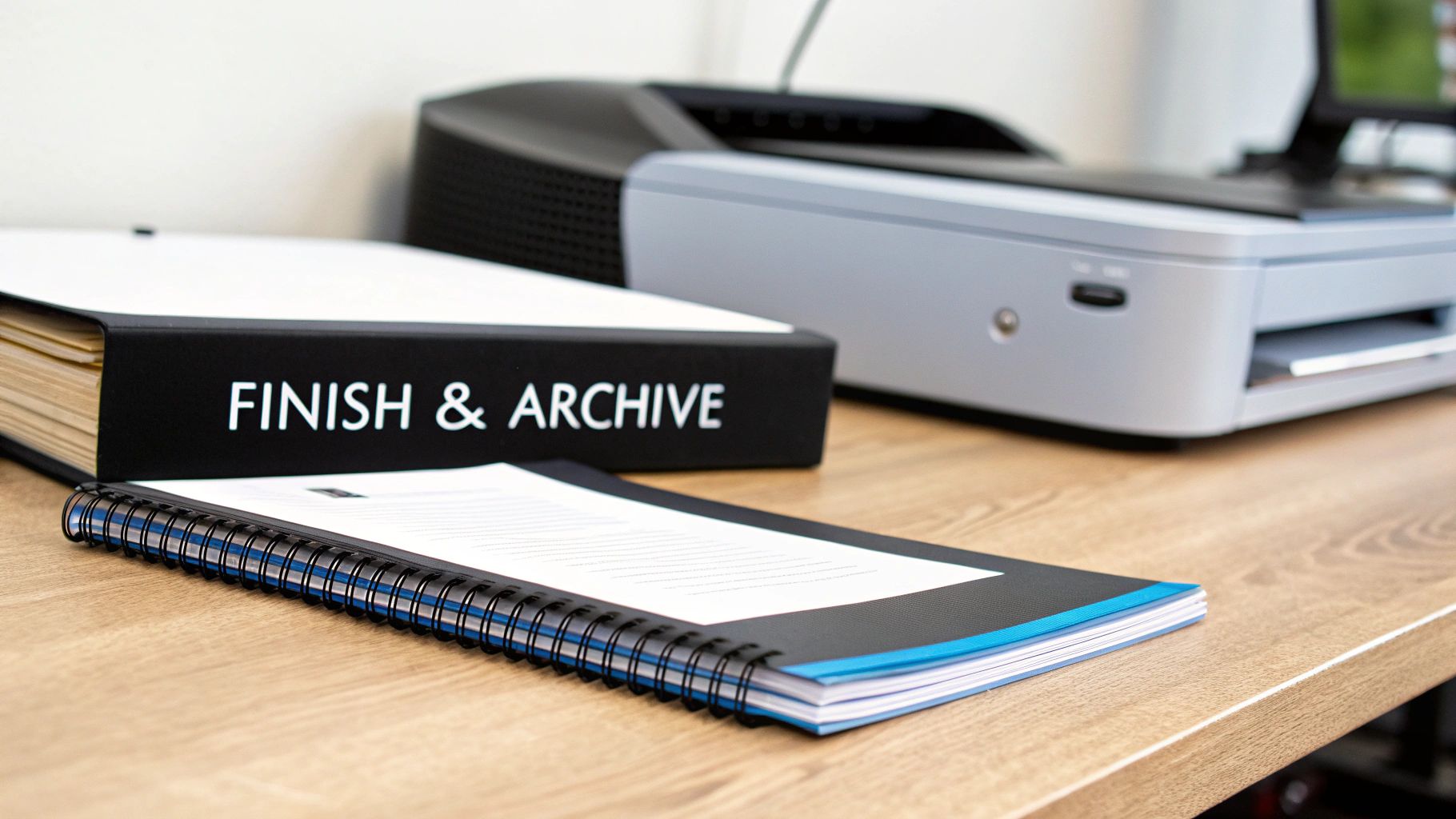
Finishing is all about day-to-day usability. A simple staple might be fine for a small set, but a full-scale project needs something more. Professional folding, for instance, makes a bulky 36x48 sheet manageable enough to slip into a project binder.
Essential Finishing Options
How you finish a set of plans really depends on where they're headed. An architect’s desk copy has very different requirements from a set destined for a muddy, rain-soaked construction site.
- Binding with Screw Posts: This is the go-to for hefty spec books or large plan sets. Screw posts are tough, holding hundreds of pages together securely, but they also give you the flexibility to swap out a sheet when a revision comes through.
- Lamination: If your plans are going to be exposed to the elements, lamination is a must. It wraps your documents in a waterproof, tear-proof shield, making them tough enough to survive pretty much anything a job site can throw at them.
- Simple Stapling: Don't overcomplicate it. For smaller drawing sets or quick prints for a team meeting, a heavy-duty staple in the corner is often the perfect, no-fuss solution to keep everything in order.
The Power of Blueprint Scanning and Archiving
Now, think about all those old paper plans rolled up in a back office or stuffed into flat files. This is where blueprint scanning completely changes the game, connecting your paper trail to your digital workflow.
Archiving isn't just about sticking old plans in a closet. It's about access. Digitizing turns a dusty pile of paper into a living, searchable database that you can use anytime, anywhere.
By scanning your old hard copies, you're creating a permanent digital backup. This protects priceless project history from fires, floods, or just the slow decay of time. Not only does this free up a shocking amount of physical storage space, but it also means you can instantly pull up and share historical data with anyone on your team. It's about preserving the past to inform the future, whether for a renovation, a legal question, or just a quick reference.
Common Questions We Hear About Blueprint Printing
Getting your plans printed shouldn't be complicated, but a few questions always pop up. We get it. To make things easier, here are the straight answers to the questions we hear most often from clients just like you.
How Fast Can I Get My Prints?
We know that in your line of work, time is money. For most standard black and white blueprint orders, we can usually have them ready for you the same or next business day.
Of course, if your project involves color prints, a massive number of sets, or special finishing like lamination, we’ll need a little more time to get every detail perfect. It's always a good idea to chat with us about your deadline when you place your order so we can make it happen.
What If I Only Have a Paper Copy?
No problem at all. If all you have is a physical hard copy of your plans, we can easily work with that. This is where our professional scanning services come in handy.
We’ll take your paper document and create a crystal-clear, high-resolution digital file from it. This not only lets us print sharp new copies for you, but it also gives you a digital backup for your archives. It's a great way to preserve your plans for the long haul.
How Much Does It Cost to Print Blueprints?
There’s no single price tag for blueprint printing because every job is different. The final cost really depends on the specifics of what you need.
A few key things will shape your quote:
- Print Size: Bigger prints just use more material. An ARCH E (36" x 48") plan will naturally cost more than a smaller ARCH C (18" x 24").
- Paper or Material: Are you good with standard 20 lb. bond paper, or do you need something more rugged like waterproof Tyvek? Your choice of material is a big factor.
- Color vs. Black & White: Full-color printing is a more complex process that uses more ink, so it costs more than a simple black and white print.
- Quantity: How many sets or individual sheets do you need? The total volume will obviously influence the bottom line.
The best way to get a solid number is to ask for a custom quote. That way, you'll get a precise price based on exactly what your project calls for.
Ready to get your project moving with plans you can count on? The team at Camelot Print & Copy Centers is standing by with expert advice and fast turnarounds. Get your free quote today and let's get building.