Think about it for a second. Your logo, your brand, is being carried around town on laptops, water bottles, and company gear. It’s in the hands of hundreds, maybe thousands, of potential customers. That’s the real power of custom stickers—they're one of the most effective, and surprisingly affordable, marketing tools out there. They’re not just fun little decorations; they’re workhorses for your brand.
Turn Your Brand Into a Statement with Custom Stickers
A custom sticker is so much more than just a piece of sticky paper. It’s a physical touchpoint, a real-world connection between you and your customers. Think of them as mini-billboards, working 24/7 to get your name out there wherever they end up. For a pretty small investment, you can turn ordinary objects into marketing opportunities, creating a kind of staying power that a fleeting digital ad just can't match.
This guide is going to get into the nuts and bolts. We’re not just talking about cool swag; we’re looking at stickers as essential tools for professional packaging, serious brand building, and even making your day-to-day operations run smoother. We’ll cover everything from picking the perfect weatherproof material for your company trucks to designing a label that grabs a customer’s eye on a packed retail shelf.
Why Custom Stickers Are a Smart Business Investment
Stickers hit a sweet spot between cost and impact that’s hard to find anywhere else. They feel personal, people love to share them, and they have a certain cool factor that makes them feel more valuable than what they cost to produce. When someone slaps your sticker on their laptop or toolbox, they’re doing more than just decorating—they’re giving your brand a personal endorsement. That's how you build a genuine community and earn trust, one sticker at a time.
Just think about all the ways you can put them to work:
- Brand Awareness: The classic move. Give them away at trade shows, tuck them into customer orders, or even sell them as branded merch.
- Professional Packaging: A simple branded sticker can instantly make your product packaging look more polished and professional.
- Operational Labeling: We’re talking durable, heavy-duty stickers for tagging equipment, posting safety warnings, or keeping your inventory system in check.
The Growing Demand for Tangible Branding
This isn't just a fleeting trend. Businesses are realizing that in a noisy digital world, something you can actually touch and feel cuts through the clutter. The global market for custom sticker printing was valued at a huge USD 1,598.2 million and is expected to rocket to USD 2,899.9 million by 2030. That's a compound annual growth rate (CAGR) of 10.5%, which shows just how much businesses are relying on personalized branding tools to make a mark. You can discover more insights about the custom printing market to see where things are headed.
A great sticker isn't just a logo. It tells a little piece of your story and creates an experience. It’s a simple invitation for people to feel like they’re part of your tribe.
Our goal here is to show you how a smart sticker strategy can pay off in a big way. We'll help you turn every available surface into a branding moment and forge connections that stick around.
Choosing the Right Sticker Materials and Finishes
Getting the right sticker isn’t just about the design—it’s about what it’s made of. The material and finish are the foundation of a sticker that looks professional and actually lasts. Think of it like this: the material is the engine, determining its performance and durability, while the finish is the paint job, dictating its look and feel. Nailing this combination is the first step to creating a sticker that works.
For example, durable vinyl is like a tough, all-weather jacket for your brand. It’s built to take a beating from the elements, which is why it's the go-to for outdoor jobs like vehicle decals, construction site signs, or equipment tags that have to survive sun, rain, and grime.
On the other hand, BOPP (Biaxially-Oriented Polypropylene) is more like a flexible, water-resistant shield. It’s perfect for product labels that might get wet or oily, like a cold brew bottle, a jar of jam, or a shampoo container. The label stays put and the ink won’t smudge.
Your Guide to Sticker Materials and Finishes
To make things simple, here’s a straightforward comparison to help you select the ideal material and finish based on durability, appearance, and what you’ll be using it for.
| Material or Finish | Ideal Environment | Key Characteristic | Common Business Use |
|---|
| Durable Vinyl | Outdoors / High-Wear | Weatherproof & Tear-Resistant | Vehicle decals, hard hat stickers, window signage |
| BOPP (Polypropylene) | Indoors / Refrigerated | Water & Oil-Resistant | Product labels, food packaging, cosmetic containers |
| Paper | Indoors / Dry | Cost-Effective & Writable | Shipping labels, event giveaways, envelope seals |
| Gloss Finish | Any | Vibrant & High-Shine | Promotional stickers, eye-catching product labels |
| Matte Finish | Any | Non-Reflective & Smooth | High-end packaging, minimalist branding, readable text |
Choosing the right combination from this table ensures your sticker not only looks great but performs exactly as you need it to in the real world.
A Closer Look at Core Materials
Let's break down the most common materials. Each one has a specific job, from quick promotional handouts to branding that sticks around for years.
- Vinyl Stickers: This is the industry workhorse. Vinyl is prized for its rugged strength and ability to stand up to the weather, making it the clear choice for car bumpers, storefronts, and any other place where you need your message to last.
- BOPP (Polypropylene) Stickers: As a plastic-based material, BOPP is fantastic at resisting water and oils, which is why you see it on so many product packages. It’s versatile, too—available in white, clear, or even a metallic finish to match your brand.
- Paper Stickers: Paper is your most budget-friendly option. Think of them as the business cards of the sticker world. They’re perfect for indoor uses like sealing packages, labeling folders, or handing out at trade shows where long-term durability isn’t the main goal.
The market backs this up. Vinyl stickers are seeing a 5.5% compound annual growth rate because they’re just so useful in advertising. At the same time, eco-friendly options are climbing even faster at 7.5% as businesses look for sustainable choices. This is all made possible by advances in digital printing, which now handles 45% of all sticker production and has helped cut costs by an average of 15% while delivering sharper results. You can explore more sticker market data to see how these industry trends are evolving.
Selecting the Perfect Finish
Once the material is sorted, the finish adds that final touch. This is what gives your sticker its personality, making it either pop with energy or whisper with sophistication.
A gloss finish is like a fresh coat of varnish. It makes colors look deeper and more vibrant, creating a high-sheen look that catches the eye instantly. It’s a great choice for promotional stickers or product labels that need to jump off a crowded shelf.
In contrast, a matte finish offers a smooth, non-reflective surface for a more subtle, modern feel. It cuts down on glare, which makes text easier to read and gives your design a premium, understated look. Matte is a favorite for luxury product packaging, professional branding, and minimalist designs.
This infographic really captures why stickers are such a powerful and versatile marketing tool.
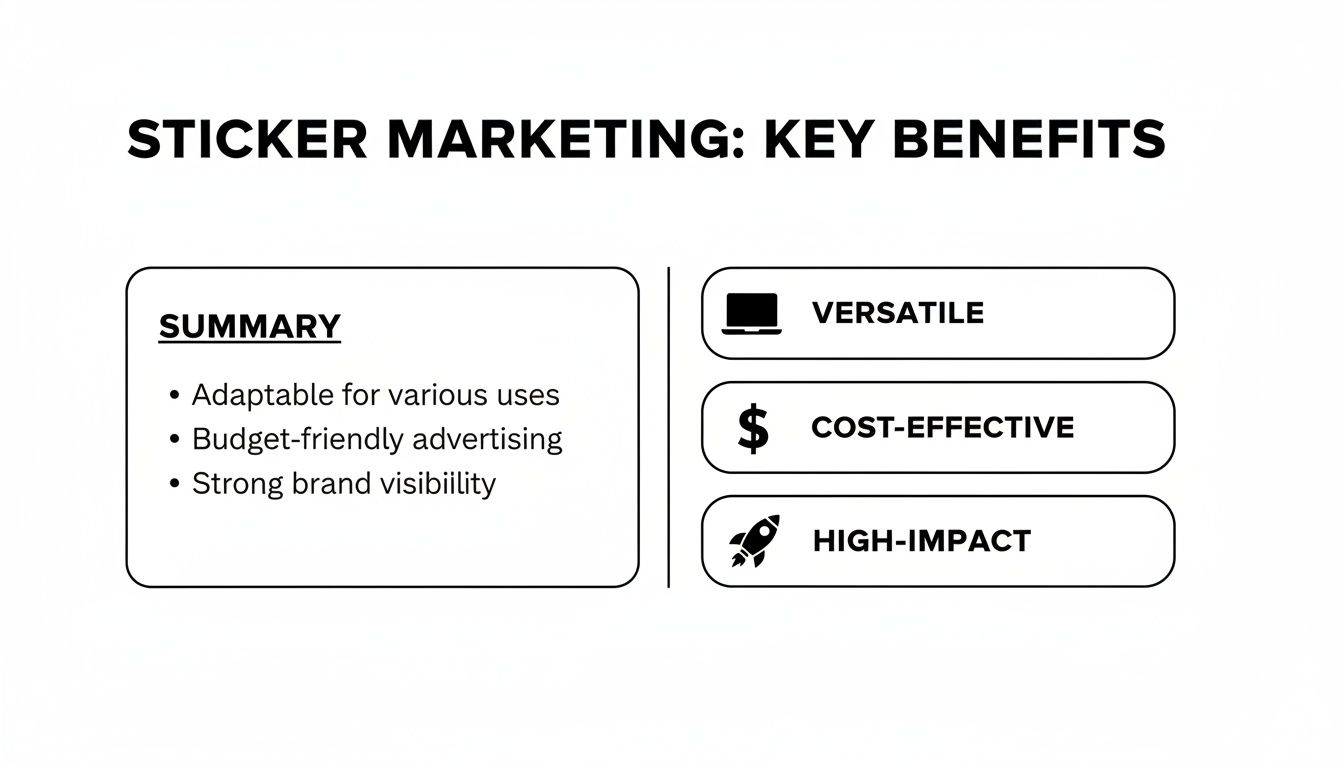
It’s clear from the visuals that custom stickers pack a punch—they’re adaptable, affordable, and make a big impact for any brand.
The material and finish you choose should directly support your sticker's purpose. A weatherproof vinyl with a protective gloss laminate is perfect for a construction company's hard hats, while an elegant matte paper sticker is ideal for a boutique's tissue paper seal.
Ultimately, matching the material and finish to your specific application isn't just a good idea—it's essential for getting professional results. By understanding these core components, you can be confident your sticker will not only look fantastic but will hold up and do its job, leaving a lasting impression.
Mastering Your Sticker Design for Flawless Printing
A fantastic sticker always starts with a creative spark, but it’s the technical prep work that makes sure it looks as good in your hand as it does on your screen. Getting a few key details right from the start is the secret to avoiding common printing headaches like fuzzy images, off-brand colors, or those pesky white borders.
Think of it like being a chef. You can have the best recipe in the world, but if your ingredients aren't prepped correctly, the final dish just won't work. For custom stickers printing, your design file is your recipe and your blueprint, all in one. By focusing on a few critical areas—file type, color mode, resolution, and bleed—you can guarantee a perfect result every time.
Vector Graphics: The Foundation of Great Stickers
The first, and maybe most important, decision is your file format. When it comes to logos, text, and illustrations, vector graphics are the undisputed industry standard. You'll typically see these as AI (Adobe Illustrator), EPS, or SVG files.
Here’s a simple way to think about it: imagine your design is made from incredibly precise, mathematical lines and curves. You can stretch or shrink that design from the size of a postage stamp to a giant wall mural, and every single edge will stay perfectly crisp. That's the power of vector.
On the other hand, files like JPG or PNG are "raster" graphics, built from a grid of tiny colored squares called pixels. If you try to enlarge a raster image too much, you’ll see those squares, and your design becomes blurry and pixelated. While raster is fine for photos, vector is an absolute must for any logo or text to ensure a professional, high-quality print.
Getting Your Colors Right with CMYK
Ever print something that looked amazing on your screen, only for it to come out looking flat and dull? That’s almost always a color mode issue. Your computer screen creates color by mixing light using an RGB (Red, Green, Blue) model. Commercial printers work differently; they create color by mixing ink on paper using the CMYK (Cyan, Magenta, Yellow, Black) model.
To make sure your brand colors print just the way you expect, your design file must be set to CMYK from the beginning. If you design in RGB and convert it later, the software has to guess at the closest matches, which can lead to some unpleasant surprises—like your vibrant lime green turning into a muddy olive.
For brands where color accuracy is non-negotiable, providing a Pantone (PMS) color code is the gold standard. Our presses are calibrated to match these colors with incredible precision, guaranteeing your stickers are a perfect reflection of your brand identity.
Your Essential Print-Ready Checklist
Beyond vector files and CMYK color, a few other details will set your project up for success. Run through this quick checklist to catch the most common design pitfalls before they become printing problems.
- High Resolution (300 DPI): If your sticker design includes any photos or raster elements, they need to be at least 300 DPI (dots per inch) at the size they'll be printed. Anything less is a recipe for a blurry, unprofessional-looking sticker.
- Adding Bleed: "Bleed" is a little bit of extra design that extends past the final cut line. A standard 1/8th inch (0.125") bleed ensures your design goes right to the very edge, preventing any accidental slivers of white from showing up after trimming.
- Readable Fonts: Make sure your fonts are clear and bold enough to be legible, especially on smaller stickers. That elegant, wispy script might look great on screen, but it can easily become an unreadable smudge when printed at a small size.
- Outlining Text: Before sending us your file, it’s a best practice to convert all your text to outlines (or "curves"). This simple step turns the letters into fixed vector shapes, so there’s zero risk of the font changing or defaulting on our end. It locks your design in place, exactly as you intended.
When you get these design fundamentals right, you're no longer just hoping for a good result—you're engineering it. These steps ensure your final printed sticker is a high-quality, professional asset that makes your brand shine.
How Businesses Use Stickers to Solve Real Problems
It’s easy to think of stickers as just a fun branding tool, but in reality, they are workhorses. Across dozens of industries, custom stickers are solving real, practical problems every single day. They’re the unsung heroes of organization, safety, and professional polish, doing far more than just showing off a logo. From a gritty construction site to a sterile hospital room, the right sticker delivers critical information when and where it's needed most.
That's the real power of custom sticker printing—its incredible adaptability. A sticker isn't just one thing. It's a rugged asset tag on a piece of heavy machinery, a clear safety warning on a high-voltage panel, or an elegant seal on a product package. Each use case proves that a simple, adhesive piece of paper or vinyl can become an essential part of how a business runs, blending practicality with professional branding.
For Architecture, Engineering, and Construction (AEC)
On any active job site, clear communication can be the difference between a project running smoothly and a costly mistake. Weatherproof vinyl stickers are indispensable here, used for everything from tagging heavy machinery with maintenance logs to labeling architectural plans and blueprints to prevent mix-ups.
Even more importantly, they are a cornerstone of site safety. A tough, high-visibility sticker that reads "Danger: High Voltage" or a hard hat decal identifying a first-aid-certified crew member has to stand up to sun, rain, and mud. In this world, a sticker isn’t a nice-to-have; it’s a critical piece of safety equipment.
A sticker in the AEC world has to be a workhorse. It needs to be tough, clear, and absolutely reliable, conveying essential information at a glance under the toughest conditions.
For Law Firms and Legal Services
The legal world runs on precision, confidentiality, and flawless organization. Custom stickers are a surprisingly vital tool for managing the mountains of physical documents that are still central to the profession. Firms rely on them to organize client files, making sure sensitive materials are properly categorized and easy to find in a hurry.
Stickers also play a key role in the courtroom itself. Attorneys use them to mark evidence exhibits with a clear, consistent labeling system that helps judges and juries follow complex arguments. On a simpler level, a professionally branded sticker on a client folder or official document reinforces a firm’s commitment to detail and quality.
For Healthcare and Medical Facilities
In a healthcare setting, accuracy isn't just important—it can be a matter of life and death. Stickers are a frontline defense against error. Hospitals and clinics use simple, color-coded stickers to manage patient charts, providing an at-a-glance signal for allergies, specific conditions, or critical treatment protocols. This visual shortcut helps medical staff make faster, safer decisions.
Beyond charts, stickers are essential for:
- Branding medical devices with serial numbers and manufacturer details.
- Providing clear instructions on prescription packaging and patient materials.
- Labeling lab specimens to ensure there are absolutely no mix-ups.
Here, a custom sticker is a tool for patient safety and operational integrity. It’s a small thing that helps uphold the incredibly high standards of modern medical care.
For Retail and Food Service Operations
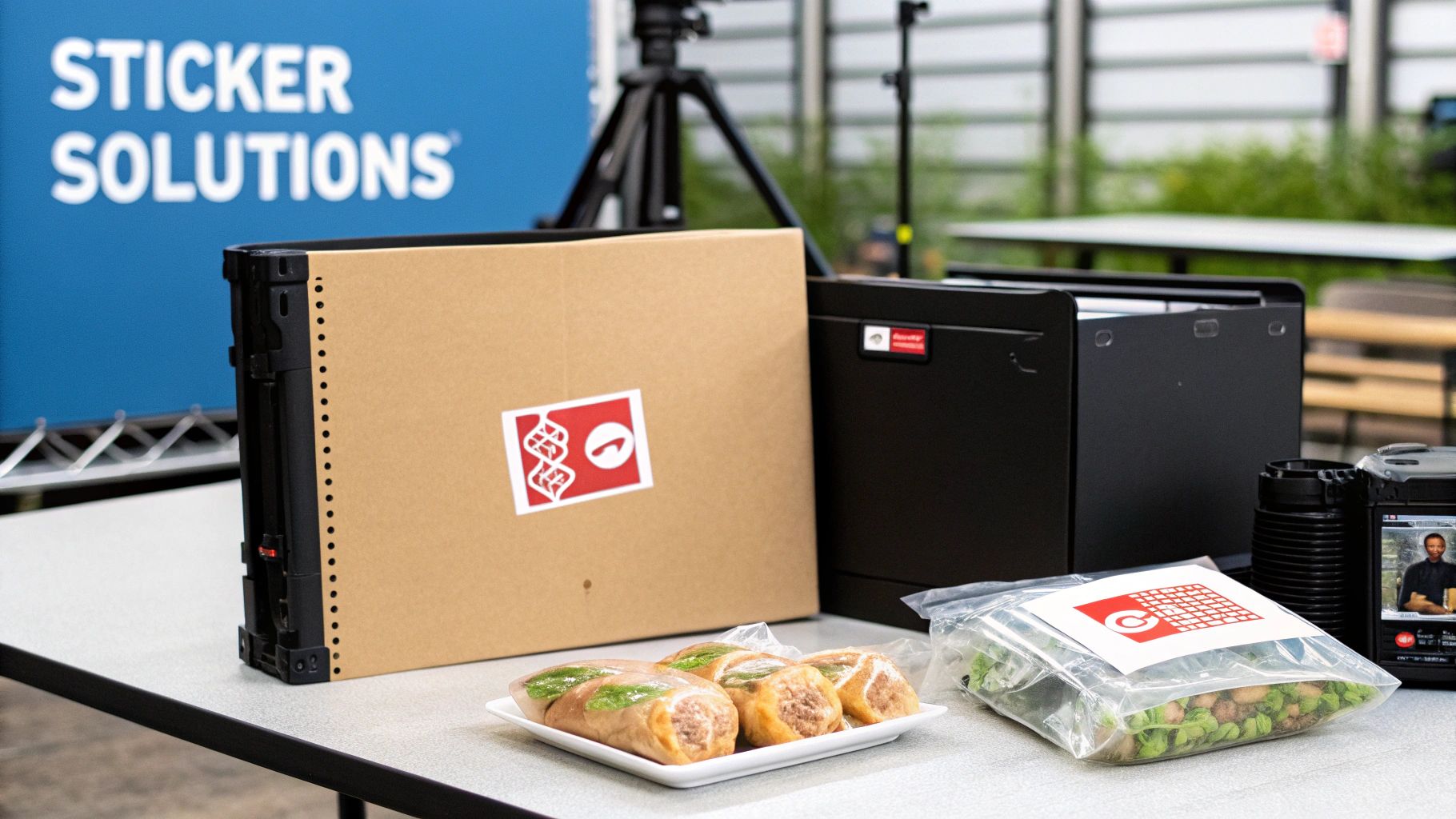
For any business selling a physical product, the packaging is the first handshake with the customer. Custom stickers are an affordable and effective way to elevate that first impression, turning a plain box, bag, or bottle into a branded experience. A well-designed sticker can share product info, highlight key ingredients, or just add a touch of personality that helps you stand out.
This is all part of a larger trend. One recent report noted that 68% of consumers now prefer personalized experiences. That demand for customization is fueling a massive global market, with Asia Pacific's commercial printing sector alone hitting USD 117.11 billion. It’s no surprise that Google searches for 'personalized business stickers' have reached peak interest. You can discover more insights about print industry trends and see just how big this movement has become.
In the food world, stickers have an even more critical job: building trust. Tamper-evident seals on delivery bags and takeout containers are now the industry standard. These simple sticker seals give customers peace of mind, assuring them that their food has arrived safely and untouched. It’s a tiny detail that builds a huge amount of customer confidence.
From construction sites to cafes, these examples show that custom sticker printing is about so much more than looks. It’s about solving real business problems with a cost-effective, adaptable, and surprisingly powerful tool.
How to Order Your Stickers with Camelot
Getting custom stickers shouldn't be a headache. We've built our process to be straightforward and supportive, so you get exactly what you need without the runaround. Whether you have a print-ready file or are starting from scratch with just an idea, we're here to help.
The first step is always the easiest: just reach out. You can send your artwork through our online portal, swing by one of our shops, or give us a call to chat through your project.
Step 1: Send Your Artwork or Work with Our Designers
If you have a design all set to go, our online job submission is your quickest path forward. Just upload your files, and you're on your way. It's a great option for businesses with an in-house design team or anyone who knows exactly what they want.
But what if you don't have a design? No problem at all. That’s what our in-house graphic designers are for. They can take your concept—even if it's just a rough sketch or a few brand guidelines—and turn it into a professional, print-ready sticker that brings your vision to life.
Step 2: Lock in the Details with Our Expert Guidance
Once your design is sorted, we'll figure out the physical specs for your sticker. This is where our experience really comes into play, helping you choose the right materials, finishes, and quantities for what you're trying to achieve.
We’ll help you think through the important questions:
- Where is this sticker going to live? This tells us if you need tough, weatherproof vinyl or if a standard indoor paper will do the trick.
- What kind of vibe are you after? We can help you pick between a bold, shiny gloss finish or a more subtle, modern matte look.
- How many do you actually need? We can guide you to a quantity that makes sense for your budget and your project.
Our team gives you practical advice to make sure your sticker doesn't just look good, but actually works perfectly for its job.
The most important part of the ordering process is the proof. It’s your final chance to review every detail—spelling, colors, and layout—before your project goes to print. We will never print without your explicit approval.
Step 3: Approve the Proof and Get Your Timeline
After we’ve nailed down all the details, we'll send over a digital proof. This is your chance to give everything a final once-over and make sure it’s perfect. Think of it as our quality-control checkpoint; we want to be 100% sure you love it before a single sticker gets printed.
Once you give us the green light, we'll give you a clear, solid turnaround time. We’re known for hitting our deadlines without cutting corners on quality. You'll know exactly when your order will be ready for local pickup at our Latham or Hopewell Junction locations or when to expect a delivery right to your door.
Got Questions? We’ve Got Answers.
It’s completely normal to have a few questions before you hit “print.” In fact, we encourage it! Getting the details right is what turns a good sticker into a great one. To help you feel confident about your order, we’ve put together a list of the most common questions we hear from clients just like you.
Think of this as your final check-in before bringing your vision to life. We’ll clear up some key terms and tackle the practical stuff so you know exactly what to expect.
What’s the Real Difference Between Kiss Cut and Die Cut?
This is easily the most popular question we get, and for good reason. The right cut can make a huge difference in how your sticker is perceived and used. The only difference is how the sticker and its backing paper are cut.
Imagine you're making cookies. A die cut sticker is like using a cookie cutter to punch out a shape from the dough. The blade cuts clean through both the sticker vinyl and the paper backing, creating a custom-shaped piece that matches your design perfectly. It has a premium, finished look right out of the box.
Now, a kiss cut sticker is a bit more delicate. The blade just "kisses" the surface, slicing through the vinyl layer but leaving the square or rectangular paper backing intact. This makes peeling off intricate designs a breeze and keeps delicate edges protected until they’re ready to be applied.
So, which should you choose?
- Go with Die Cut for: A premium, standalone look. They're perfect for handing out at events or selling as individual items.
- Go with Kiss Cut for: Complex designs with sharp points, easy peeling, or printing multiple designs on a single sheet.
How Can I Make Sure My Brand Colors Don't Look "Off"?
Brand consistency is everything. Nothing is more frustrating than seeing your company’s signature color look dull or just plain wrong on the final product. The single best thing you can do to prevent this is to set up your design file in CMYK color mode from the very beginning.
CMYK (Cyan, Magenta, Yellow, Black) is the four-color language that all professional printers speak. Your computer screen, on the other hand, uses RGB (Red, Green, Blue) light, which can create colors that are far brighter than ink can ever replicate on paper. If you design in RGB, the mandatory conversion to CMYK for printing can cause some surprising and disappointing color shifts.
If your brand requires a perfect, non-negotiable color match, providing a Pantone (PMS) color code is the industry gold standard. Our equipment is calibrated to hit these specific shades with incredible accuracy, ensuring your stickers are a perfect extension of your brand identity.
What's the Smallest Number of Stickers I Can Order?
This is a big question for small businesses, startups, or anyone who just wants to test a new design without being stuck with a thousand stickers. The minimum order quantity (MOQ) often depends on the sticker type and the printing process involved.
The good news? Modern digital printing has made small-batch orders incredibly affordable and easy. We can produce small runs for clients who just need a handful for a special event, a new product prototype, or a limited-time promotion. This flexibility means you can get professional-grade stickers without a huge upfront cost.
Because every project is a little different, the best way to get a firm number is to simply ask us for a custom quote. We’re set up to handle jobs of all sizes and will work with you to find a solution that fits your budget.
How Long Will My Custom Stickers Actually Last?
A sticker’s lifespan really comes down to three things: its material, its finish, and where it’s going to live. There’s no one-size-fits-all answer, but we can definitely give you some solid guidelines.
Take a laminated vinyl sticker, for instance. It's engineered to be tough. Built to stand up to UV sunlight, rain, and scuffs, it can easily last 3-5 years outdoors—sometimes even longer—without fading or peeling. That’s why it’s the go-to choice for vehicle decals, outdoor equipment labels, and storefront window graphics.
On the other hand, an indoor paper sticker is meant for shorter-term use. It’s perfect for adding a branded touch to product packaging, sealing an envelope, or as a fun giveaway at a trade show. It looks fantastic, but it's not designed to handle moisture or a sunny window.
Knowing this helps you match the sticker to the job. When you choose the right materials and finish, you can be sure your sticker won't just look great on day one, but will keep representing your brand well for its entire intended life.
Ready to create stickers that solve problems, build your brand, and make a real impression? The team at Camelot Print & Copy Centers is here to guide you through every step, from design to delivery.
Start Your Custom Sticker Project Today