In an age of overflowing inboxes and digital ad fatigue, tangible marketing is making a powerful comeback. The right direct mail strategy doesn't just get noticed; it gets results. But success isn't about simply printing and mailing. It's about a scientific, data-driven approach that transforms a simple mailpiece into a high-performing conversion tool.
This guide cuts through the noise to deliver a definitive list of direct mail marketing best practices that modern businesses use to drive measurable growth. We will explore the precise methods required to build a campaign that feels personal, arrives at the perfect moment, and compels action. Forget generic advice; we are focusing on specific, repeatable strategies that deliver a clear return on investment.
You will learn how to:
- Use data to create one-to-one messaging that resonates deeply.
- Integrate your mailers with digital channels for a unified customer experience.
- Design compelling creative and offers that demand a response.
- Track every campaign element to prove its value and optimize future sends.
These techniques are the blueprint for building a direct mail program that not only works but thrives. From hyper-personalization that speaks directly to your audience to sophisticated tracking that proves your ROI, these strategies will help you use this powerful channel for maximum impact. When you need a reliable partner to bring these concepts to life with expert printing and fulfillment, Camelot is ready to help you execute your vision.
1. Personalization and Variable Data Printing
Gone are the days of one-size-fits-all mailings. The most effective direct mail marketing campaigns today feel like a one-to-one conversation. Variable Data Printing (VDP) is the technology that makes this possible, allowing you to customize individual pieces within a single print run. By connecting a customer database to a digital press, VDP populates specific fields in your design template with unique information for each recipient. This could be anything from their name and address to their purchase history, loyalty status, or a personalized offer based on their past behavior.
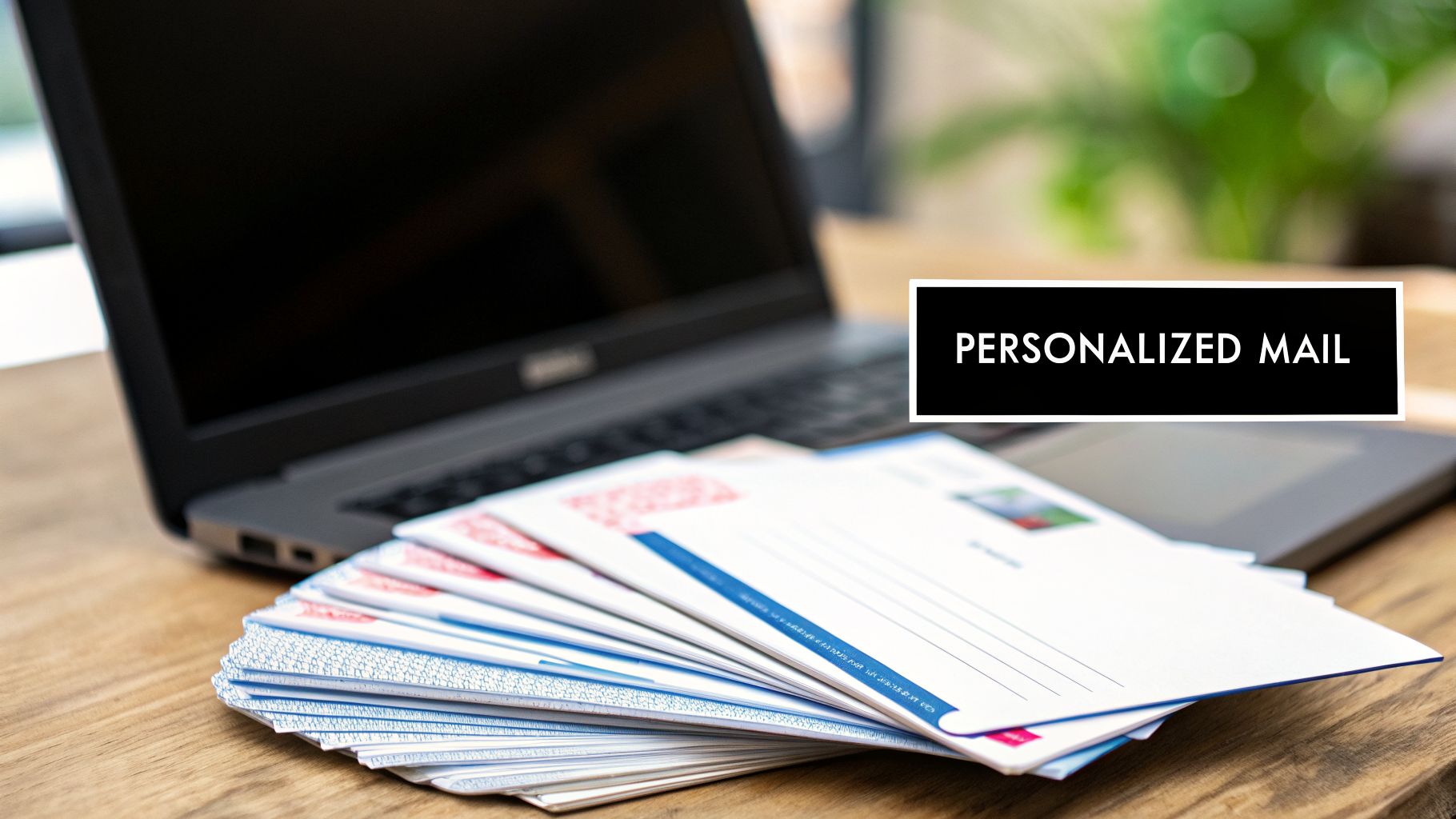
This level of detail dramatically increases relevance and engagement. For instance, a medical practice can send appointment reminders that include the patient's name, doctor, and specific time, reducing no-shows. Similarly, a bank can send pre-approved credit offers with personalized limits based on a customer's credit profile, making the offer more compelling. This technique transforms a generic advertisement into a valuable piece of communication.
Putting Personalization into Practice
To implement VDP effectively, start with clean, well-organized data. A robust Customer Relationship Management (CRM) system is crucial for maintaining accurate and up-to-date information.
- Segment Your Audience: Don't just personalize names. Group your list by lifecycle stage, customer value, or past interactions to tailor the core message and offer.
- Test Key Elements: Before a full-scale launch, run a small test to see which personalized elements (e.g., name in the headline vs. a personalized image) generate the best response.
- Integrate Tracking: Use unique QR codes, custom URLs, or promo codes for each recipient. This allows you to attribute conversions directly to the mail piece and measure ROI accurately.
- Think Beyond the Mailer: Consider how the personalized message can extend to other brand touchpoints. For instance, integrating tangible, personalized items like personalised notebooks into your direct mail can create a memorable experience and reinforce your message.
Key Insight: The goal of VDP is to show your customer you understand their specific needs, not just that you know their name. Every personalized element should add value and make the recipient feel seen.
Our team at Camelot can help you design VDP templates that maximize impact while maintaining brand consistency. To dive deeper into the technical aspects and possibilities, you can explore our detailed guide on what Variable Data Printing involves.
2. Strategic Segmentation and Targeted List Selection
Sending the same message to everyone is one of the quickest ways to waste your marketing budget. Strategic segmentation is the practice of dividing your mailing list into smaller, more focused groups based on shared characteristics. By targeting these specific segments, you ensure your message is highly relevant, dramatically increasing its chances of resonating with the recipient. This approach shifts resources away from a broad, ineffective mass mailing and concentrates them on high-probability prospects and valuable existing customers.
This method allows for precise and impactful communication. For instance, an AEC firm can target architects and contractors within a specific geographic radius with specialized plan reproduction services. A law firm could segment its client list by practice area, sending tailored updates about real estate law changes only to relevant clients. Similarly, a medical practice can identify and mail patients who are due for preventive care based on their appointment history, making the communication both timely and helpful. This targeted approach is a cornerstone of effective direct mail marketing best practices.
Putting Segmentation into Practice
A successful segmentation strategy begins with understanding your audience and organizing your data. Clean, well-maintained lists are the foundation for any targeted campaign.
- Create Detailed Buyer Personas: Develop clear profiles for each key segment. Understand their pain points, needs, and motivations to guide your messaging and creative strategy.
- Enrich Your Data: Use third-party data providers to add valuable demographic, firmographic, or behavioral details to your existing customer lists, allowing for more granular targeting.
- Prioritize High-Value Segments: Start by focusing on your most profitable or loyal customer groups. Test your campaigns with them first before expanding to broader or less-proven audiences.
- Use Geographic Precision: For local businesses, leverage postal carrier databases or Every Door Direct Mail (EDDM) to target specific neighborhoods or zip codes, even without a pre-existing list.
Key Insight: The goal of segmentation is not just to divide your list, but to align your message with the distinct needs and context of each group, making your mail piece feel intentionally crafted for them.
Our team can help you analyze your audience and design segment-specific collateral that speaks directly to each group. Get a quote today to see how targeted printing can improve your campaign results.
3. Compelling Copy and Attention-Grabbing Design
Your direct mail piece has just a few seconds to capture attention in a crowded mailbox. This is where strategic design and persuasive copy become critical. One without the other is ineffective; they must work together to communicate value, create an emotional connection, and motivate the recipient to act. The right combination of visuals, headlines, and messaging can transform a piece of paper into a powerful sales tool.
Effective design guides the reader's eye through the most important information, while compelling copy provides the reason to care. For example, a law firm might use bold typography and powerful case success statistics to instantly establish authority and trust. Similarly, an accounting firm can use a clean, minimal design with a clear headline like "Save an Average of $3,500 on Your Business Taxes" to immediately convey a tangible benefit. These direct mail marketing best practices ensure your message is not just seen, but understood and acted upon.
Putting Design and Copy into Practice
A successful mailer starts with a clear goal, which informs every design choice and word written. Focus on one primary objective and build the creative around it.
- Lead with Value: Your headline is the most important element. Start with your most compelling benefit or unique value proposition to immediately answer the recipient's question: "What's in it for me?"
- Use Visual Hierarchy: Employ elements like white space, high-quality images, and bold fonts to draw attention to key information. A cluttered design is an unread design.
- Create a Single, Clear CTA: Don't confuse recipients with multiple competing requests. Decide on the one action you want them to take (e.g., call, visit a URL, scan a QR code) and make it prominent.
- Establish Urgency: Motivate immediate action with time-sensitive offers, limited availability, or deadlines. This simple tactic can significantly boost response rates.
Key Insight: Great design makes your message easy to read; great copy makes it impossible to ignore. The two must be perfectly aligned to achieve your marketing goals.
Creating professional, high-impact designs that align with postal regulations can be a challenge. To see the benefits of working with a professional, explore these top reasons to use one of our in-house graphic designers for your next campaign.
4. Multi-Touch Integration with Digital Marketing
Direct mail is no longer a standalone channel; its greatest strength is revealed when it works in concert with your digital marketing efforts. A multi-touch strategy integrates physical mail with email, social media, and digital advertising to create a cohesive and powerful customer journey. When a recipient sees consistent messaging across different platforms, brand recall and response rates increase significantly compared to campaigns that rely on a single touchpoint. The physical mail piece acts as a high-impact, tangible anchor for your digital follow-ups.
This synchronized approach makes your marketing more persistent and effective. For example, a law firm can send a high-quality printed case study to a list of potential corporate clients, then follow up with a targeted email nurture sequence and LinkedIn ads directed at the same decision-makers. The physical mail piece grabs their attention, and the subsequent digital touches keep the firm top-of-mind, guiding the prospect through the consideration phase.
Putting Multi-Touch Integration into Practice
Executing a successful integrated campaign requires careful timing and consistent messaging across all channels. Your direct mail piece is often the catalyst, but the digital components must be ready to capture the interest it generates.
- Bridge the Physical-Digital Gap: Use QR codes and personalized URLs (PURLs) on your mailers to guide recipients directly to a specific online destination. This creates a seamless transition and makes it easy to track engagement.
- Time Your Touchpoints: Plan your digital follow-ups to coincide with the mail delivery window. An email or social media ad that appears 3-5 days after a postcard arrives can reinforce the message at the perfect time.
- Maintain Brand Consistency: The visual identity, core message, and offer must be identical across your mail piece, landing page, emails, and ads. This consistency builds trust and reinforces your brand.
- Build a High-Converting Destination: Your QR code or URL is only as good as the page it leads to. For integrated campaigns, your digital touchpoints are as important as the physical mail piece. Discover how to create a landing page that converts fast to effectively capture responses driven by your direct mail.
Key Insight: Treat direct mail as the high-impact opening act that makes your digital marketing encore more effective. The goal is to create an omnipresent brand experience where each channel strengthens the others.
The team at Camelot can help coordinate your print production and mailing schedule to align perfectly with your digital campaign launch. Contact us to discuss your integrated marketing strategy and get a quote for your next project.
5. Unique Offers and Limited-Time Promotions
A compelling call-to-action is the heart of any direct mail piece, but a unique offer is what truly motivates a recipient to act. Direct mail campaigns that feature exclusive, time-sensitive promotions consistently outperform generic messaging by creating a sense of urgency and special value. This approach transforms your mailer from a simple advertisement into an immediate opportunity, giving prospects a tangible reason to engage with your brand right away.
This tactic is effective across countless industries because it provides a clear, measurable path to conversion. For example, an accounting firm can send business owners a mailer for a "Free tax assessment" that must be claimed by a specific date, driving timely leads before tax season. Likewise, a medical practice might offer a "Free preventive screening" during an open enrollment period, encouraging new patient sign-ups when they are most likely to be seeking a provider. This strategy makes tracking campaign success straightforward through offer redemption rates.
Putting Offers into Practice
To create a promotion that drives action without hurting your bottom line, careful planning is essential. The offer must feel valuable to the recipient while remaining profitable for your business.
- Create Scarcity: Set realistic expiration dates, typically between 30 and 90 days, to encourage immediate action. This creates urgency without making your brand appear desperate.
- Communicate Value Clearly: The offer should be the most prominent element on your mailer. Use bold fonts and place it "above the fold" on postcards to ensure it’s seen instantly.
- Test Offer Types: Before a full campaign launch, test different incentives with small audience segments. Compare the performance of a percentage discount (e.g., 20% off) versus a fixed dollar amount (e.g., $50 off) or a value-added service (e.g., free consultation).
- Segment for Tracking: Use unique coupon codes, custom URLs, or distinct QR codes for different audience segments. This allows you to measure which groups respond best to your promotion and provides critical data for future direct mail marketing best practices.
Key Insight: A strong offer does more than generate a single sale; it gives you a powerful tool to measure interest, test messaging, and build a predictable model for customer acquisition.
Our team at Camelot can help you design and print mailers that make your offers impossible to ignore. To discuss your next promotional campaign, get a custom quote today.
6. Strategic Mail Piece Format and Dimensional Design
In a crowded mailbox, the physical form of your mail piece is your first opportunity to make an impression. Going beyond standard letters and postcards can significantly boost open rates and engagement. Unique formats like dimensional boxes, intricately folded brochures, and mailers containing product samples ("lumpy mail") physically disrupt the sorting process, capture attention, and create a memorable tactile experience that increases the perceived value of your offer.
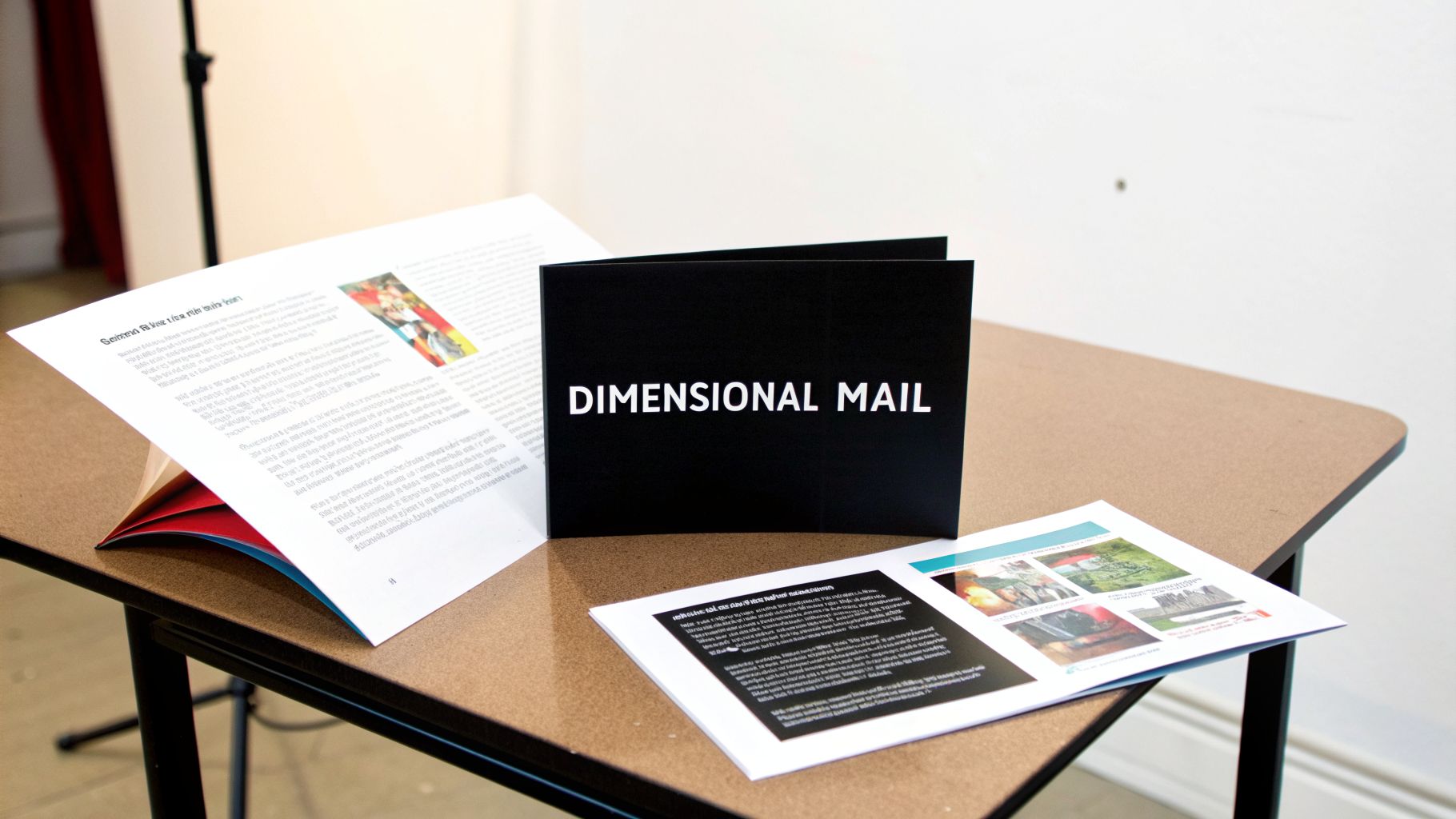
This approach is one of the most effective direct mail marketing best practices because it taps into sensory engagement. A financial advisor mailing a dimensional box with a high-quality strategy report feels more substantial and authoritative than a simple letter. Likewise, an architectural firm can showcase its portfolio in a specialty folded format with unique textures and finishes, communicating creativity and attention to detail before the recipient even reads a word. The format becomes part of the message itself.
Putting Format and Design into Practice
Choosing the right format requires a balance of creativity, budget, and brand alignment. The goal is to stand out without alienating your audience or overcomplicating the experience.
- Align Format with Your Message: Ensure the physical design supports the offer. Use dimensional mailers for high-value B2B proposals or exclusive product launches. A law firm might use an oversized, foil-stamped folder to convey prestige and success.
- Factor in Postage and Handling: Before committing to a design, verify postage rates and dimensional requirements with your mail carrier. Unusual shapes and weights can significantly impact costs.
- Enhance with Finishes: You can increase visual impact without the cost of a full dimensional mailer. Specialty finishes like gloss, matte, embossing, or die-cutting add a premium feel to traditional formats. The right paper choice also matters; you can explore our guide on what paper weight points mean to make an informed decision.
- Test Before You Invest: Run a small pilot campaign comparing a standard format against a more creative one. Measure the difference in response rates to determine if the increased production cost delivers a worthwhile return on investment.
Key Insight: The physical weight, texture, and shape of your mail piece communicate brand quality non-verbally. A unique format makes your message feel important and demands attention before it's even opened.
Our experts at Camelot can guide you through the production possibilities for specialty and dimensional pieces. Get a quote today to explore formats that will make your campaign unforgettable.
7. Data-Driven Testing and Optimization (A/B Testing)
Sending a direct mail campaign without testing is like navigating without a map; you might reach your destination, but you won't know the most efficient route. A/B testing, also known as split testing, is a systematic approach to improving campaign performance. It involves creating two or more versions of a mail piece that differ by a single variable and sending them to a small, statistically significant segment of your audience to see which one performs better. This data-driven method replaces guesswork with evidence, ensuring your full campaign rollout is based on proven results.
This scientific approach identifies the highest-performing elements and dramatically improves ROI by allowing you to scale only the winning variations. For example, a law firm might test two headlines on 5,000 recipients each: "Client Won $2M Settlement" versus "We Fight For Your Rights." The version that generates more calls becomes the control for the full-scale campaign. Similarly, a medical practice can A/B test a postcard against a folded letter for appointment reminders to determine which format minimizes no-shows most effectively.
Putting Testing into Practice
Effective A/B testing requires discipline and a clear process to ensure the results are reliable. Start by identifying a key metric you want to improve, such as response rate or cost per lead.
- Isolate One Variable: To get clean data, test only one major element at a time. Change the headline but keep the image, offer, and format identical. If you change multiple variables, you won't know which one caused the change in performance.
- Use Adequate Sample Sizes: For results to be statistically significant, you need a large enough test group. A common recommendation is a minimum of 5,000 pieces per variation to avoid drawing false conclusions from random chance.
- Run Tests Simultaneously: Mail all test versions at the same time. This eliminates seasonal or time-based factors that could skew the results and ensures you are comparing apples to apples.
- Document Everything: Keep a detailed record of what you tested, the hypothesis, the results, and the winning variation. This creates an institutional knowledge base that will inform future campaigns and accelerate optimization over time.
Key Insight: A disciplined testing framework is fundamental to any successful direct mail marketing best practices. Small, incremental gains from consistent testing compound over time, leading to significant improvements in campaign profitability and customer engagement.
Our team at Camelot can help you manage staggered production runs and print variations to facilitate your testing workflow. To discuss your next campaign and build an effective testing plan, get a quote from our experts.
8. Timing, Frequency, and Sequence Strategy
Effective direct mail is not just about what you send, but when and how often you send it. A well-planned timing, frequency, and sequence strategy ensures your message arrives at the precise moment it will have the greatest influence. This approach moves beyond single, isolated mailings to create a coordinated series of communications that guide a recipient through a decision-making process, building familiarity and trust over time.
This strategic cadence dramatically boosts response rates by aligning with the customer's natural journey. For example, a law firm might send an initial service overview, followed by a case results mailer a month later, and then a client testimonial letter to nurture a prospect. Similarly, an architecture firm can time portfolio mailings to coincide with bid season and send case studies just before clients begin year-end planning. This transforms your mail from an interruption into a timely, welcome resource.
Putting Timing into Practice
A successful sequence strategy begins with a deep understanding of your customer's lifecycle and buying patterns. Analyzing past campaign data is a great starting point to identify your own peak response windows.
- Map the Customer Journey: Create a clear map of your customer's path from awareness to conversion and retention. Identify key moments where a direct mail piece would be most influential.
- Establish a Cadence: Avoid mail fatigue by spacing touches appropriately. Aim for 2-3 weeks between mailings for active prospects and 4-6 weeks for longer-term nurturing or retention campaigns.
- Use Triggered Mailings: Automate mailings based on specific customer actions or milestones. Send a thank-you postcard after a first purchase, a special offer on a customer's anniversary, or a reminder when a subscription is nearing renewal.
- Plan for Seasonality: Time your initial prospecting mailings 30-45 days before the peak buying season in your industry. This gives your message time to resonate before purchase decisions are made.
Key Insight: The most successful direct mail marketing best practices treat mail as part of a larger conversation. Each piece in a sequence should build upon the last, guiding the recipient logically toward the next step.
Coordinating the production and delivery of a multi-touch campaign requires precise scheduling. Our team at Camelot can help you plan your production timeline to ensure each component of your sequence arrives exactly when it needs to. Contact us for a quote to get started on your strategically timed campaign.
9. Response Tracking and Measurement (Unique Identifiers)
Without a reliable way to measure results, a direct mail campaign is merely a hopeful guess. One of the most critical direct mail marketing best practices is implementing unique identifiers to track every response. This method transforms your mailers from a creative endeavor into a measurable science, allowing you to attribute conversions, calculate return on investment (ROI), and gather valuable data to refine future campaigns. Unique identifiers are specific codes or links assigned to individual mail pieces or campaign segments.

This process involves assigning unique coupon codes, personalized URLs (PURLs), dedicated phone numbers, or QR codes to your mailers. For instance, a law firm might use promo codes like 'LAW2024-A' for one audience segment and 'LAW2024-B' for another to see which one responds better. Similarly, a university could use a PURL like www.university.edu/JSmith2024 to track when a specific prospective student engages with their application portal, providing clear attribution that digital advertising alone often misses.
Putting Tracking into Practice
Effective tracking begins during the campaign planning phase, not after the mailers are sent. A clear strategy ensures that every response is captured and correctly attributed.
- Choose the Right Identifier: Use QR codes for tech-savvy audiences to drive web traffic. Simple, memorable promo codes work well for in-person or phone redemptions. For older demographics, a unique, trackable phone number is often most effective.
- Prepare Your Team and Tech: Ensure your website landing pages are live and optimized before the campaign launch. Train all customer-facing staff to correctly input promo codes and ask customers how they heard about the offer.
- Integrate with Your CRM: Connect your tracking data back to your Customer Relationship Management system. This provides a full view of the customer journey and helps measure the long-term value of leads generated from direct mail.
- Measure Beyond Immediate Response: Track initial responses within the first 30-60 days, but also monitor how many of those leads convert over a longer period (6-12 months) to understand the full impact of your campaign.
Key Insight: The goal of tracking is not just to count responses, but to understand who is responding and why. This data is your most valuable asset for improving campaign performance over time.
Our team at Camelot can help you strategically select, design, and place unique identifiers on your mail pieces to ensure they are clear, scannable, and effective. Ready to build a measurable direct mail campaign? Contact us to get a quote.
10. Compliance, Deliverability, and USPS Optimization
Even the most brilliant creative and compelling offer will fail if the mail piece never reaches its destination. Maximizing deliverability while maintaining strict compliance with United States Postal Service (USPS) regulations is a foundational element of successful direct mail. This involves properly preparing your mailing list, formatting your mail pieces correctly, and taking advantage of postal programs to reduce costs and improve efficiency. Essentially, it's about working with the USPS system, not against it, to ensure your message arrives as intended.
This process directly impacts your campaign's bottom line by reducing wasted postage on undeliverable mail and qualifying your mailings for significant discounts. For example, a law firm must use CASS-certified lists to guarantee court documents and client communications are accurate. Similarly, a medical practice that runs its patient list through National Change of Address (NCOA) updates prevents appointment reminders from being returned, reducing administrative costs and improving patient care.
Putting Optimization into Practice
To ensure your mail is compliant and cost-effective, focus on data hygiene and mail preparation. Partnering with a print and mail expert who understands USPS requirements is the most direct path to success.
- Clean Your Mailing List: Regularly run your address list through CASS (Coding Accuracy Support System) and NCOA (National Change of Address) services. CASS standardizes addresses to USPS specifications, while NCOA identifies recipients who have moved.
- Choose the Right Mail Class: Use First-Class Mail for time-sensitive materials like invoices or urgent offers, as it offers faster delivery and return service. Use USPS Marketing Mail (Standard Mail) for less time-sensitive, high-volume campaigns where cost savings are a priority.
- Qualify for Presort Discounts: Presorting your mail by ZIP code before it reaches the post office can earn you major postage discounts. Barcoding provides additional savings and helps the USPS process your mail more quickly.
- Monitor Postal Regulations: The USPS frequently updates its rates and regulations. Stay informed or work with a partner who does to avoid compliance issues and budget surprises.
Key Insight: Deliverability isn't just about avoiding returned mail; it's about maximizing your budget. Every dollar saved on postage is a dollar you can reinvest into your creative, offer, or list acquisition.
Navigating USPS guidelines can be complex. The team at Camelot specializes in mail preparation and postal optimization, ensuring your campaigns are compliant and achieve the lowest possible postage rates. Contact us to get a quote to see how we can streamline your next mailing.
10-Point Direct Mail Best Practices Comparison
Turn Best Practices into Bottom-Line Results
Mastering direct mail is not about executing a single tactic perfectly; it’s about orchestrating a symphony of proven strategies. We've explored the essential pillars of a successful campaign, from the foundational work of strategic segmentation to the precision of response tracking with unique identifiers. Each of these direct mail marketing best practices represents a critical control point, a place where you can actively steer your campaign toward greater profitability and customer engagement.
The true power of direct mail emerges when these elements work in concert. A hyper-personalized message created with Variable Data Printing falls flat if it's sent to the wrong audience. A brilliant, attention-grabbing design won't deliver results without a compelling offer that motivates action. Similarly, even the most creative mailer can fail if it’s not optimized for USPS deliverability and postage discounts. This interconnectedness is the core principle of effective direct mail strategy. It’s a discipline that rewards meticulous planning and punishes shortcuts.
From Theory to Tangible Returns
Moving these concepts from a checklist to a real-world campaign requires a shift in mindset. Instead of viewing direct mail as a one-off project, see it as an iterative process of continuous improvement.
- Start with Data: Your customer list is your most valuable asset. Prioritize clean data and thoughtful segmentation above all else.
- Test Relentlessly: Never assume you know what will work best. Consistently A/B test your headlines, offers, formats, and calls to action to build a library of proven tactics.
- Integrate and Amplify: Your direct mail piece should not exist in a vacuum. Connect it to your digital efforts through QR codes and dedicated landing pages to create a cohesive, multi-channel customer journey.
- Measure Everything: The only way to prove ROI and justify future investment is through rigorous tracking. Implement a system to measure every response, call, and conversion tied back to a specific mail piece.
Ultimately, adopting these direct mail marketing best practices is about taking control of your marketing outcomes. It's about moving away from "spray and pray" and toward a calculated, data-informed approach that respects your customers' attention and your company's budget. The difference between a mailer that gets tossed and one that gets treasured lies in the details, the personalization, and the perceived value you deliver directly into their hands. This strategic execution transforms a simple piece of paper into a powerful engine for business growth.
Executing these strategies with precision requires more than just a printer; it demands a partner with deep expertise in mail design, data management, and postal logistics. The team at Camelot Print & Copy Centers specializes in turning these best practices into high-performing campaigns, ensuring every detail from print quality to mail preparation is handled for maximum impact and cost-efficiency. Ready to see the difference a professional partner can make? Get a quote today and let's build your next successful campaign together.