So, what exactly is foam board printing? At its core, it's a simple but brilliant concept: we print your design directly onto a lightweight yet surprisingly sturdy material.
Think of it like a visual sandwich. You have a dense, polystyrene foam center that gives the board its structure, and it's pressed between two smooth paper facings. This creates a beautifully flat, receptive surface that's perfect for printing. The result? Crisp, vibrant, professional-looking graphics that are ideal for presentations, signs, and event displays.
What Is Foam Board Printing?
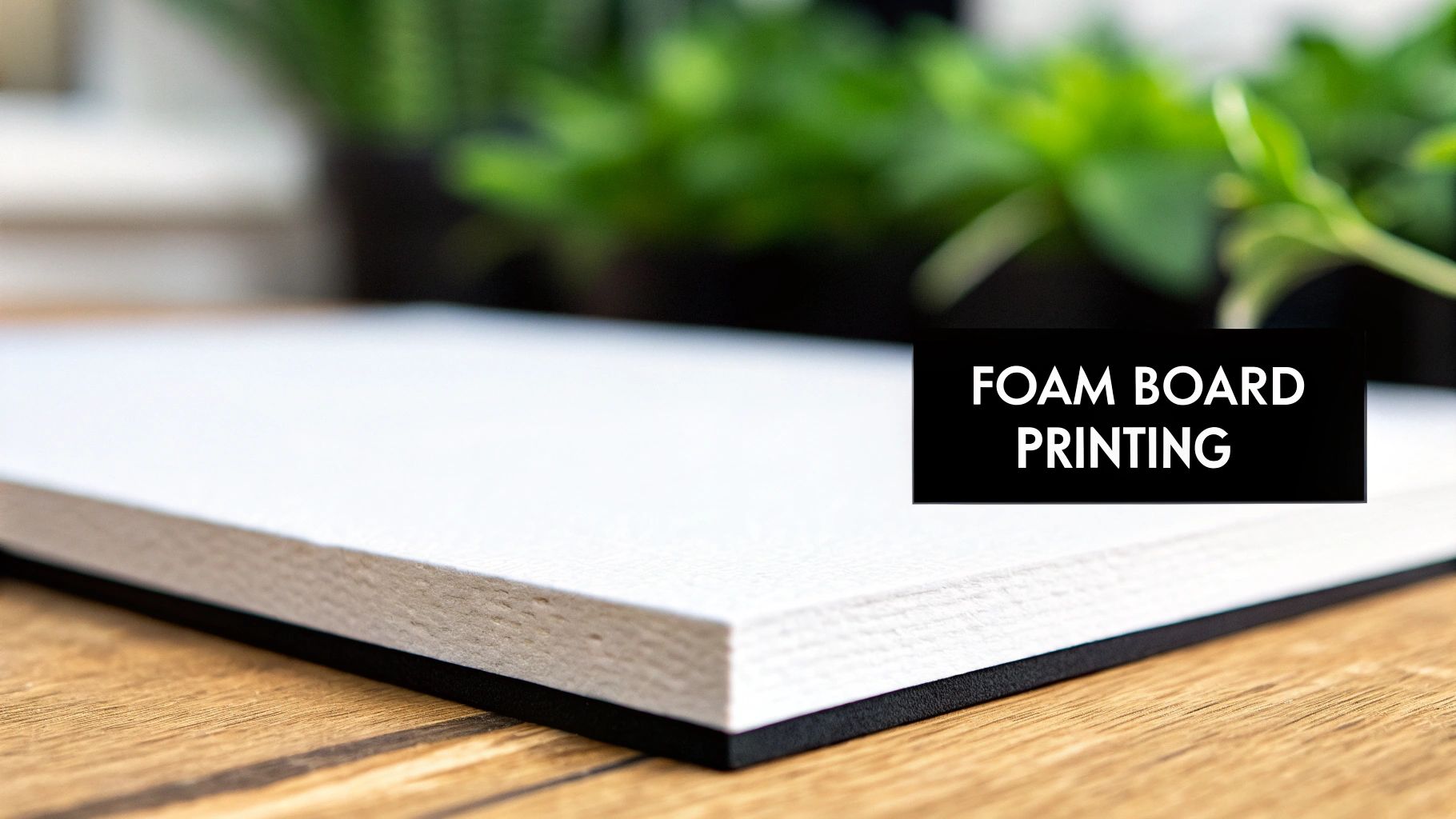
Let's break that down a bit more. The magic of foam board is in its construction. That inner polystyrene foam core provides rigidity without the bulk or weight you’d get from wood or metal. The paper faces on either side are the real secret sauce, though—they create the perfect canvas for high-resolution printing, making colors pop and details look incredibly sharp.
What you end up with is a versatile and professional-looking display that feels premium but doesn't come with a hefty price tag. Because they're so light, foam board prints are a breeze to transport, set up, and move around, which has made them a go-to choice for all sorts of temporary and semi-permanent displays.
The Go-To Choice for Visuals
Why do so many people, from small businesses to large corporations, rely on foam board? It really comes down to a few key advantages that solve a lot of common problems.
- It’s Incredibly Affordable: You get a high-end look without the high-end cost associated with materials like acrylic or metal.
- It’s Perfectly Portable: The lightweight design means you can easily carry your signs to trade shows, conferences, or pop-up events without any trouble.
- It Looks Professional: The ultra-smooth surface ensures every graphic is sharp and every color is true to your design, projecting a polished, credible image.
This powerful combination of price, portability, and quality has made foam board a major player in the visual graphics world. In fact, the signage industry alone makes up approximately 35% of the entire global PVC foam board market. That’s a huge testament to how effective it is for professional use, driven by its amazing print surface and cost-effectiveness compared to traditional sign materials. You can dive deeper into the PVC foam board market trends on lairdplastics.com.
Foam board printing perfectly fills the gap between flimsy paper posters and heavy, permanent signs. It gives you a durable, high-quality option that’s still portable and easy on the budget for almost any project.
Whether you're putting together a welcome sign for a wedding, a new menu for your café, or a critical visual aid for that big business pitch, foam board printing gives you a reliable foundation for a flawless presentation.
To give you a quick overview, here’s a breakdown of what makes foam board printing so useful.
Foam Board Printing at a Glance
| Feature | Description | Best For |
|---|
| Material | A lightweight polystyrene foam core sandwiched between two paper facings. | Indoor signage, presentations, and temporary displays. |
| Weight | Extremely light and easy to handle, transport, and mount. | Trade shows, pop-up events, and portable marketing materials. |
| Finish | A smooth, matte surface that produces vibrant, non-glare prints. | High-resolution photos, detailed graphics, and text-heavy signs. |
| Cost | One of the most budget-friendly options for professional-quality rigid signs. | Short-term projects, bulk orders, and budget-conscious marketing. |
Ultimately, foam board is one of the most versatile tools in a marketer's or event planner's toolkit.
Choosing Your Ideal Foam Board and Finish
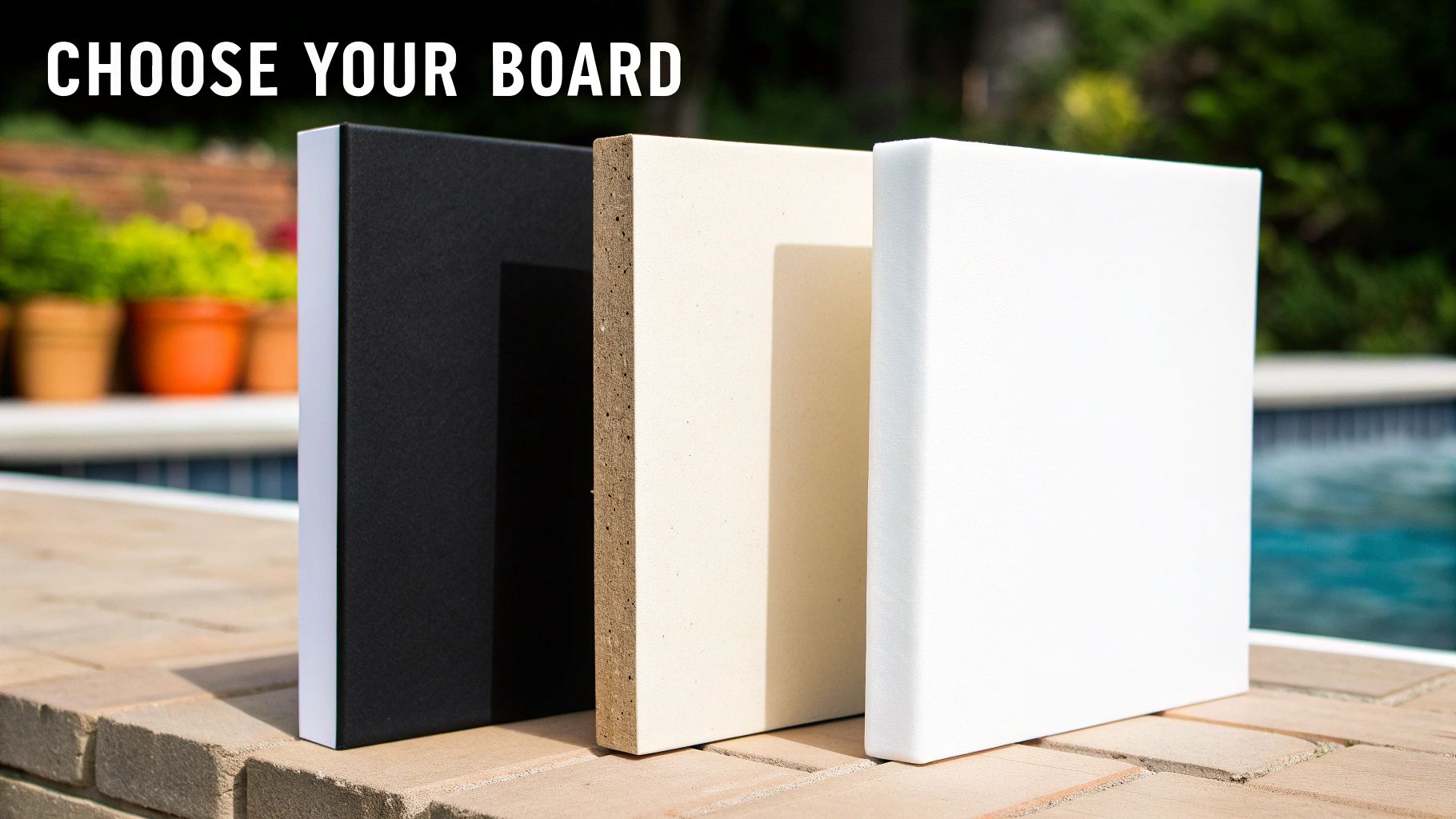
The first real decision you'll make when printing on foam board is picking the right material. This step is crucial for bringing your vision to life. Not all foam boards are the same; they’re each built for different jobs, creating a balance between toughness, price, and visual appeal.
Think of it like choosing tires for a car. You wouldn't put racing slicks on a truck you're taking off-road, right? The same logic applies here. Your main choices will be standard foam core, PVC foam board, and Gatorboard, and knowing which is which will ensure your project looks fantastic and holds up as intended.
Comparing Foam Board Materials
To pick the best material, you need to think about where your sign will live, how long it needs to last, and what your budget looks like. Let's break down the common options.
Standard Foam Core: This is your everyday, go-to choice. It’s super lightweight and friendly on the wallet, making it perfect for temporary indoor displays. Think school projects, one-off conference presentations, or signs for a single-day event. The tradeoff is its paper surface, which can easily dent, scratch, or suffer from water damage.
PVC Foam Board: A solid step up in durability. Instead of paper, PVC board has a plastic (polyvinyl chloride) surface. This makes it more rigid, resistant to moisture, and a great fit for longer-term indoor displays like point-of-sale signs. It can even handle short-term outdoor use if the weather cooperates.
Gatorboard: This is the heavyweight champion of foam boards. Gatorboard is incredibly tough, thanks to its wood fiber veneer shell that fights against warping, denting, and moisture. It’s the professional's choice for high-end trade show graphics, gallery-mounted artwork, or any sign that needs to survive a lot of handling and travel.
Choosing the right board is all about matching the material to the mission. For a single-use presentation, standard foam core is the smart, cost-effective play. But for a reusable trade show display, investing in the resilience of Gatorboard will absolutely pay off in the long run.
Selecting the Perfect Print Finish
After you’ve picked your board, the final touch is the finish. This isn't just a protective layer; it completely defines the visual personality of your print. The two main paths you can take are matte or gloss.
A matte finish gives you a smooth, non-reflective surface that cuts down on glare. This is a lifesaver in brightly lit spaces like conference halls or retail stores, ensuring your message is easy to read from any angle. No annoying reflections getting in the way.
On the flip side, a gloss finish delivers a shiny, reflective surface that makes colors look richer and more vibrant. This high-impact look is fantastic for photography, art reproductions, or any design where you want the colors to jump off the board and grab someone's attention.
Getting this choice right is more important than ever. The demand for high-quality visuals has caused the large format printer market—the technology behind foam board printing—to be projected to hit USD 10.36 billion by 2030. This boom is driven by the growing need for powerful signage in both advertising and decor. You can find more large format printing trends at marketsandmarkets.com.
Cool and Creative Ways to Use Foam Board Prints
Okay, let's move past the technical details and talk about where the real magic happens. Foam board is a creative powerhouse, and its versatility is what makes it so popular. It’s the kind of material that can transform a boring space, make a brand pop, or turn an event into something truly special. Seeing how others use it is often the best way to get your own ideas flowing.
Think about a startup gearing up for its first big trade show. Their budget is tight, but they need to look like they belong there. Foam board is the perfect answer. They can create a stunning, branded back wall for their booth, design some sleek signs showing off product features, and even make tabletop displays. All of this comes without the crazy cost or shipping headaches of heavier, more permanent signs.
Making a Statement in Business
In the business world, making a strong visual impact is everything. Foam board's clean, professional finish gives an instant air of credibility to just about any display or presentation.
- Conference & Presentation Graphics: Instead of just another PowerPoint slide, imagine a massive foam board print behind you with your key chart or main takeaway. It keeps your audience locked in and makes your point unforgettable.
- Point-of-Sale (POS) Displays: In retail, eye-catching signs are a must. Foam board is perfect for shouting about a new sale, highlighting a must-have product, or guiding customers through the store.
- Architectural Models: This is a classic one. Architects and students have used foam board for years to build lightweight but detailed 3D models. Its rigidity and smooth surface are exactly what they need to bring their designs to life.
Unforgettable Signs for Events and Personal Projects
But foam board isn't just for the corporate world. Not even close. Its affordability and the fact that you can print literally anything on it make it a go-to for personal events where you want to add a special touch.
The beauty of foam board is that it lets you create totally custom, professional-looking signs for a one-time event without a huge investment. It’s the secret to making special occasions feel even more personal and polished.
Let’s say a local restaurant wants to update its menu. Instead of commissioning expensive permanent boards, they print their menu on custom-cut foam board, complete with mouth-watering photos of their food. When the seasons change, they can just print new ones. It keeps their space feeling fresh and their customers excited.
Or picture a wedding reception. A beautifully designed foam board welcome sign greets guests as they arrive, and a matching seating chart helps them find their tables. These elegant touches are simple, but they create a cohesive theme that makes the whole event feel incredibly high-end. From academic poster sessions to baby showers, foam board is how you take a great idea and turn it into something tangible and impressive.
How to Prep Your Artwork for a Flawless Print
Sending a design file to a professional printer can feel a bit like a final exam you forgot to study for. You'll hear technical terms like DPI, CMYK, and "bleed," and while they sound intimidating, getting them right is the secret to a perfect print.
Let's break it down. This is your simple, jargon-free guide to creating a print-ready file. Think of it as the inside scoop to ensure what you see on your screen is exactly what you get on the finished board. We'll sidestep the common (and costly) mistakes by mastering just a few core concepts.
The Gold Standard for Image Quality
First up is resolution, which we measure in DPI (Dots Per Inch).
Imagine you're building a mosaic. A low-DPI image is like using big, chunky tiles. From far away, it might look okay, but get up close and it’s a blocky, pixelated mess. A high-DPI image, on the other hand, uses thousands of tiny, detailed tiles to create a picture that’s sharp and clear, no matter how closely you inspect it.
For professional printing, the gold standard is 300 DPI. This high resolution guarantees that every line in your design is crisp and every photograph looks crystal clear. If you use a file with a lower resolution—like the 72 DPI typically used for websites—the result will be a fuzzy, unprofessional-looking sign.
Speaking the Printer’s Language: Color
Next, let's talk color. Your computer screen and a printing press speak two different languages. Screens use the RGB (Red, Green, Blue) color model, mixing light to create the colors you see. Printers use the CMYK (Cyan, Magenta, Yellow, Black) model, which works by mixing physical ink.
If you send us an RGB file, our equipment has to make its best guess at how to translate those light-based colors into ink. This often causes unexpected color shifts. Your brand’s vibrant red might come out looking dull, or a deep blue could suddenly have a purple tint.
To avoid any surprises, always set up and export your artwork in the CMYK color mode. It gives you—and us—complete control, ensuring your colors print exactly as you intended.
You can see just how versatile foam board is for all kinds of business needs in this quick visual breakdown.
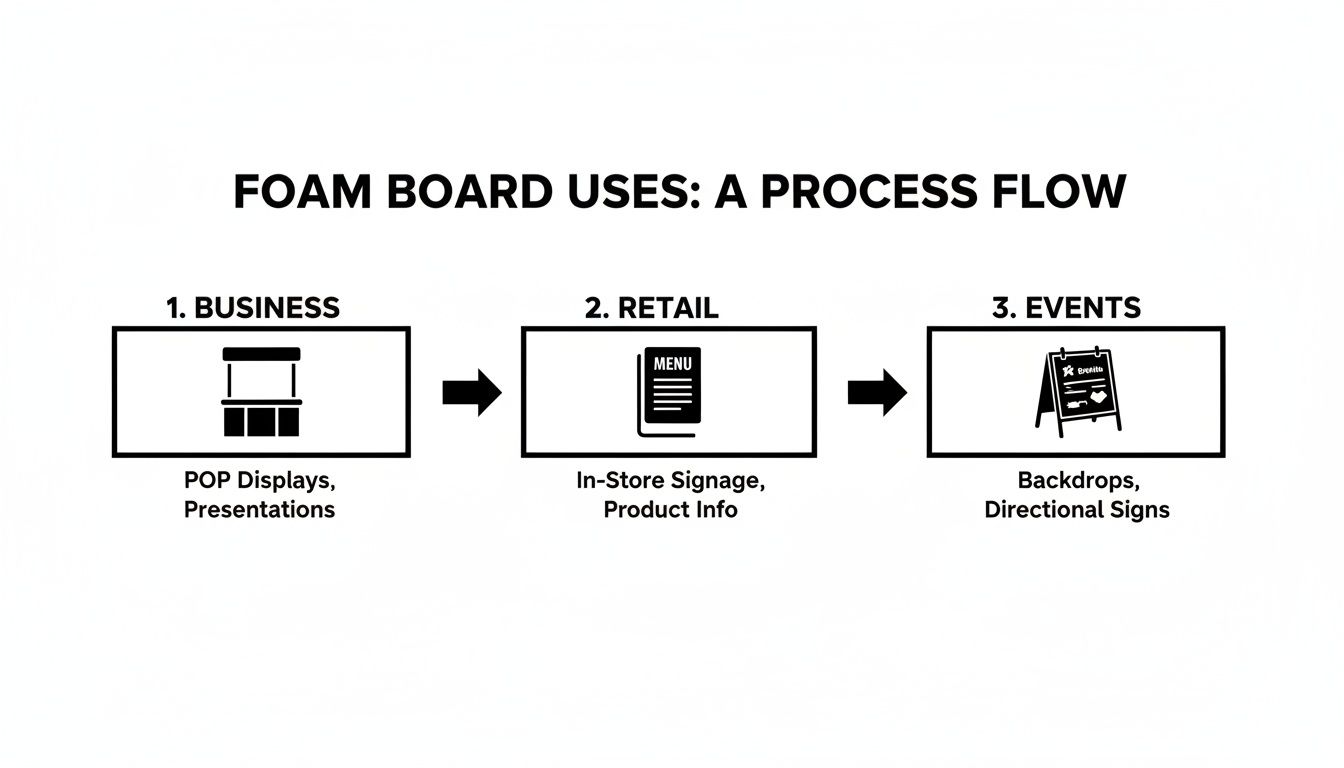
From trade shows to in-store promotions, it's a reliable solution for making a visual impact.
Mastering the Art of the "Bleed"
This might be the most important concept to nail down: the bleed.
Think about putting a photograph into a picture frame. You’d want the photo to be just a tiny bit larger than the frame's opening, right? That way, you won't see any ugly white gaps around the edges. Bleed is the exact same principle for printing.
Physical cutting machines are incredibly precise, but they still have a tiny margin of error. To prevent a thin white sliver from showing up if a cut is off by a fraction of a millimeter, we ask you to extend your design's background beyond the final cut line.
A design without bleed is a gamble. By extending your background images or colors into the bleed area, you guarantee a clean, professional, edge-to-edge finish, no matter what.
Here’s the simple way to set up your file correctly:
- Bleed Area: Add an extra margin of 0.125 inches on all four sides of your design. Your background color or image must fill this entire area.
- Trim Line: This is the edge where the board will be physically cut to its final size. Your design stops here.
- Safe Zone: This is an inner margin, usually another 0.125 inches inside the trim line. Keep all your important text, logos, and critical elements within this zone to ensure they don't get accidentally clipped during trimming.
Here's a quick checklist to help you double-check your files before you send them over. It's a great reference to have handy.
Artwork File Specification Checklist
| Specification | Requirement | Why It's Important |
|---|
| Resolution | Minimum 300 DPI | Ensures your images and text are sharp, not pixelated or blurry. |
| Color Mode | CMYK (not RGB) | Guarantees accurate color reproduction from screen to print. |
| Bleed | 0.125 inches on all sides | Prevents unwanted white borders and allows for a clean, edge-to-edge look. |
| Safe Zone | 0.125 inches inside trim | Protects your critical text and logos from being cut off during finishing. |
| File Formats | PDF, AI, PSD, EPS | These formats preserve layers, vectors, and quality for the best possible print. |
| Fonts | Outlined or Embedded | Converts text to shapes so there are no issues with missing fonts on our end. |
Getting these few things right from the start is the best way to ensure your project moves smoothly from design to production without any delays or unexpected results.
The Technology That Makes Your Prints Stand Out
Ever wonder how we get such sharp, vibrant images on a solid board? It’s a world away from your standard paper printer. The magic behind professional foam board printing is a process called direct-to-surface UV printing.
Picture this: a highly specialized printer meticulously applies ink directly onto the foam board. But instead of letting it air-dry, a powerful ultraviolet (UV) light follows right behind the ink, instantly hardening—or "curing"—it on the spot. This creates a durable, solid layer of color that sits right on top of the surface, rather than soaking into it.
This instant curing is what gives professional prints their signature edge. Because the ink doesn't have time to bleed or get absorbed by the material, the details stay incredibly crisp and the colors pop. It’s the secret sauce for that polished, high-definition look your project needs to really shine.
The Power of UV-Curable Inks
The real star of this process is the UV-curable ink. This is a far cry from what you’d find in a desktop printer. It’s a special formula engineered to react to UV light, which brings some serious benefits to the table for your finished product.
- Superior Durability: The cured ink creates a tough, scratch-resistant surface. This means your boards can handle being moved around and displayed without easily scuffing up.
- Fade Resistance: UV-cured prints are built to last, even when exposed to sunlight. This makes them a great choice for signs in storefront windows or well-lit event spaces.
- Vibrant Color Saturation: Since the ink sits on the surface, the colors appear much brighter and more intense. The result is a high-impact visual that immediately grabs people's attention.
In fact, this technology is so effective that the market for printers using UV-curable inks is expected to grow faster than any other part of the large-format printing world. Its instant-dry properties and incredible durability are a perfect match for rigid materials like foam board. You can read more about the future of UV-curable ink to see where the industry is headed.
Think of it like this: Standard printing is like using watercolor on a sponge—the color soaks in and the edges blur. UV foam board printing is like painting with a quick-drying acrylic on a canvas—the color stays right where you put it, bold and defined.
At the end of the day, knowing a bit about the technology helps you understand the value you're getting. You're not just paying for a design on a board; you're investing in a sophisticated process that guarantees your vision comes to life with unmatched longevity, color accuracy, and a flawless finish.
Ordering Your Prints and the Perks of Going Local
Once your design is polished and ready, it's time for the exciting part: bringing it to life. This last leg of the journey involves nailing down the size, figuring out your timeline, and deciding how you’ll get your hands on the finished product. And while you could click "upload" on a dozen different websites, there's a world of difference when you partner with a local shop like Camelot Print & Copy Centers.
So, let's talk size. One of the most common and versatile options we see is 24” x 36”. It’s big enough to make a real impact at trade shows or in a presentation without being overwhelming. For something more subtle, like a sign for a checkout counter or a tabletop display, 16” x 20” is a fantastic choice. It gets the message across without taking up too much real estate. Your final price will depend on the size and material, so knowing these dimensions helps us get you a fast, accurate quote.
Why a Local Printer Makes All the Difference
It’s tempting to use a big online printer, I get it. Their websites are slick and they promise the world. But that convenience often comes at a cost, especially when things don't go exactly as planned. Working with a local team isn't just a transaction; it's a partnership. This is particularly true for something as delicate as foam board.
Here’s why choosing Camelot is a game-changer:
- Forget Shipping Damage and Fees: Foam board is light, which is great, but its corners are notoriously easy to dent and ding in transit. When you pick up locally, that risk completely disappears. Your prints look perfect from the get-go, and you don't pay a dime for shipping.
- Lightning-Fast Turnaround and Local Delivery: Got a last-minute event that popped up? We live for that stuff. We can often turn jobs around incredibly quickly and even offer local delivery right to your office or event space. You just can’t get that kind of speed and service from a national chain.
- Talk to a Real Person Who Cares: Have a question about your file? Not sure if you chose the right finish? You can call us and speak directly to the person who will actually be handling your project. That simple conversation can prevent a costly mistake and make sure the final product is exactly what you had in mind.
Think of it this way: a local printer is a partner who’s just as invested in your project as you are. Instead of wrestling with a faceless website, you have an expert in your corner who can spot a problem and offer a solution before it ever goes to print.
Ultimately, that’s what it’s all about. It’s not just ink on a board. It’s the confidence and peace of mind you get from knowing your project is in good, local hands.
Answering Your Top Foam Board Printing Questions
Alright, let's tackle some of the most common questions we get about foam board printing. Getting these details ironed out will help you order your next project with complete confidence. We'll cover the practical stuff—durability, printing options, and size limits.
How Long Will My Foam Board Print Last?
That’s a smart question, and the honest answer is: it all depends on where you put it.
If you keep it indoors and out of direct sunlight, a standard foam board print can look fantastic for several years. It's a go-to choice for long-term office art, indoor retail displays, or presentation graphics you'll use again and again.
However, its lifespan shortens considerably if it’s exposed to the elements or placed in a busy, high-traffic area where it might get bumped around. For those tougher jobs, we always recommend upgrading to a more rugged material like PVC board or adding a protective laminate finish. That one small step makes a huge difference in how long your print will last.
Think of standard foam board as a reliable indoor specialist. When you need something for an outdoor gig or a heavy-duty job, it’s best to call in the reinforcements like PVC or Gatorboard to protect your investment.
Can You Print on Both Sides of a Foam Board?
You bet! Double-sided printing is one of the most useful features of foam board, and it's a brilliant way to get more eyes on your message. This is a super popular option for signs that hang from the ceiling or stand in open spaces where people approach from all directions—think trade show booths or busy store aisles.
Prepping your artwork for a two-sided job is easy. Just send us a two-page file: page one for the front, page two for the back. We'll take it from there, making sure everything is aligned perfectly for a clean, professional look no matter which way you see it.
What’s the Biggest Size You Can Print on Foam Board?
We're all about bringing big ideas to life, and our equipment is up to the task. The largest single sheet we can print on is a whopping 48 x 96 inches—that’s a full 4 by 8 feet. This size is perfect for creating high-impact backdrops, oversized informational signs, or event displays that command attention from across the room.
And what if your vision is even bigger? No problem at all. For massive projects like a full wall mural, we can print your design across multiple panels. When placed side-by-side, they create a stunning, nearly seamless graphic. If you have a unique custom size in mind, just get in touch with our team to talk through the options.
Ready to bring your vision to life with professional foam board printing? The team at Camelot Print & Copy Centers is here to help with expert advice, fast turnarounds, and local service you can count on. Explore our custom printing options and start your project today.