When you need to make a statement that can't be ignored, you go big. That’s the entire idea behind large format printing. It’s the process for creating those massive, high-impact graphics that are simply too large for a standard commercial printer to handle.
Think of it this way: your office printer makes business cards. A large format printer makes the billboard that stops traffic. This specialized technology is what turns a digital design into a real-world, larger-than-life marketing tool like a banner, a vehicle wrap, or a stunning trade show display.
Bringing Big Ideas To Life
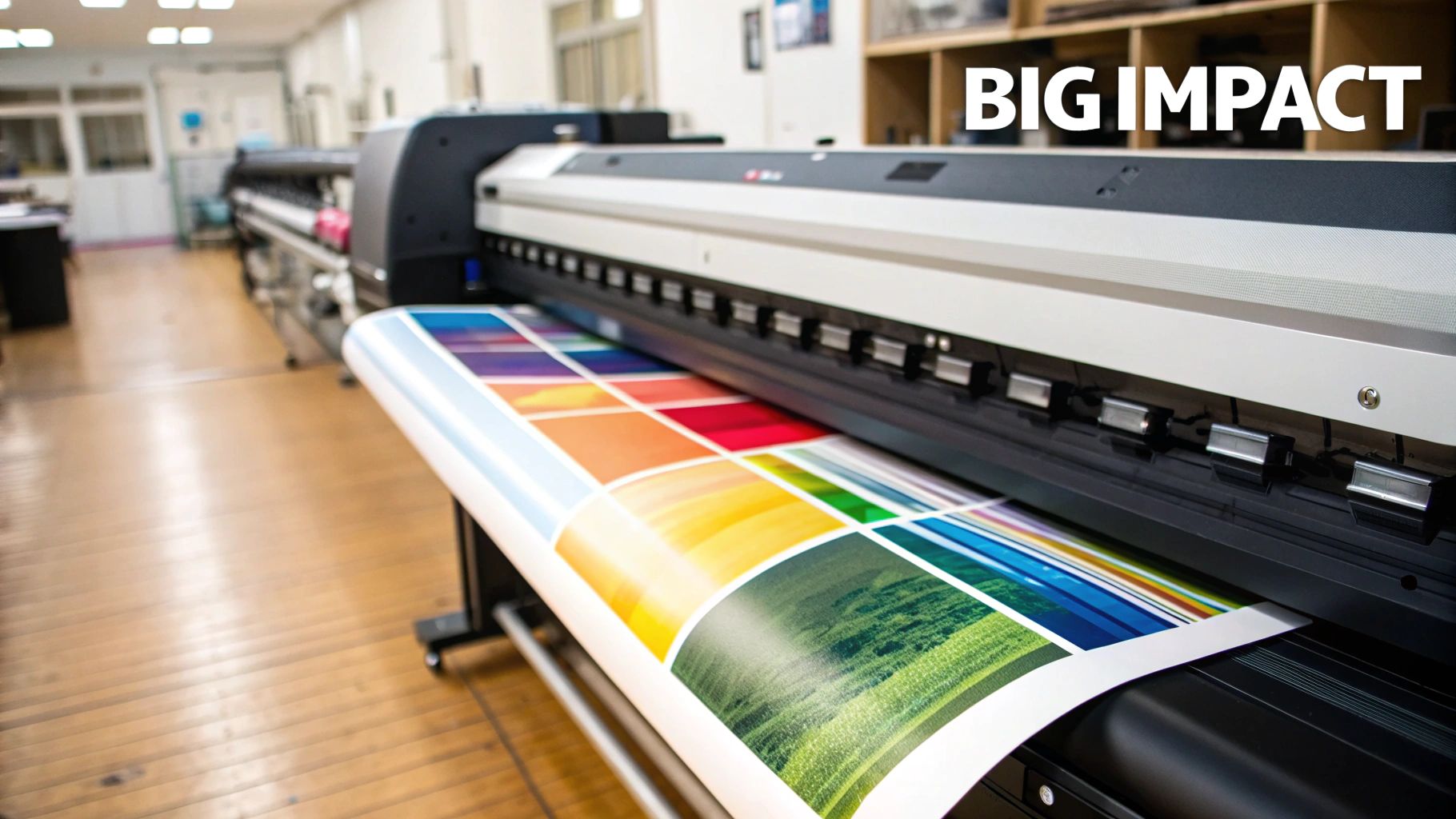
While a standard printer is great for documents, large format printing operates on a completely different level. It requires advanced, highly specialized equipment that can print on an incredible range of materials, giving businesses the power to make a bold statement in any physical space.
But it’s not just about making things bigger. It’s about making them more durable and more effective. The whole process is defined by a few key characteristics that really set it apart from your everyday printing.
Scale and Impact
The most obvious difference is size, of course. Large format prints are designed to be seen clearly from a distance, which is why they’re perfect for advertising, boosting brand awareness, and creating clear informational signs. Their sheer scale allows them to grab attention in crowded environments where smaller marketing materials would just fade into the background.
Specialized Inks and Materials
Forget plain paper. Large format jobs use a huge variety of substrates. We're talking about everything from flexible vinyl for banners and vehicle wraps to rigid materials like foam board, PVC, and even wood or metal. This versatility is what allows us to create custom graphics that are perfectly suited for their intended purpose, whether indoors or out.
On top of that, the inks are engineered for serious durability. Many are UV-curable, which means they dry instantly under UV light and become resistant to fading, moisture, and scuffs. This is essential for outdoor applications that need to hold up against sun, rain, and wind.
Large format printing bridges the gap between digital concepts and the physical world. It gives brands a tangible presence that can inform, direct, and inspire audiences in a way that digital ads simply cannot.
The demand for these powerful visuals is taking off. The global market is projected to jump from an estimated USD 12.68 billion in 2025 to over USD 16 billion by 2030. This boom shows a massive opportunity for businesses ready to use large-scale graphics to capture consumer attention. You can learn more about these industry trends and what they mean for your business.
Here's the rewritten section, crafted to sound human-written, natural, and expert-led.
How Businesses Use Large Format Printing To Get Noticed
Think of large format printing not just as making things bigger, but as solving real business problems. It's about grabbing attention where it matters most—out in the real world. Whether it's on a busy retail floor, at a jam-packed trade show, or on a construction site, these graphics are powerful tools that communicate, build brands, and get people to act. They're what turn a casual glance into a real customer interaction.
Imagine a local retail shop. With a few bold window graphics, they can shout about a massive sale, turning their entire storefront into an unmissable billboard. Step inside, and custom floor decals can create a trail, guiding shoppers right to a new product line or the clearance rack. It's visual storytelling, plain and simple.
Driving In-Person Engagement
Nowhere does large format printing have a bigger impact than in physical stores and spaces. It's how you shape the entire customer experience, from the moment they walk past your door to the second they check out. The goal is to build an environment that's both helpful and engaging, making the shopping journey feel effortless and even a little bit fun.
Here are a few ways it comes to life:
- Point-of-Purchase (POP) Displays: Those custom-cut signs you see at the checkout counter or on aisle endcaps? They’re perfect for highlighting a special offer or encouraging a last-minute buy.
- Wall Murals: A gorgeous, branded wall mural can completely change the vibe of a boring office lobby or a coffee shop, reinforcing your identity and giving visitors a great spot for a photo.
- Backlit Graphics: You often see these used for menu boards in restaurants or directories in malls. The illumination makes them incredibly easy to read and gives the whole space a sleek, professional polish.
Creating Memorable Event Experiences
Trade shows and events are a battle for attention. Every brand is doing its best to be seen and heard. This is where large format printing gives you the arsenal you need to build a booth that doesn't just blend in but actually pulls people in for a conversation.
The right display graphics can be the difference between a booth people walk past and an experience they remember. It’s what establishes your credibility before you even say a word.
Things like retractable banners, vibrant fabric backdrops, and branded tablecloths all work in harmony to create a professional, unified look. Best of all, these pieces are designed to be portable and a breeze to set up, which is a lifesaver for any team that's constantly on the move.
Expanding Beyond Marketing
While marketing is where most people see large format printing, its reach goes far beyond ads and promotions. Take construction and engineering firms—they depend on perfectly printed, large-scale blueprints and site plans. These aren't just posters; they are critical documents that have to be crystal clear and tough enough to handle life on a messy job site.
Interior design is another area that's absolutely booming. One of the biggest trends right now is custom decor like unique wall coverings and canvas prints, all driven by our desire for personalized spaces. In fact, the digitally printed wallpaper market is set to grow by a massive 23.6% CAGR. This opens up a huge opportunity for businesses to create one-of-a-kind environments, and you can learn more about this large format printing market trend to see how it might fit your own space.
To make it even clearer, let's break down which products work best for different goals.
Choosing The Right Large Format Product For Your Goal
Not sure whether you need a banner or a window cling? This table connects common business goals to the specific large format products that can help you achieve them, making it easier to choose the perfect fit for your next project.
| Product | Primary Business Goal | Best For | Material Type |
|---|
| Banners (Vinyl/Mesh) | Announce events, promotions, or grand openings | Outdoor advertising, temporary sales, event sponsorship | Heavy-duty vinyl, porous mesh for windy areas |
| Posters & Foam Board | Inform customers, promote products indoors | In-store promotions, directional signs, event presentations | Paper, foam core, PVC, styrene |
| Window Graphics/Clings | Attract foot traffic, enhance privacy, display hours | Storefront advertising, office branding, seasonal decor | Perforated vinyl (one-way vision), static cling, adhesive vinyl |
| Wall Murals/Decals | Transform an interior space, reinforce branding | Office lobbies, retail feature walls, restaurant ambiance | Adhesive-backed vinyl, canvas, fabric |
| Floor Graphics | Guide customers, promote safety, advertise sales | Wayfinding in stores, social distancing markers, POP ads | Scuff-resistant, non-slip adhesive vinyl |
| Trade Show Displays | Create a professional booth presence, attract attendees | Exhibitions, conferences, corporate events | Fabric (backdrops), vinyl (banners), various rigid substrates |
Ultimately, the right product choice comes down to what you want to accomplish. By matching the material and format to your specific objective, you can ensure your message not only gets seen but also makes a lasting impression.
Understanding The Right Materials And Technologies
The real secret to a stunning large format print isn’t just a great design—it’s the perfect marriage between ink and material. Think of it like cooking a gourmet meal. The ingredients you choose and how you cook them completely define the final dish. Let's pull back the curtain on the technical side so you can choose the best combination for your project.
First up, let's talk about the ink itself. The technology we use depends entirely on the end goal. How long does the print need to last? Where will it be displayed? For maximum durability, one of the most powerful tools in our arsenal is UV-curable ink.
Imagine painting with a liquid that hardens into a solid, plastic-like layer the instant it's hit with a special light. That’s the magic of UV printing. The ink doesn't just dry on the surface; it cures, creating an incredibly tough finish that stands up to fading, scratches, and water. This makes it the go-to choice for outdoor signs, rigid displays, and anything that needs to withstand the elements or a lot of handling.
Choosing Your Printing Surface, or "Substrate"
Once we've got the right ink, the next big decision is the material we're printing on, known in the industry as the substrate. The sheer number of options can feel a bit overwhelming at first, but it gets a lot simpler when you group them by what they do and how flexible they are.
Your primary goal is the best place to start. This quick decision tree can help point you in the right direction, whether your needs are temporary, permanent, or on the move.
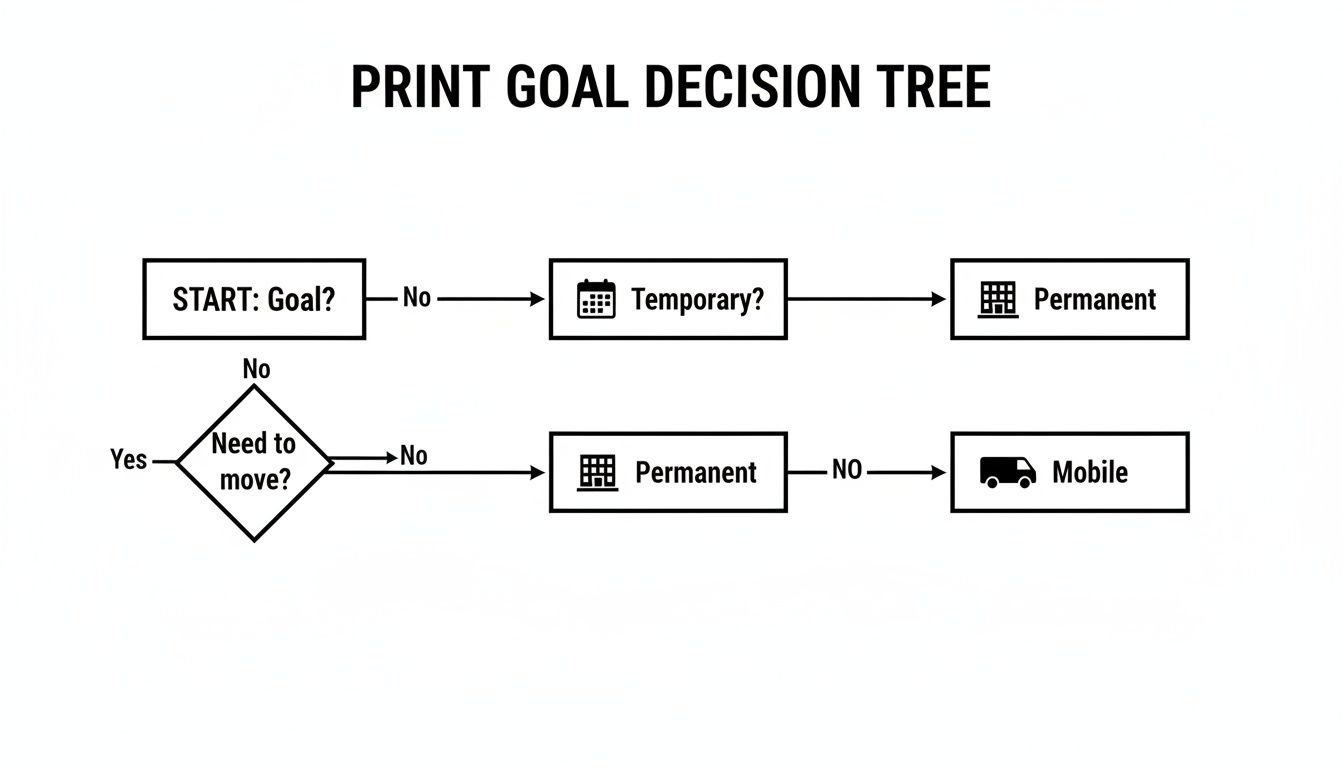
As you can see, your intended use—a short-term event, a long-term installation, or on-the-go advertising—is the clearest signpost to the right category of materials.
Rigid Materials for Structure and Stability
When your print needs to stand tall on its own without bending or sagging, you’ll want a rigid substrate. These materials are perfect for creating sturdy, self-supporting displays that hold their shape.
- Foam Board (or Foam Core): This is a lightweight and budget-friendly classic. It’s essentially a foam center sandwiched between two sheets of paper, making it perfect for temporary indoor signs, presentations, and conference displays.
- PVC (Sintra): A step up in durability, PVC is a smooth, solid plastic that gives a very professional finish. It’s also moisture-resistant, which makes it a fantastic option for long-term indoor signage or even short-term outdoor use.
- Gatorboard: Think of this as the heavy-duty cousin of foam board. It has a much denser core and a wood-fiber veneer, making it extremely rigid and resistant to warping. It's a great pick for premium displays and gallery-style prints.
Flexible Materials for Versatility
For any project that needs to be rolled, stretched, or wrapped around a curved surface, flexible materials are the way to go. Their adaptability makes them some of the most popular choices in large format printing.
The real power of flexible media is its ability to adapt. From a banner that catches the wind to a wrap that transforms a vehicle, these materials bring brands to life in dynamic environments.
Vinyl is, without a doubt, the champion in this category. It comes in a few different flavors, each designed for a specific job:
- Scrim Vinyl: This is your classic banner material, reinforced with crisscrossing polyester fibers that give it great tear resistance. It’s the workhorse for indoor or outdoor banners you plan to hang with grommets.
- Adhesive Vinyl: With a sticky backing, this is the material used for vehicle wraps, window graphics, and wall murals. It's designed to be applied directly to smooth surfaces.
- Mesh Vinyl: If you’re hanging a huge banner outside in a windy spot, mesh is the answer. The material is full of tiny holes that let the wind pass right through, which prevents the banner from turning into a giant sail and getting damaged.
Making the right choice here ensures your project not only looks incredible but is also perfectly engineered for its purpose.
Getting Your Files Ready for a Flawless Print
Even the most brilliant design can fall flat if the digital file isn't set up correctly for a large format press. Think of your design file as the blueprint for a building—if the plan has a flaw, the final structure will too. Taking a few extra minutes to prep your files is the single best thing you can do to guarantee the stunning visual you approved on-screen is exactly what you get in your hands.
This isn't about getting lost in technical jargon. It's about a simple checklist that helps you sidestep common mistakes, avoid frustrating delays, and ensure a professional result every time. By focusing on four key areas, you can send your project to print with total confidence.
Nail Down Your Resolution
Resolution, measured in Dots Per Inch (DPI), is all about the sharpness and clarity of your printed image. For standard documents you hold in your hand, 300 DPI is the gold standard. But here’s a pro tip for large format: since these graphics are usually seen from a distance, you can often get away with a lower resolution without anyone noticing a difference.
It all comes down to viewing distance. A massive billboard doesn't need the same pinpoint sharpness as a small flyer.
- For prints viewed up close (think posters or detailed retail displays), stick with 300 DPI to keep every detail crisp and clean.
- For graphics viewed from a few feet away (like trade show backdrops or large banners), 150 DPI is often the magic number. It maintains fantastic visual quality while keeping your file sizes from becoming enormous.
A low-resolution file is the number one culprit behind blurry, pixelated prints. Always, always check your image resolution at its final print size, not just on your small computer screen.
Set the Correct Color Mode
Your computer screen and a commercial printer create color in two completely different ways. Screens use the RGB (Red, Green, Blue) color model, mixing light to produce those bright, glowing images. Printers, on the other hand, run on the CMYK (Cyan, Magenta, Yellow, Black) model, which works by mixing physical ink on a surface.
If you send an RGB file to a printer, its software has to make a guess and convert the colors on the fly. This often leads to disappointing, muddy shifts in your brand’s carefully chosen palette. To keep your colors true, always design and save your final print files in CMYK mode from the start. This gives you control and ensures what you see is what you get.
Choose The Right File Format
The type of file you save your design as really matters. When it comes to large format printing, vector files are almost always the better choice over raster (or pixel-based) files like JPEGs.
- Vector files (which come from programs like Adobe Illustrator and are saved as a .PDF, .AI, or .EPS) are built with mathematical equations. This is a huge advantage because it means they can be scaled to any size—from a business card to a building wrap—with absolutely zero loss of quality.
- Raster files are made up of tiny squares called pixels. When you try to blow them up, they get blurry and you start to see those jagged, "pixelated" edges.
For the best, most reliable results, submitting your design as a high-quality, print-ready PDF is the industry standard. It locks in all your vector data, embeds fonts, and preserves quality, making it the safest bet for a perfect print.
Always Include a Bleed Area
Ever seen a brochure or poster with a weird, thin white line along the edge? That’s almost always because the design didn't have a "bleed." A bleed is simply a small safety margin—usually 1/8th of an inch (0.125")—where your design's background color or image extends beyond the final trim line.
After printing, every piece is trimmed down to its final size. Because it's impossible for a mechanical blade to hit the exact same spot perfectly every single time, the bleed area provides some wiggle room. It ensures that if the cut is a tiny bit off, the blade slices through the extra printed color instead of leaving an unprofessional-looking sliver of white paper. It’s a simple step that makes a huge difference in the final product.
Professional Finishing Options That Make An Impact
A large format print isn't really done when the ink dries. The final step, what we in the business call professional finishing, is what turns a nice print into a polished, durable, and ready-to-use final product. It’s the difference between having a pile of lumber and having a finished, painted bookshelf—these last touches add strength, style, and get your print ready for the real world.
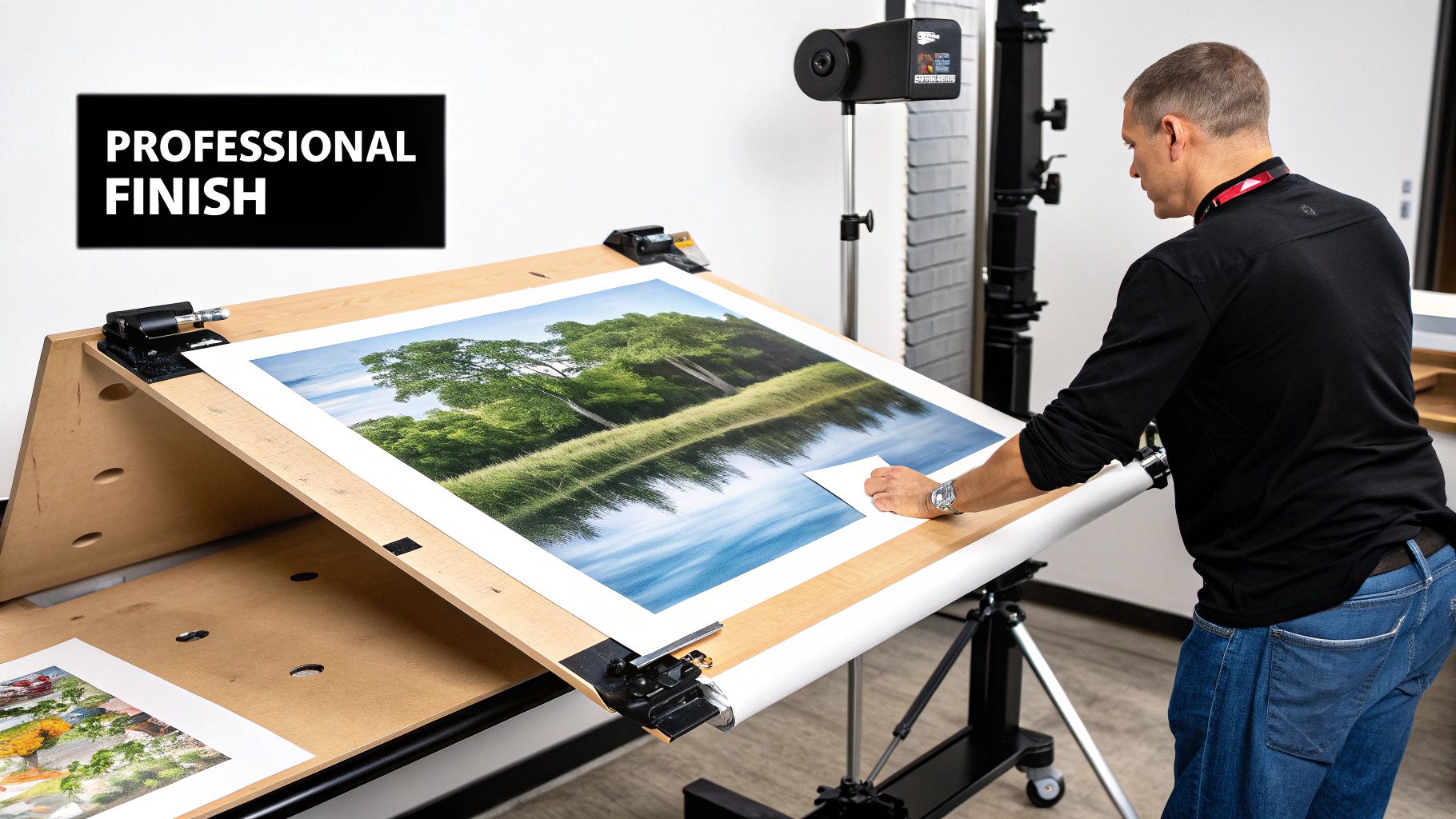
This process is what makes sure your investment not only looks great on day one but holds up over its entire lifespan, whether it's facing down a rainstorm outdoors or standing out in a crowded convention hall.
Lamination For Protection And Style
One of the most popular finishing options is lamination. This is where we apply a thin layer of protective plastic film over the print's surface. Think of it like a shield, guarding the ink and the material underneath from scratches, moisture, and the fading that comes from harsh UV light.
But lamination isn't just about playing defense; it also seriously kicks up the visual appeal.
- Gloss Lamination: This finish gives you that vibrant, shiny look that makes colors jump off the page. It's a fantastic choice for promotional posters and photos where you need to grab attention from across the room.
- Matte Lamination: If you're going for a more understated, sophisticated vibe, a matte finish is the way to go. It cuts down on glare, offering a smooth, non-reflective surface perfect for indoor signage, art prints, or any display in a brightly lit space.
Mounting And Hardware For Display
When you need a sign that can stand on its own, mounting is the key. This just means we adhere your print to a rigid backing material, like gatorboard or PVC. This creates a solid, gallery-quality piece that won’t bend or warp over time.
Finishing is where a print gets its real-world functionality. It’s the hardware that lets you hang a banner and the professional installation that ensures a vehicle wrap looks seamless.
Little details like hardware are what prepare your prints for easy use. Grommets, for example, are those metal rings punched along the edges of a banner. They reinforce the holes so you can hang it securely with rope or hooks without tearing the material. For trade shows, retractable banner stands have smart, spring-loaded bases that let you set up (and tear down) your display in just a few seconds. These details make all the difference.
Finally, for bigger jobs like vehicle wraps or massive window graphics, professional installation is an absolute must. Getting that perfectly smooth, bubble-free finish on a curved surface like a van takes specific tools and a lot of experience. A pro installer makes sure the vinyl is applied just right, giving you a flawless look that lasts.
How to Choose the Right Printing Partner
Finding the right team for your large format printing is just as important as the design itself. Think of a great printer not as a transactional vendor, but as a true partner—someone who can guide you to the smartest solutions for your goals and budget. They’re the ones who take your digital file and turn it into something real and impressive.
This all starts by asking the right questions. Before you sign on the dotted line, you need to dig deeper than just the price and really understand their capabilities, experience, and how they treat their clients.
Evaluating Technical Capabilities
First things first, what kind of equipment are they working with? A print shop with a solid in-house setup can tackle a much wider range of projects without having to send work out to someone else. This usually means you get better quality control and a quicker turnaround.
Here are a few questions you should absolutely ask:
- What kinds of large format printers do you have on-site? This gives you a clear idea of what materials they can handle and the scale of jobs they're equipped for.
- Can I see samples of projects you've done that are similar to mine? There’s no substitute for seeing their work in person. Getting your hands on vinyl, fabric, or rigid board samples tells you everything you need to know about their quality.
- Do you have your own installation team? For tricky jobs like vehicle wraps or massive wall murals, professional installation is a must. You don't want to leave the final, critical step to chance.
Assessing Their Experience and Service
Beyond the printers and the tech, it’s the people who make all the difference. You're looking for a team that's easy to talk to, knows their stuff, and actually cares about your project turning out great. A local provider who gets the market and offers hands-on support is often your best bet.
A truly valuable print partner won’t just print what you send them. They’ll look over your files, spot potential problems before they happen, and even suggest ways to improve the final product, saving you headaches and money.
That’s exactly the approach we take at Camelot Print & Copy Centers. We see ourselves as part of your team, handling everything under one roof—from a careful design review to the final installation. Our goal is to make sure your brand’s message comes through loud and clear. We build trust by offering straightforward pricing and realistic timelines. With deep roots right here in the Capital Region, we know what local businesses need to stand out, and we bring that expertise to every single project.
Frequently Asked Questions About Large Format Printing
When you’re diving into the world of large format printing, it's natural to have a few questions. We get them all the time. Here are some of the most common ones we hear, with straightforward answers to help you get started.
How Much Does Large Format Printing Cost?
This is usually the first question on everyone's mind, but there's no simple answer. The cost of a large format project really comes down to the specifics of what you need.
Think of it like this: the final price is a mix of three key ingredients. We've got the overall size of the print, the material you choose, and the quantity you're ordering. A small indoor foam board sign, for example, is going to be a lot friendlier on the wallet than a massive vehicle wrap printed on premium cast vinyl. The best way to get a real number is to simply ask for a custom quote where you can lay out exactly what you're thinking.
What Is The Typical Turnaround Time?
Just like pricing, turnaround times can vary quite a bit depending on how complex your project is. For straightforward jobs like standard vinyl banners or a batch of posters, we can often have them printed and ready to go in just 1-3 business days.
On the other hand, more involved projects that have multiple steps—like building a custom trade show display from scratch or handling a professional vehicle wrap installation—will naturally need a bit more time. It's always a good idea to chat with your print provider about your deadline. Most can work with you on a rush order if you're in a pinch.
The key to accurate color is communication. Providing precise brand color codes is the surest way to guarantee your prints match the colors you use everywhere else.
How Do I Ensure My Brand Colors Print Accurately?
Getting your colors just right is crucial, and thankfully, it's pretty simple. The absolute best way to ensure perfect color matching is to provide your brand’s Pantone (PMS) color codes. This system gives us an exact shade to target.
Another vital step is to make sure your design files are set up in CMYK color mode, not RGB. CMYK is the standard for professional printing, while RGB is for screens. A good print partner can also run a small proof for you, so you can see and approve the colors with your own eyes before the full job goes to press.
Ready to make a big impact? The team at Camelot Print & Copy Centers is here to guide you through every step, ensuring your vision is brought to life with precision and quality. Get a quote for your next large format printing project today!