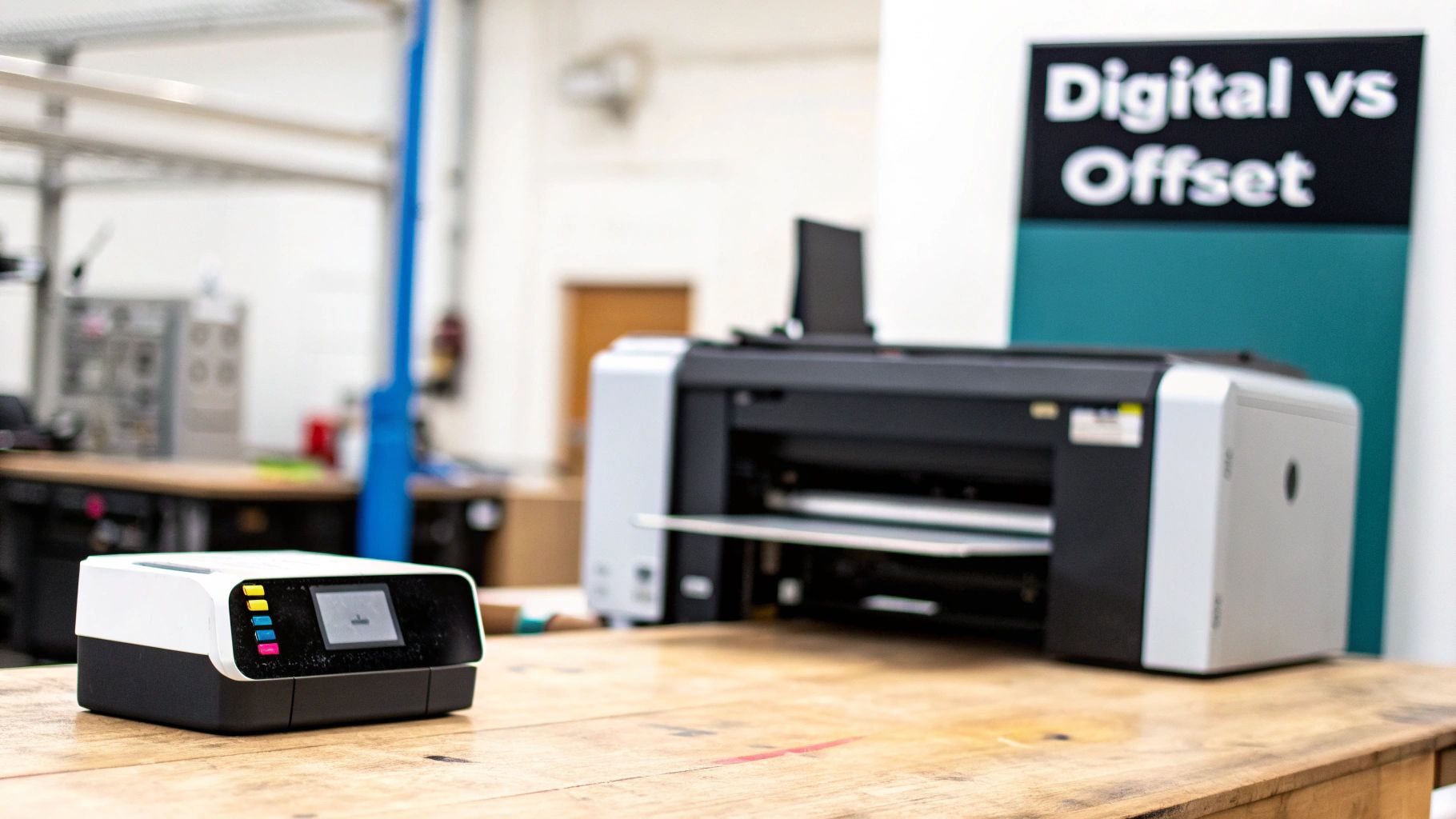
When you're trying to decide between offset and digital printing, it really boils down to a classic trade-off: speed versus scale. Think of it this way: digital printing is your go-to for smaller, faster, and highly personalized jobs, while offset printing is the powerhouse for large-volume projects where getting the lowest possible price per piece is the name of the game.
The right choice isn't about which one is "better" in a vacuum; it's about which one is the perfect fit for your specific project's quantity, timeline, and quality goals.
Choosing Your Printing Method: A Quick Guide
The world of printing can feel a bit overwhelming, but the choice between digital and offset becomes much clearer once you know what to look for.
Imagine digital printing as a high-end, professional version of your desktop printer. It’s incredibly versatile and perfect for when you need a smaller batch of prints turned around quickly, especially if you need to personalize each one.
Offset printing, on the other hand, is like a massive manufacturing assembly line. It’s built for one thing: mass production. While the initial setup takes more time and investment, once those presses start rolling, the cost for each brochure, flyer, or postcard drops dramatically. It's an economy of scale, pure and simple.
Key Decision Factors
Your decision will almost always hinge on three key questions: how many do you need, how soon do you need them, and what kind of finish are you after?
- Quantity: Is this a run of 100 flyers for a weekend sale, or are you printing 10,000 brochures for a nationwide marketing campaign? Your answer here is the single biggest pointer.
- Turnaround: Do you need these in your hands tomorrow, or is your deadline a few weeks out? Digital can offer same-day service, but offset requires a bit more planning.
- Quality and Customization: Do you need an exact Pantone color match to protect your brand's integrity? Or does every piece need a unique name, address, or coupon code?
The fundamental trade-off is this: Digital printing gives you incredible flexibility and speed for smaller runs. Offset printing delivers unbeatable cost savings and pristine quality for large-volume orders. Grasping this core difference is the first step toward making a smart choice.
This decision tree gives you a quick visual guide for how to weigh your project's needs.
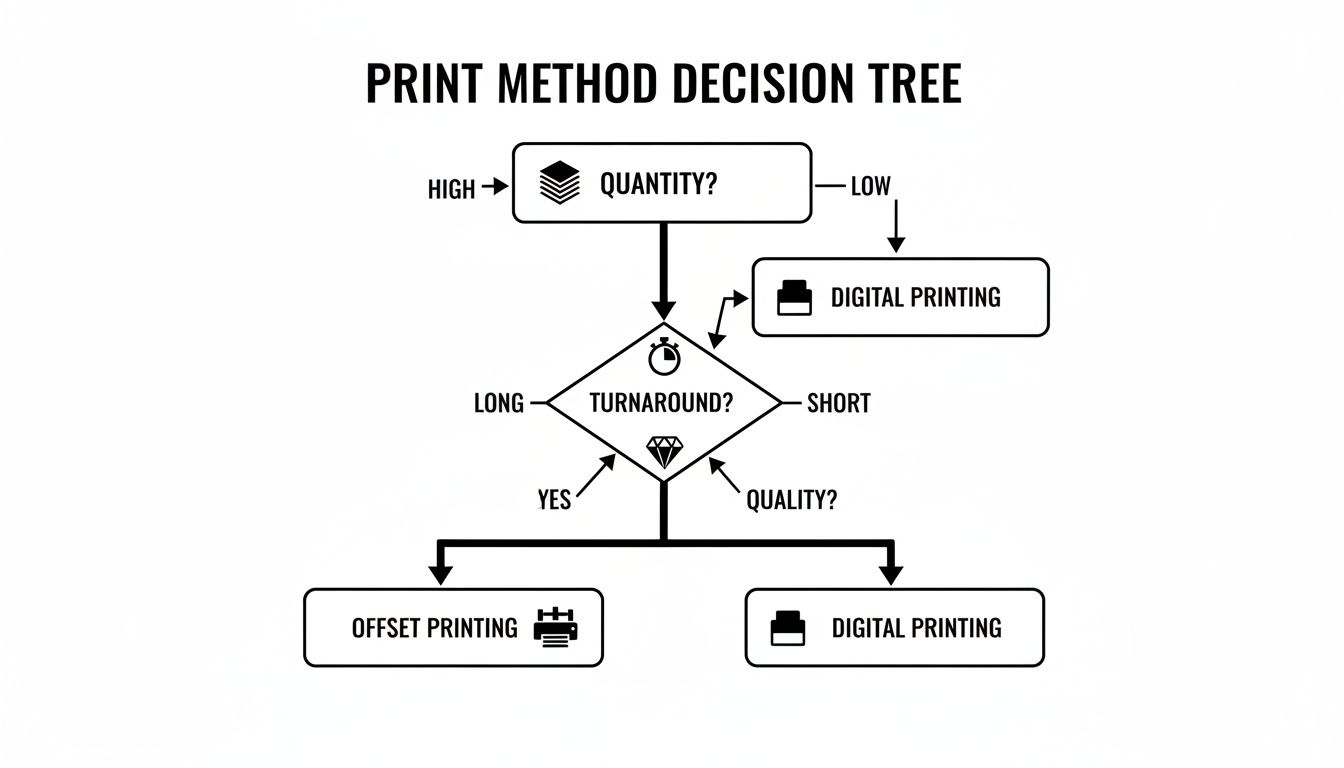
As you can see, if you're in a hurry or only need a small batch, the path leads straight to digital. But for big jobs where top-tier quality is a must, offset is almost always the right call.
Offset Vs Digital Printing At a Glance
For a quick side-by-side comparison, this table breaks down the key strengths of each method. It's a handy cheat sheet to see which approach aligns best with what you need right now.
| Feature | Digital Printing | Offset Printing |
|---|
| Best For | Short runs (under 500-1,000 units), variable data, proofs, rush jobs | High-volume runs (1,000+ units), projects needing exact color matching |
| Cost Per Unit | Consistent cost per unit, more affordable for small quantities | High initial setup cost, but very low cost per unit on large runs |
| Turnaround Time | Fast, often same-day or next-day | Slower, typically takes several days due to plate creation and setup |
| Color Fidelity | Very good CMYK color, but can have slight variations between prints | Superior color accuracy, supports true Pantone® spot colors and metallic inks |
| Material Options | Good range of standard paper stocks and weights, but can be limited | Extremely wide range of papers, specialty substrates, and finishing options |
| Personalization | Excellent for variable data printing (VDP) like names, addresses, or codes | Not possible; every piece is identical |
| Proofing | Easy and inexpensive; the first print off the press is the final proof | More complex and costly; requires hard-copy contract proofs |
Ultimately, both methods produce beautiful results. The "best" one just depends on the job at hand.
This guide will walk you through each of these factors in more detail, giving you the confidence to decide whether the on-demand nature of digital or the powerful efficiency of offset is the right move. From business cards and marketing mailers to intricate brochures and event signage, getting this first choice right ensures your vision comes to life exactly as you imagined it.
How Each Printing Process Actually Works
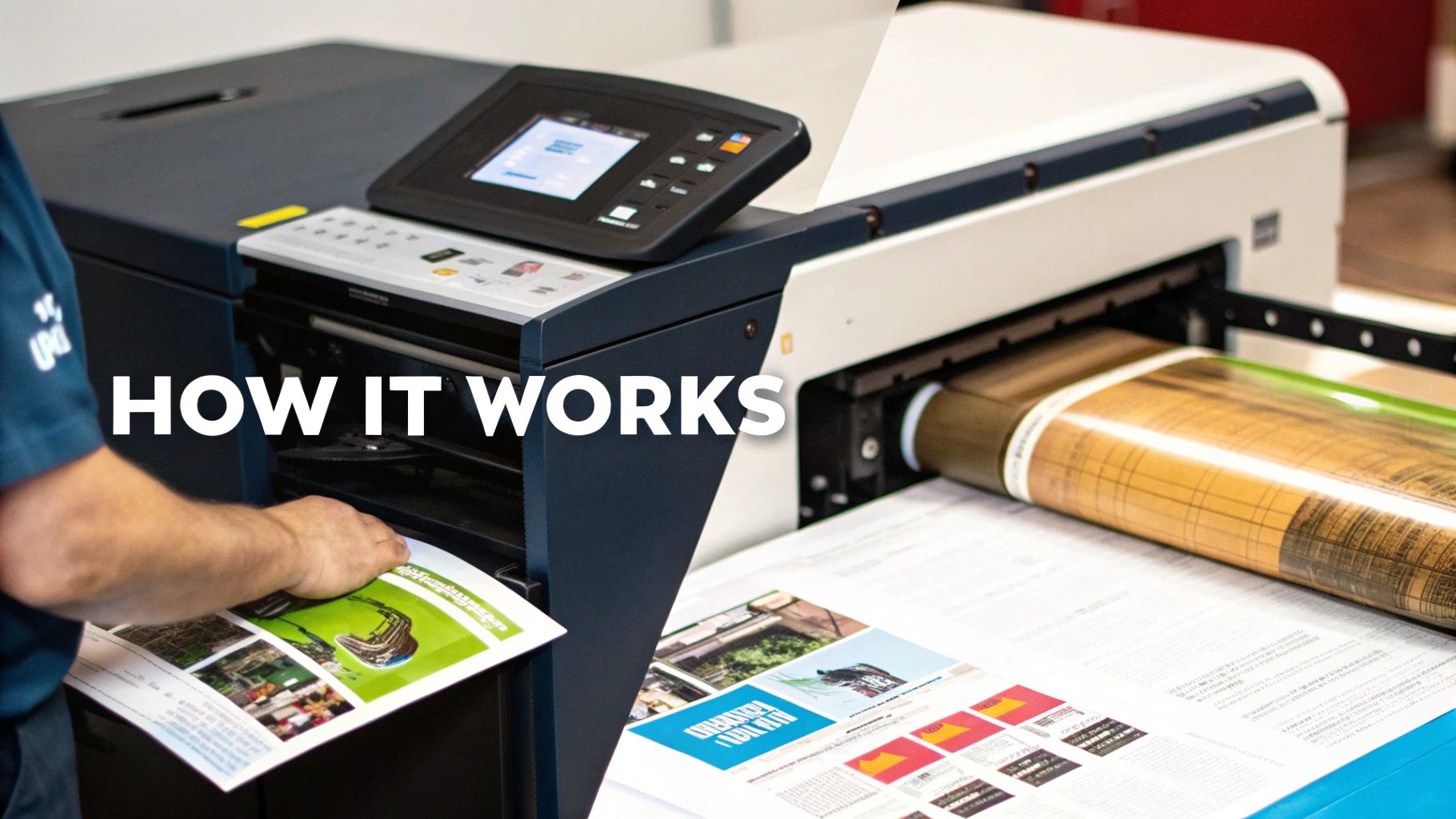
To really get why offset and digital printing differ so much in cost, speed, and quality, you need to look under the hood. They aren't just two ways to do the same thing; they are fundamentally different mechanical processes, each built for a specific job. One is a massive, methodical operation, while the other is all about speed and direct-to-paper agility.
Once you understand how the ink actually gets on the paper, it becomes crystal clear why one is perfect for a rush job of 100 event flyers and the other is the only real choice for 10,000 glossy corporate brochures. It’s all in the mechanics.
The Mechanical Art of Offset Printing
Think of offset printing as the classic, industrial-strength method. It’s a more involved, indirect process that relies on creating custom printing plates for your project. The name "offset" is literal—the ink isn't put directly onto the paper from the plate. Instead, it’s first transferred, or "offset," to a rubber blanket.
This traditional approach involves a lot of initial setup, which is why it has longer lead times and higher upfront costs. Here’s a quick look at how it works:
- Plate Creation: First, we break your digital design down into its four primary color components: Cyan, Magenta, Yellow, and Black (CMYK). A separate, thin aluminum plate is then laser-etched for each color.
- Inking the Plate: Each plate is mounted onto a cylinder in a massive printing press. As it spins, rollers apply both water and oil-based ink. The ink sticks only to the etched image area, while the water repels ink from the blank areas.
- Offsetting to the Blanket: The inked image is then pressed from the aluminum plate onto a soft rubber "blanket" cylinder. This is the key step—it ensures the ink transfers smoothly and evenly.
- Printing to Paper: Finally, the paper is fed through the press, where it gets squeezed between the rubber blanket and another cylinder. The image is pressed cleanly from the blanket onto the paper.
This process is repeated for each of the four colors, layering them perfectly to create a final image with stunning sharpness and color depth.
The Direct Approach of Digital Printing
Digital printing is essentially a super-powered, highly advanced version of the office printer you're familiar with. It takes your digital file and prints it directly onto paper without any of the intermediate steps like plates or blankets. No mess, no fuss.
This direct-to-paper model is precisely what makes digital printing so incredibly fast and versatile. The workflow is simple: your file goes straight to the press, and it applies toner or liquid ink to the paper in one clean pass.
The real beauty of digital printing is its simplicity. By skipping the whole plate-making process, it enables on-demand printing. You can run one copy or five hundred with almost no setup time.
This efficiency makes digital the undisputed champion for quick-turnaround jobs. And because each print is made fresh from the digital file, it opens up a world of possibilities with variable data printing (VDP). We can easily change names, addresses, or even images on every single piece in a print run—perfect for personalized mailers. The advanced machines we have are built for this kind of flexible, high-speed work, and you can see them for yourself by exploring our state-of-the-art printing equipment. This adaptability is a game-changer when comparing offset printing vs digital printing.
The Financial Breakdown: Cost Per Piece and Quantity
When it comes down to it, the budget often has the final say. For any print job, the financial logic behind offset and digital printing is fundamentally different, and understanding this is the key to getting the most out of your money.
The big divide is setup cost. Digital printing is a straight shot from your digital file to the printed page, so there are virtually no upfront costs. This makes printing just one copy nearly as cost-effective per piece as printing a hundred. Offset, on the other hand, is a much bigger operation to get started. It requires creating custom metal plates and calibrating a massive press, which means that initial investment makes very small runs impractical and expensive.
But once that offset press is fired up and running, the per-piece cost plummets. It’s a powerhouse built for volume, and the savings on large orders are massive.
Finding Your Break-Even Point
This dynamic creates a "break-even point"—the magic number where offset printing officially becomes the cheaper option. Think of it like buying a single slice of pizza versus buying a whole pizza oven. The single slice (digital) is fast and cheap for a quick meal. The oven (offset) is a huge investment that only pays off if you plan on making pizza for the whole neighborhood, every night.
In the world of professional printing, that break-even point usually lands somewhere between 500 and 1,000 units. If your project is below that number, digital is almost always your best bet. Go above it, and the per-piece savings from offset printing start to really stack up, making a huge difference in your total cost.
The core financial rule is simple: Digital is for smaller quantities and projects that need flexibility. Offset is for mass production where the lowest possible per-piece price is the main goal.
This economic reality is what guides our recommendations for everyone from architects printing a few sets of plans to marketing teams ordering thousands of promotional flyers. Choosing the right method from the start can slash your costs and get your project delivered faster. It's a trend we're seeing across the industry; as average print quantities get smaller, digital is perfectly positioned to handle those short-run jobs. In fact, forecasters predict digital printing's market share will jump from 27% to 35% in just two years, while offset’s share is expected to decline.
A Tale of Two Brochures
Let's put this into a real-world context. Imagine you need a full-color, tri-fold brochure to promote a new service.
Scenario 1: The Test Run (200 Brochures)You want to test a new marketing message at a local event and only need a small batch of 200.
- Digital Printing: With minimal setup, the cost might be $1.50 per brochure. Your total comes out to a manageable $300. It's fast, affordable, and perfect for a test.
- Offset Printing: The upfront cost for plates and press setup could easily be $400 before you even print a single piece. Even with a low per-piece cost of $0.20, the total would be $440 ($400 setup + $40 for the prints). Digital is the clear winner here.
Scenario 2: The Full Campaign (5,000 Brochures)The test was a huge success! Now you’re ready to roll out a full campaign and need 5,000 brochures.
- Digital Printing: That $1.50 per-piece cost doesn't change much with volume. Your total would be a whopping $7,500.
- Offset Printing: This is where offset shines. That same $400 setup fee is now spread thin across thousands of prints. At $0.20 per piece, your total is just $1,400 ($400 setup + $1,000 for prints).
By switching to offset for the larger run, you just saved over $6,000. This is a perfect example of why matching the technology to your quantity is so critical for your budget. This same logic applies to book production, where authors and publishers weigh similar factors. For a deeper look into these economics, you can find a helpful guide on the real price to print a book, comparing offset vs. Print-on-Demand.
Comparing Print Quality, Finishes, and Color Accuracy
Beyond the cost, what really matters is how your final piece looks and feels. The choice between offset and digital printing has a huge impact on color vibrancy, sharpness, and the overall impression your project makes. Let's break down how each one delivers professional results.
For a long time, offset printing was the undisputed king of quality. It’s still the gold standard for jobs where you absolutely cannot compromise on color or pristine detail. Think of it like a master painter carefully mixing custom pigments for a canvas.
Offset presses use liquid inks that actually soak into the paper fibers, which is how they create such rich, deep colors and smooth gradients. This is especially obvious in large, solid color blocks—offset delivers a perfect, even finish without any of the subtle inconsistencies you might see in a digital print.
Getting Your Brand Colors Just Right
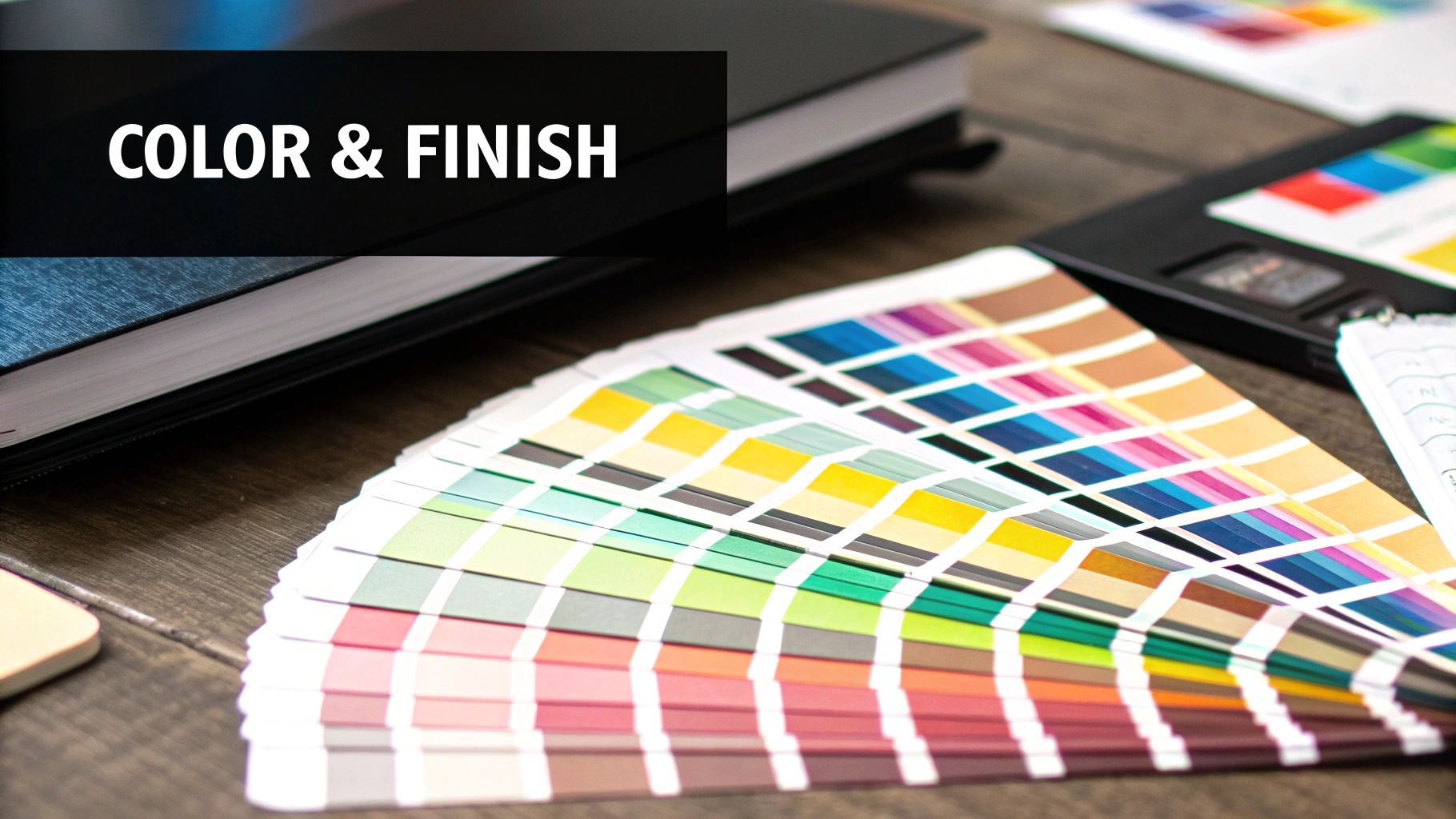
If your brand identity is built on a specific color, offset printing has a major advantage: precise color matching. It’s the only way to use the Pantone® Matching System (PMS).
This system relies on pre-mixed "spot" colors to guarantee your specific shade of blue, red, or green is exactly the same on every single piece, every single time. If your logo uses a specific Pantone color, offset is the only way to hit that target perfectly.
With offset printing, color fidelity is a given. Using PMS inks takes all the guesswork out of color reproduction, ensuring your brand’s signature color is spot-on for every brochure, business card, and mailer you produce.
Offset also opens up a world of specialty finishes that can take your project from good to unforgettable. You can add things like:
- Metallic Inks: Give your design a brilliant silver or gold shimmer for a premium feel.
- Varnishes and Coatings: Use a spot gloss or matte finish to create texture and make certain design elements pop.
- Custom Substrates: Print on a huge variety of materials, including thick cardstock, textured fine papers, and even plastics.
High-Quality Digital Printing Has Arrived
While offset has traditionally worn the quality crown, modern digital printing has come a long way. For most projects today, the average person wouldn't be able to tell the difference. The latest digital presses can produce incredibly sharp text, vibrant images, and consistent color.
The main difference is in how the color gets on the page. Digital printing uses toner or tiny droplets of ink that sit on the paper's surface instead of being absorbed. This creates a slightly different look, but for most business needs—from marketing flyers to event programs—the quality is more than up to the task.
Of course, no matter the printing method, getting great color starts with a great file. This often involves technical steps like mastering RGB to CMYK conversion for accurate print colors long before your design ever hits the press.
Digital’s Secret Weapon: Variable Data Printing
This is where digital printing really shines. Its ability to handle Variable Data Printing (VDP) is a total game-changer for personalized marketing, and it's something offset simply can't do.
Because a digital press prints each piece directly from a file, you can change elements on every single item within the same print run. Imagine sending 500 postcards where each one is unique:
- The recipient's name is printed right in the headline.
- They get a special offer based on their past purchases.
- It even shows a picture of a product they recently looked at online.
That kind of personalization can boost response rates for direct mail campaigns through the roof. It turns a generic mailer into a one-to-one conversation with your customer, giving digital a unique and powerful advantage.
Turnaround Time: When Speed Is Everything
When you're up against a tight deadline, the printing method you choose can make or break your project. In the race against the clock, digital printing is the undisputed champion, built for the fast-paced world we live in.
Think of offset printing as a commercial flight—powerful and cost-effective for long hauls (large quantities), but it requires scheduling, ticketing, and boarding (plate creation and press setup). Digital printing, on the other hand, is like a private jet. It’s ready for takeoff almost immediately.
Since there are no plates to make or complex press calibrations, a job can go from a digital file to a finished product in hours, not days. This on-demand capability makes it the perfect solution for urgent projects where time is a luxury you just don't have.
The Digital Advantage for Quick-Turn Jobs
Digital printing is the clear answer for any project with a fast-approaching deadline. Its streamlined workflow skips the mechanical setup that defines offset, making it perfect for all kinds of time-sensitive needs.
This speed is a game-changer for situations like:
- Last-minute conference materials: Need 150 professional handouts printed for tomorrow's big event? Digital is your go-to.
- Urgent event signage: A sudden change means you need new banners or posters. Digital presses can often have them ready the same day.
- Rapid marketing tests: You can quickly print a small batch of flyers to test a new offer over a weekend without a huge investment.
The global digital printing market is booming, valued at $38.07 billion in 2023 and projected to hit $57.03 billion by 2030. This growth is fueled by its knack for providing flexible, on-demand solutions that businesses need. For Camelot's clients—from schools printing coursework to law firms needing court documents—digital's minimal setup and rapid turnaround are invaluable. Read more about the trends shaping the digital printing market.
When to Plan Ahead with Offset Printing
In contrast, offset printing is a more deliberate process. It’s built for scale and cost-efficiency, not raw speed. The time it takes to create plates, calibrate the press for a specific job, run the prints, and let the liquid ink fully dry means a typical project takes several days to complete.
Offset printing's timeline isn't a flaw; it's a trade-off. You're trading a bit of time for significant per-piece savings on large runs. It’s a method that rewards planning.
This makes offset the superior choice for projects you can schedule in advance, where the main goal is achieving the lowest possible cost per unit on a massive run. It’s ideal for high-volume jobs like annual reports, product catalogs, and large-scale marketing campaigns.
At Camelot, we've invested heavily in top-tier technology to help close this gap. Our recent installation of the Océ VarioPrint i300 Inkjet Press brings incredible speed and quality to high-volume digital jobs, offering our clients the best of both worlds.
Real-World Scenarios: When to Choose Digital or Offset
Knowing the technical specs is one thing, but making the right call for your actual business needs? That’s where the rubber meets the road. Let's move past the theory and look at common situations where one printing method is the clear winner.
Think of this as your practical playbook. When you match the unique strengths of each technology to your project goals, you don't just get a great print—you get the best possible value for every dollar you spend.
Choosing Digital for Speed and Personalization
Digital printing is your go-to whenever a project demands speed, flexibility, or a personal touch. Because it goes directly from a digital file to the finished product with almost no setup, it’s tailor-made for the fast pace of modern business.
Here are a few classic scenarios where digital printing really shines:
- Small Business Product Launch: A local bakery is rolling out a new seasonal pastry and needs 250 flyers. Digital is perfect here. It's cost-effective for a small run, the turnaround is quick enough for a weekend promotion, and the quality is fantastic for showing off vibrant food photos.
- Personalized Real Estate Mailers: A real estate agent wants to send 500 postcards to a specific neighborhood. With digital's variable data printing (VDP), each postcard can feature the homeowner's name and address, which dramatically boosts engagement.
- Urgent Trade Show Handouts: Your company needs 150 updated brochures for a trade show that’s just two days away. Digital is really the only game in town that can hit such a tight deadline without making your materials look rushed or unprofessional.
The heart of digital’s advantage is its agility. For any project under roughly 500 pieces, or any job that needs personalization, digital printing offers a combination of speed, quality, and affordability that’s tough to beat.
This adaptability is exactly why the industry is seeing such a big shift. While offset has been the king of high-volume jobs for decades, its market share is changing as average print runs get shorter. Research from Keypoint Intelligence shows that while offset print volume is projected to decline, the number of digitally printed pages is expected to climb. This trend just goes to show how powerful digital is for the quick, targeted jobs so many businesses now depend on. You can discover more insights on these market shifts.
Choosing Offset for Volume and Brand Consistency
When your project involves a massive quantity and brand integrity is non-negotiable, offset printing is the undisputed champion. The whole process is built for mass production, delivering stunning quality and the lowest per-piece cost once you hit that break-even volume.
Consider these situations where offset is the obvious choice:
- Corporate Annual Reports: A large corporation needs to print 10,000 copies of its annual report. At this scale, the cost savings with offset are enormous. Plus, its superior color control guarantees every single copy perfectly matches the company’s strict brand guidelines.
- High-End Architectural Brochures: An architecture firm is creating 2,000 premium brochures for a major industry event. Offset can handle the specialty textured paper they've chosen and perfectly reproduce their brand’s specific Pantone blue, creating a flawless, high-impact final product.
- Restaurant Chain Menus: A restaurant with dozens of locations needs 5,000 durable, high-quality menus. Offset’s consistency ensures every menu at every location looks identical, reinforcing a professional brand experience for customers.
For a deeper dive into the specific jobs where this method shines, you can learn more about what offset printing is great for in our detailed guide. In the end, the choice between offset and digital printing comes down to your project's goals. Whether you need speed for a small batch or cost-efficiency for a massive run, letting that goal guide you will always lead to the right decision.
A Few Lingering Questions? Let's Clear Them Up.
Even with a solid understanding of the basics, you might still be weighing the options. That's perfectly normal. The final decision between offset and digital printing often boils down to a few specific project details.
Let's walk through some of the most common questions we hear from clients. This should help you move forward with total confidence.
Which Method Is Better for Vibrant Photos?
This is a classic question. If you're printing a fine art photography book or a luxury fashion catalog where every subtle color gradient matters, offset printing is the traditional champion. Its liquid inks absorb into the paper, creating incredibly rich, deep, and nuanced images that are hard to beat.
That said, today's high-end digital presses are phenomenal. For most marketing materials—think flyers, stunning postcards, or company brochures—digital printing delivers photo quality that is sharp, vibrant, and, to most eyes, indistinguishable from offset. It really comes down to whether you need "amazing" or "museum-quality" results.
Can I Get a Sample Before I Order Thousands?
Absolutely, and how you do it highlights a huge difference between the two methods.
With digital printing, getting a one-off sample is simple and cheap. Because there are no plates, the very first print that comes off the press is a perfect preview of your final run. We can hand you a finished piece to touch, feel, and approve on the spot.
For an offset printing job, creating a single "press proof" is incredibly expensive because it means going through the entire setup process (plates, ink, etc.). To get around this, we provide highly accurate "contract proofs"—calibrated digital prints that simulate the final color and quality, giving you a reliable preview before the presses start rolling on thousands of copies.
The ability to get a quick, inexpensive physical sample is a major advantage of digital printing. It’s perfect for when you need to see exactly how a new design will look and feel before committing to a larger quantity.
Is One Printing Method More Eco-Friendly?
Sustainability is a big deal, and the answer isn't always cut and dried.
For short runs, digital printing is generally the greener choice. It sidesteps the chemicals and water needed for creating and cleaning offset plates, and there are no "make-ready" sheets wasted during setup. It's a print-on-demand process with minimal upfront waste.
However, offset printing has made huge strides with eco-friendly practices, like using vegetable-based inks and recycling all the aluminum plates. On a massive print run, the efficiency of offset can actually lead to a lower carbon footprint per piece. Both methods offer sustainable options, so the "greener" choice often depends on the scale of your project.
Ready to turn your ideas into high-quality printed materials? The team at Camelot Print & Copy Centers is here to help you choose the perfect printing method for your project and budget. Get started with your order today!