When we talk about paper stock weight, we’re really talking about the thickness and sturdiness of the paper itself. It's measured in two main ways: Grams per Square Meter (GSM) or Basis Weight (lb). Getting a handle on these terms is the first step to making sure your print projects turn out just right—so your business cards have that satisfying heft and your brochures fold crisply without cracking.
Decoding Paper Weight Fundamentals

Navigating the world of paper stock can feel a bit overwhelming, especially with two different measurement systems to juggle. This guide is designed to cut through the noise and give you a straightforward reference for making smart, cost-effective printing decisions.
At its heart, paper weight dictates the feel, durability, and even the print quality of your finished piece. Let's break down the two systems you'll see most often.
GSM (Grams per Square Meter): Think of this as the universal standard. GSM is a metric measurement of a paper’s density, so it’s a consistent and reliable way to compare different paper types directly. No matter the sheet size, a higher GSM number always means a heavier, thicker, and more substantial paper.
Basis Weight (lb): This is the traditional system used here in the United States. It gets a little more complicated because it’s based on the weight of a 500-sheet ream of paper in its original, uncut "parent" size. The catch is that parent sizes differ between paper categories (like Bond, Text, and Cover). This means two papers can have the same pound rating but feel completely different in your hands.
For any professional, understanding this difference is crucial. It’s what prevents you from accidentally ordering flyers that are too flimsy to hand out or business cards that feel disappointingly thin.
Understanding GSM Versus Basis Weight
When you’re spec'ing out a print job, you'll quickly run into two different ways of measuring paper thickness: GSM and Basis Weight. They both describe a paper stock's weight, but they get there from completely different directions. Getting a handle on both is crucial for making sure your finished piece has the right feel, durability, and professional touch.
Think of GSM (Grams per Square Meter) as the universal standard. It's beautifully straightforward. GSM tells you the exact weight of a single sheet of paper cut to one square meter. Because it's a direct measure of density, a 350 GSM paper is always going to be heavier and thicker than a 150 GSM paper. No exceptions, no confusion.
The Tricky Business of Basis Weight
Then there's Basis Weight (lb), the system you'll see most often in the United States. This is where things get a little more complicated. Basis Weight is calculated from the weight of a 500-sheet ream of paper in its original, uncut "parent sheet" size. The catch? The size of that parent sheet changes depending on the type of paper.
Here are the common parent sheet sizes you'll encounter:
- Bond: Parent sheet is 17" x 22" (think letterhead and copy paper).
- Text: Parent sheet is 25" x 38" (used for things like brochures and catalogs).
- Cover: Parent sheet is 20" x 26" (your go-to for business cards and postcards).
This is exactly why an 80 lb Text stock feels so much thinner than an 80 lb Cover stock. The parent sheet for Text paper is almost double the size of the one for Cover. Even though the ream weighs the same, that weight is spread out over a much larger area, making each individual sheet flimsier.
Key Takeaway: To avoid expensive mistakes, always specify both the pound weight and the paper type (e.g., 80 lb Cover). It’s one of the most common printing mix-ups, and it happens when people assume all pound weights are created equal. They're not.
The weight you choose has a massive impact on your project. While lighter stocks like 30-50 lb (44-74 gsm) are budget-friendly and can lower shipping costs, the ever-popular 80 lb Text stock (around 118 gsm) hits a sweet spot for quality and cost, which is why it accounts for over 40% of commercial print jobs. It's the perfect workhorse for things like tri-fold brochures. To see how these choices play out in real-world scenarios, it's worth digging into some insights on commercial printing.
Paper Stock Weight Conversion Chart
When you're dealing with print specs, it's easy to get lost in translation. Different suppliers often use different measurement systems, which can create a lot of confusion. Having a reliable way to convert paper stock weight from pounds (lb) to Grams per Square Meter (GSM) — and back again — is an absolute must for keeping your projects on track.
This simple tool takes the guesswork out of the process, ensuring everything from marketing mailers to architectural plans is printed on the correct stock. It gets everyone on the same page, from designers to project managers, and clears up common mix-ups, like why an 80 lb Text stock feels so much lighter than an 80 lb Cover stock. Catching these details upfront can save you from a costly reprint down the road.
From Metric To Imperial and Back
The chart below gives you a quick visual guide comparing the universal GSM system with the more traditional US-based Basis Weight system.
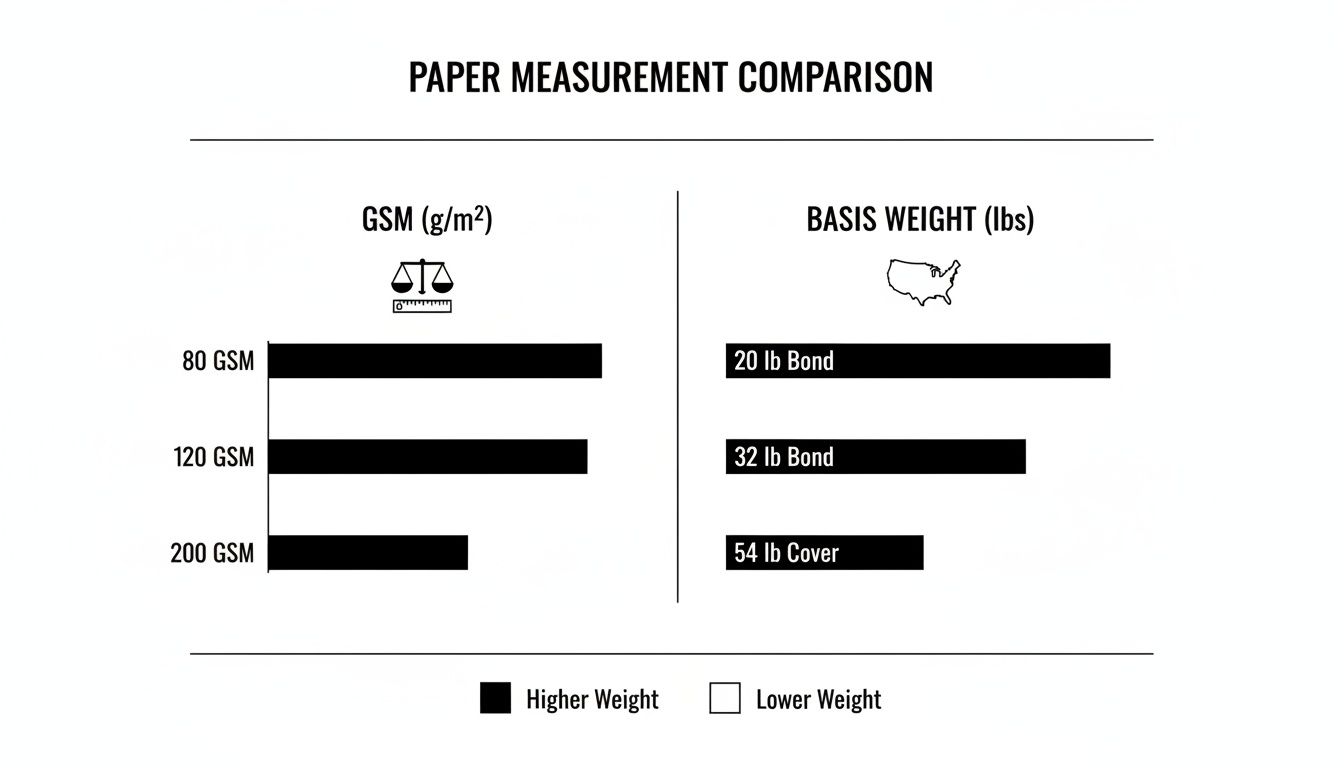
As you can see, GSM offers a straightforward, linear scale for paper density. On the other hand, the Basis Weight system can be tricky because the pound values often overlap between different categories like Text and Cover.
For a more granular breakdown, the table below is your go-to reference. It’s organized from the lightest to the heaviest stocks, making it easy to cross-reference common paper weights and find the perfect match for your next project—whether it's a lightweight manual or a premium business card.
Comprehensive Paper Weight Conversion Table
This detailed cross-reference chart is designed for quickly converting paper stock weights between GSM and the various US Basis Weight systems, including Text, Cover, Bond, and Index. Keep it handy to ensure you’re always ordering with confidence.
| Grams per Square Meter (GSM) | Text Weight (lb) | Cover Weight (lb) | Bond Weight (lb) | Index Weight (lb) |
|---|
| 75 gsm | 50 lb | 41 lb | 20 lb | 41 lb |
| 90 gsm | 60 lb | 50 lb | 24 lb | 50 lb |
| 105 gsm | 70 lb | 58 lb | 28 lb | 58 lb |
| 120 gsm | 80 lb | 65 lb | 32 lb | 67 lb |
| 150 gsm | 100 lb | 80 lb | 40 lb | 83 lb |
| 175 gsm | -- | 95 lb | 47 lb | 97 lb |
| 215 gsm | -- | 115 lb | 58 lb | 120 lb |
| 270 gsm | -- | 145 lb | 72 lb | 150 lb |
| 350 gsm | -- | 190 lb | 94 lb | 195 lb |
Bookmark this page for your future print jobs! Having this information at your fingertips helps streamline the entire process, preventing miscommunication and ensuring the final product looks and feels exactly as you intended.
Choosing the Right Paper Weight for Your Project
This is where the rubber meets the road—picking the right paper stock weight for what you’re actually trying to create. Getting this choice right means your project won't just look the part, it will feel substantial and function exactly as you imagined. After all, a flimsy business card won't make a great first impression, and a brochure page that's too thick will fight every attempt to fold it, cracking along the crease.
Think of this section as your practical guide. We’ll connect specific paper weights to their best uses so you can get a real feel for the final product. Let's walk through the common options we handle at Camelot every day, from high-impact marketing materials to critical industry documents, and see what makes the most sense for you.
Lighter Stocks for Everyday and Bulk Use
Lighter paper stocks are your go-to for internal documents, large-scale mailings, and any project where keeping an eye on the budget is a top priority. They’re known for being flexible, lightweight, and easy to fold.
24 lb Bond (90 GSM)A definite step up from the paper in your office copier, this stock offers better opacity and a more professional touch. It's a reliable workhorse for everyday business needs.
- Feel: It’s noticeably sturdier than copy paper and has a smooth, clean finish.
- Best For: Think professional letters, reports, legal documents, and high-quality manuals. For our clients in the AEC industry, this is a fantastic choice for specification books and plan reproductions that need to be durable but still easy to handle in a large set.
70 lb / 80 lb Text (105-120 GSM)You’ll find this weight in a lot of professionally printed materials. It really hits the sweet spot between quality and cost, feeling premium without being too thick for items that need a good fold.
- Feel: Smooth and flexible, with solid opacity that keeps images on the other side from showing through.
- Best For: Perfect for brochures, flyers, catalogs, and the inside pages of booklets. Its excellent foldability is what makes it the standard for tri-fold or bi-fold marketing pieces.
Mid-Weight Stocks for High-Impact Marketing
When you need your project to grab attention and feel important without being as rigid as a board, mid-weight stocks are the answer. They deliver a great mix of durability and elegance.
100 lb Text (150 GSM)This is a very popular choice for marketing materials when you want to signal a higher level of quality. It feels substantial in your hands and immediately sends a high-end message.
- Feel: Thick and durable with a satisfying heft.
- Best For: High-quality brochures, sales sheets, event posters, and booklet covers. The extra thickness really helps colors look more vibrant, especially when you add a gloss or matte coating.
A quick tip: Choosing a coated stock like 100 lb Gloss Text can make a huge difference in visual appeal. The coating not only protects the ink but makes images and graphics truly pop, which is why it's a favorite for marketing campaigns that rely on strong visuals.
Heavyweight Stocks for Maximum Durability
Often called "cardstock," these heavyweights are built for business. They’re designed for items that need to be rigid, stand up to a lot of handling, and leave a lasting impression.
14 pt / 16 pt Cover (310-350 GSM)This is the classic range for premium business cards and postcards. The points (pt) measurement is a direct indicator of the paper's thickness—a 16 pt stock is a sturdy 0.016 inches thick.
- Feel: Stiff, rigid, and incredibly durable. It resists bending and has an authoritative feel.
- Best For: Business cards that need to stand out, postcards that can survive the postal system, greeting cards, and covers for presentations or reports. That inherent rigidity also provides the perfect, solid base for special finishes like foil stamping or embossing.
How Coatings Change the Feel and Finish of Your Paper
Think of your paper stock weight as the foundation of your print project. The coating you add on top is the finishing touch—like the varnish on a piece of furniture—that completely transforms the final look and feel. A coating does more than just change the texture; it adds a protective layer, boosts durability, and can even make the paper feel thicker and more substantial than its weight suggests.
This extra layer literally adds to the paper's thickness, giving you a more rigid and premium-feeling product. For instance, a 100 lb Text stock with a high-gloss UV coating will feel noticeably stiffer and more significant in someone's hands than the same uncoated paper. That perceived quality can be a game-changer for marketing materials where making a great first impression is critical.
Gloss vs. Matte Finishes
When it comes to coatings, gloss and matte are the two most popular choices, and each offers a very different experience. Your project’s goal will really dictate which one is the right fit.
Gloss Coating: This finish gives you a shiny, reflective surface that makes colors look incredibly rich and vibrant. It’s a fantastic choice for photo-heavy catalogs, promotional flyers, or any piece where you want the images to leap off the page. The slick surface also adds a nice layer of protection against fingerprints and moisture.
Matte Coating: If you’re aiming for a more subtle, sophisticated vibe, a matte finish is the way to go. It creates a smooth, non-glare surface that’s easy on the eyes, making it perfect for text-heavy documents like corporate reports or training manuals that will be read under bright lights.
The big takeaway here is that coatings are about function, not just aesthetics. A matte varnish, for example, gives you a soft, almost velvety texture while still resisting scuffs and smudges. This makes it a perfect match for high-end business cards or booklet covers that need to look great even after being handled.
Ultimately, the right coating works hand-in-hand with your chosen paper weight to create the exact experience you want your audience to have, blending visual appeal with real-world durability.
How Paper Weight Impacts Shipping Costs
If your business relies on direct mail or ships products, the paper stock weight you choose is much more than a creative decision—it's a serious line item on your budget. Heavier paper means higher postage and freight bills, a reality that can quickly chip away at the ROI of any marketing campaign.
Every single ounce matters. A seemingly small jump in paper weight can easily bump your mailer into the next, more expensive postage tier. When you're sending out thousands of pieces, those tiny increments add up fast, potentially costing you thousands of extra dollars and turning a great campaign into a costly one.
This is especially true with the explosion of e-commerce. As the growing paper packaging market at Mordor Intelligence shows, global demand for shipping materials is massive, and smart logistics are essential. We've seen businesses that carefully manage their stock weights cut their logistics costs by an average of 18%.
Strategic Choices for Smarter Shipping
The good news is you don't have to choose between quality and cost. Making smart, strategic choices about your paper allows you to find that sweet spot between making an impact and staying on budget. A few simple tweaks can lead to big savings without making your brand feel cheap.
Here are a few practical tips to keep in mind:
- Self-Mailers: Instead of a heavy cardstock, try a durable 100 lb Text (150 GSM) with a protective coating. It still has a premium feel and folds neatly, but you can skip the envelope, saving money on both materials and postage.
- Postcard Dimensions: Always check the latest USPS guidelines for postcards. You can often use a thick, impressive 16 pt cardstock and still qualify for the cheaper First-Class Mail postcard rates as long as you stick to the standard dimensions.
- Booklet Insides: For catalogs, manuals, or programs, use a sturdy stock like 100 lb Cover for the outside but switch to a lighter 80 lb Text for the inside pages. This simple change dramatically reduces the overall weight and shipping cost.
Thinking about logistics at the start of your design process—not at the end—is the key. Making an informed decision about paper stock weight from the get-go protects your budget and makes sure your materials get where they need to go affordably. This kind of foresight is what makes a campaign truly effective.
Paper Stock Recommendations by Industry
Choosing the right paper isn't just a design decision; it's a practical one that hinges on how it will be used in the real world. A delicate menu won't survive a single dinner service, and a flimsy legal brief just doesn't command the same respect. Getting this right shows you understand your clients' needs and adds a layer of professionalism to everything you print.
Think of it this way: matching the paper to its purpose proves you’ve considered the entire lifecycle of the document, not just how it looks coming off the printer.
AEC and Legal Industries
When you're working in Architecture, Engineering, Construction (AEC), or the legal field, your documents have to be workhorses. They need to be durable, easy to read, and built to last through constant handling, folding, and scribbled annotations.
- AEC Plan Reproductions: We almost always recommend 20-24 lb Bond (75-90 GSM) for blueprints and plans. It’s the perfect balance—sturdy enough to hold up on a messy job site but still light enough to handle in large, multi-page sets without becoming bulky.
- Legal Court Filings: For official documents that need to feel authoritative, stepping up to a 28 lb Bond (105 GSM) makes a real difference. That extra weight and opacity give it the substantial feel required for important filings that will be passed around and reviewed.
Healthcare and Food Service
In sectors like healthcare and food service, your printed materials face a different set of challenges. They often need to resist moisture and meet strict hygiene and safety standards. The right paper stock and finish are non-negotiable for durability and compliance.
For that matter, security is a huge deal for both law firms and healthcare providers. We can use security papers over 120 gsm that embed special fibers, which are 99.9% detectable under UV light, cutting forgery risks by a massive 40%. In healthcare, using virgin fiber papers in the 100-200 gsm range is critical; they withstand 50% more stress than recycled options, a key feature for durable medical wraps or documents destined for high-speed scanners. This is a huge field, and you can get a sense of its scale by exploring the specialty paper market growth on MordorIntelligence.com.
Pro Tip: If you're printing restaurant menus, don't skimp. For something that gets handled constantly, go with a synthetic paper or a heavyweight 100 lb Cover (270 GSM) coated with a heavy-duty laminate. This combination is practically indestructible—it resists spills, tears, and frequent wipe-downs, protecting your investment.
This industry-focused approach ensures your printed materials perform exactly as they should, whether they're on a construction site or in a courtroom.
Common Questions About Paper Stock
Diving into the world of paper weights can bring up a few questions. We get it. To help you nail down the final details for your print project, we've put together some quick answers to the questions we hear most often.
What Is the Best Paper Weight for Business Cards?
When it comes to business cards, you want something that feels substantial and holds up well. We almost always recommend a heavyweight cardstock. The sweet spots are 14 pt (310 GSM) and 16 pt (350 GSM).
A 16 pt stock, in particular, has that premium, rigid quality that won’t easily bend or crease. It’s the kind of card that makes a great first impression just by its feel.
Can I Print on Both Sides of a Lighter Paper?
Technically, yes, but you have to be careful about opacity. If you print on both sides of a really light paper—something like a standard 20 lb Bond—you’ll almost certainly get "show-through," where the design on one side is visible from the other. It looks messy and unprofessional.
For clean, double-sided printing, we suggest using a paper that's at least 70 lb Text (105 GSM). This provides enough opacity to keep your designs from bleeding through and distracting from the message.
Expert Tip: If you're on the fence, going a little heavier is usually the best move for double-sided jobs. It not only solves the show-through problem but also gives the finished piece a more solid, high-quality feel.
How Much More Expensive Is Heavier Paper Stock?
Heavier paper does cost more—it simply uses more raw material and takes more to produce. While the exact price jump can vary, you can generally expect to see a 15-30% increase when you move from a standard mid-weight paper (like an 80 lb Text) to a premium heavyweight stock (like a 16 pt Cover).
What Exactly Is Cardstock?
It's a common misconception that cardstock is one specific thing. It's actually a whole category of thick, durable paper. Think of it as any paper that’s significantly heavier and more rigid than the stuff you’d find in an office printer.
Generally, anything from 80 lb Cover (216 GSM) on up falls into the cardstock family. Its defining traits are its sturdiness and resilience.
Ready to feel the difference for yourself? The experts at Camelot Print & Copy Centers can walk you through the options and help you land on the perfect paper for your project.
Explore our custom printing services today!