Let's be honest, we're all drowning in digital noise. Emails pile up, social media feeds are a blur, and online ads are everywhere. So, how do you make a real connection with your customers? Sometimes, the answer is surprisingly old-school: postcard printing. It’s about putting something real and tangible into your customer’s hands—a physical message that cuts through the online static.
This isn't just about sending mail; it's about creating a moment. A postcard isn't just another pixel on a screen. It's something you can hold, feel, and even stick on the fridge. That physical connection is what keeps postcards a surprisingly powerful tool for any business.
Why Postcards Still Pack a Punch
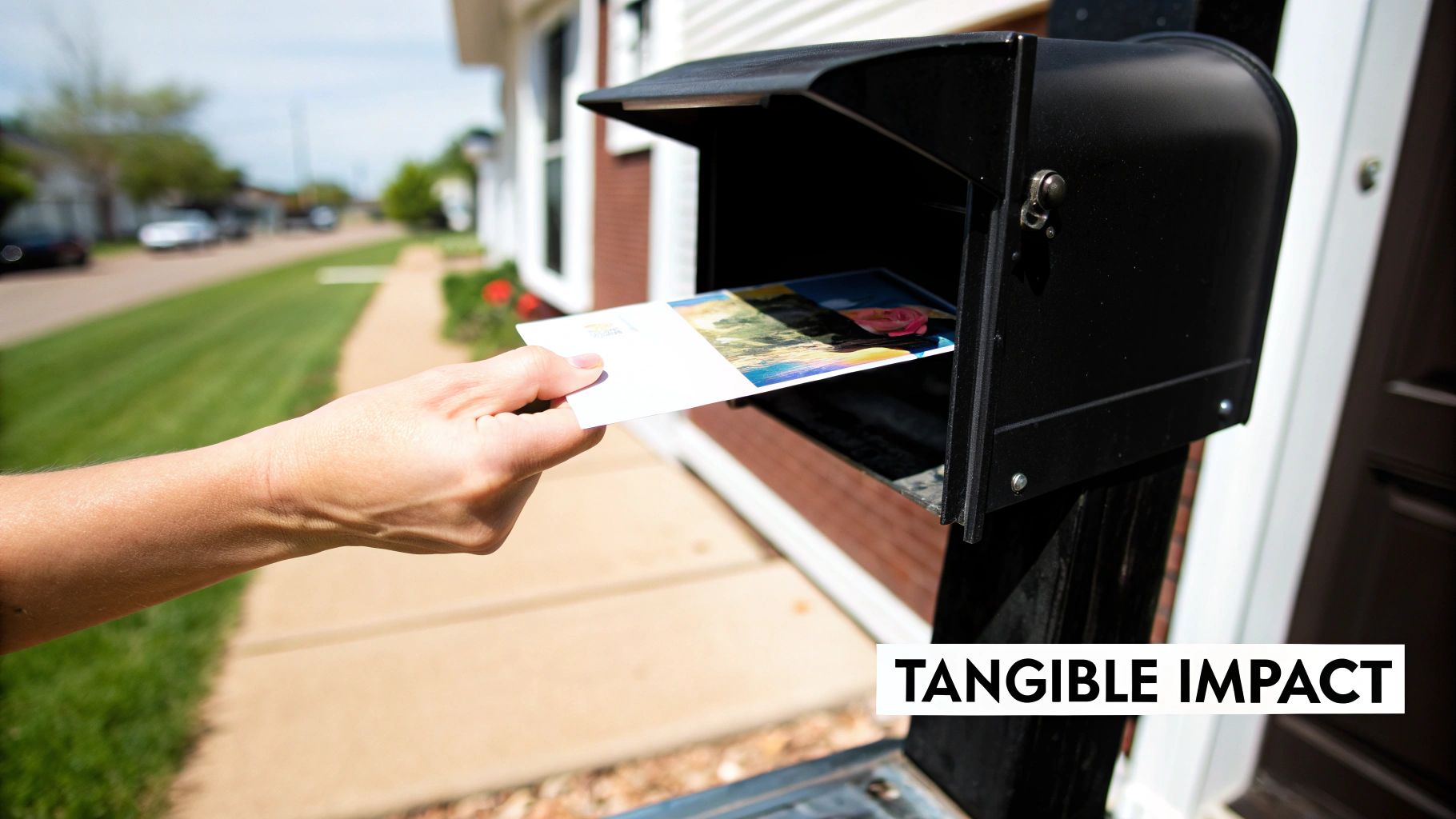
Think about your own daily routine. You probably delete dozens of promotional emails without a second thought and scroll past countless ads. It’s automatic. We’ve all developed a filter for the digital chaos.
Now, imagine finding a beautifully designed, custom-printed postcard in your mailbox. It’s different, isn't it? It stands out. It feels more personal, like a handshake in a crowded digital room. It can’t get caught in a spam filter or blocked by an ad-blocker. It lands directly in your customer's hands, demanding a moment of their attention in a way a digital ad just can't.
The Power of Being Real
This physical presence is more than just a neat trick; it gets real results. Postcards are so effective because they do a few things brilliantly:
- They cut through screen fatigue. Getting something in the mail offers a welcome break from endless scrolling, making your message feel more personal and less intrusive.
- They stick around. A physical postcard can be pinned to a corkboard or set on a desk, keeping your brand top-of-mind long after an email has been archived and forgotten.
- They spark immediate action. A clear call-to-action, like a QR code leading to a special offer or an invitation to an event, seamlessly bridges the gap between the physical and digital worlds.
Postcards force a decision. Unlike an email that can be ignored with a single swipe, a physical piece of mail must be handled. That simple act ensures your message gets at least a glance—and that first glance is often all you need to pique someone's interest.
A Classic Tool in a Growing Market
And this isn't just a nostalgic trend. The numbers back it up. The global postcard market is set to grow from roughly $2.98 billion in 2025 to an estimated $4.36 billion by 2034.
For a local printer like Camelot Print & Copy Centers, this steady growth confirms what we see every day: businesses are successfully using everything from small, personalized postcard runs to massive direct mail campaigns. If you're curious, you can discover more about the postcard market's growth and see why it remains a smart investment.
Designing a Postcard That Captures Attention
Let's be honest, most mail goes straight from the mailbox to the recycling bin. A great postcard is the one that makes someone pause on that journey. It has to grab them instantly. Think of it less like a piece of mail and more like a tiny, handheld billboard. Every single inch has a job to do, and you don't need to be a pro designer to get it right.
The real secret is something designers call visual hierarchy. It's just a fancy way of saying you're intentionally guiding the reader's eye through the most important stuff, in the right order. Your main goal? Make the core message impossible to ignore. Start with a headline that pops, pair it with an image they can't look away from, and seal the deal with a clear call to action.
Create a Strong Visual Foundation
The look and feel of your postcard create an impression before anyone reads a single word. To make sure it looks professional and polished, nail these three things:
- High-Resolution Images: Nothing screams "amateur" faster than a blurry, pixelated photo. Your images need to be sharp and clear. For printing, the gold standard is 300 DPI (dots per inch)—this ensures everything looks crisp.
- Brand-Consistent Colors and Fonts: Now is not the time to experiment. Stick with the colors and fonts that people already associate with your brand. This consistency is how people recognize you instantly and build trust.
- Embrace White Space: It’s tempting to fill every last bit of space, but don't. That empty area—what designers call "white space" or "negative space"—is your best friend. It gives your design room to breathe and makes your key elements truly stand out.
You have about three seconds to make an impression. If someone has to struggle to figure out what you're saying, you've already lost them. Simplicity and clarity are everything.
Craft an Irresistible Call to Action
This is it. The most important part of your postcard. Without a clear next step, you’ve just sent someone a nice piece of paper. Your call-to-action (CTA) needs to tell the reader exactly what you want them to do next. Be specific, make it singular, and make it simple.
Don't give them a laundry list of options. Instead of asking them to call, visit your website, and follow you on social media, pick the single most important action you want them to take.
Here are a few ideas for powerful, focused CTAs:
- Drive Online Traffic: "Scan this QR code for 20% off your first order."
- Encourage In-Person Visits: "Bring this postcard in for a free coffee."
- Generate Leads: "Visit our website to schedule a free consultation."
By zeroing in on one compelling CTA, you give your customer a clear and easy path to follow. This is how you turn a passing glance into a real, measurable action and see a return on your postcard printing investment.
Preparing Print-Ready Files Without the Headache
This is where the magic happens—turning your digital design into something your customers can actually hold. Getting a file ready for a professional print shop might sound a bit technical, but trust me, understanding a few key concepts is all it takes to avoid those common, and often costly, mistakes.
Think of it like framing a photo. You wouldn't want the most important parts of the picture cut off by the frame, right? The same idea applies to printing. We need a little extra wiggle room around the edges of your design to make sure everything comes out perfectly. This is handled with three simple boundaries.
Understanding Your Design's Boundaries
To make sure no critical text or logos get trimmed off during the cutting process, you just need to get familiar with these terms:
- Bleed: This is a small border of your background color or image—usually 1/8th of an inch—that extends past the final cut line. It's basically a safety net that prevents ugly white slivers from appearing if the cutting blade is off by a hair.
- Trim Line: This is exactly what it sounds like: the line where we'll cut the postcard to its final, intended size. Anything beyond this line is history.
- Safety Margin: Think of this as an inner fence, also about 1/8th of an inch inside the trim line. All your crucial stuff—text, logos, contact info—needs to live comfortably inside this "safe zone" so it doesn't look awkwardly close to the edge.
Honestly, setting up your bleed, trim, and safety margins correctly is the single best thing you can do to prevent printing mishaps. It's a small step that ensures every postcard looks sharp and professional.
This whole design process can really be boiled down to three core stages, from grabbing attention to getting a response.
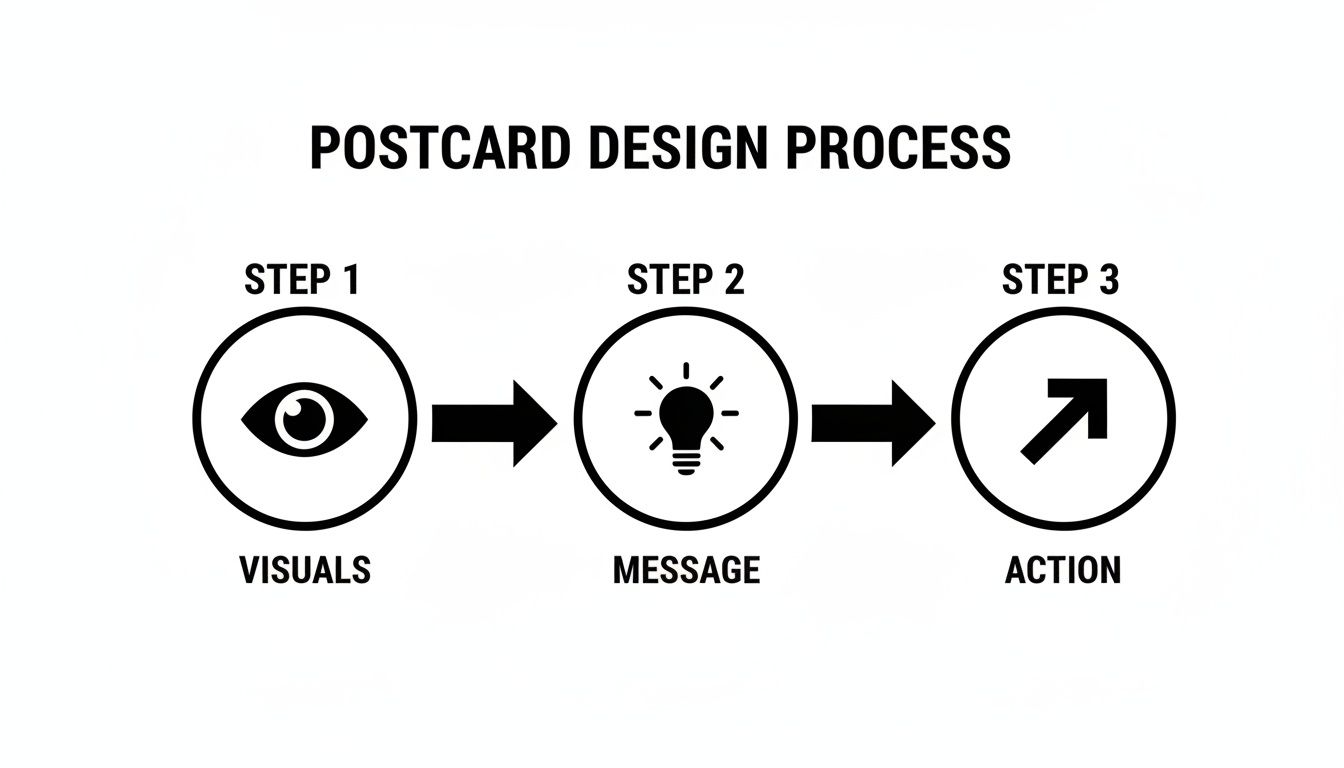
As you can see, a great postcard isn't just about pretty pictures. It’s about balancing those visuals with a message that clicks and an action that’s easy to take.
Finalizing Your File for Flawless Printing
Okay, once the layout is locked in, there are just a few more technical details to check off for a high-quality print job.
To make sure your files are ready for the press, we've put together a quick checklist. This little guide helps you double-check the most important specs before you send anything our way.
Print-Ready File Checklist
| Specification | Requirement | Why It Matters |
|---|
| Color Mode | CMYK | This four-color model is the standard for professional printing. RGB is for screens and will cause color shifts. |
| Image Resolution | 300 DPI | Ensures your images print sharp and clear, not blurry or pixelated. |
| File Format | High-Quality PDF | Locks your fonts, images, and layout in place, guaranteeing it looks the same on our end as it did on yours. |
| Bleed | 1/8th inch (0.125") | Prevents white edges after trimming by extending the design beyond the cut line. |
| Safety Margin | 1/8th inch (0.125") | Keeps important text and logos from being cut too close to the edge. |
Getting these settings right from the start saves a ton of back-and-forth and ensures the final product is exactly what you envisioned. A print-ready PDF is the gold standard we work with at Camelot Print & Copy Centers, and it’s your ticket to perfect results every time.
Choosing the Right Paper and Finish
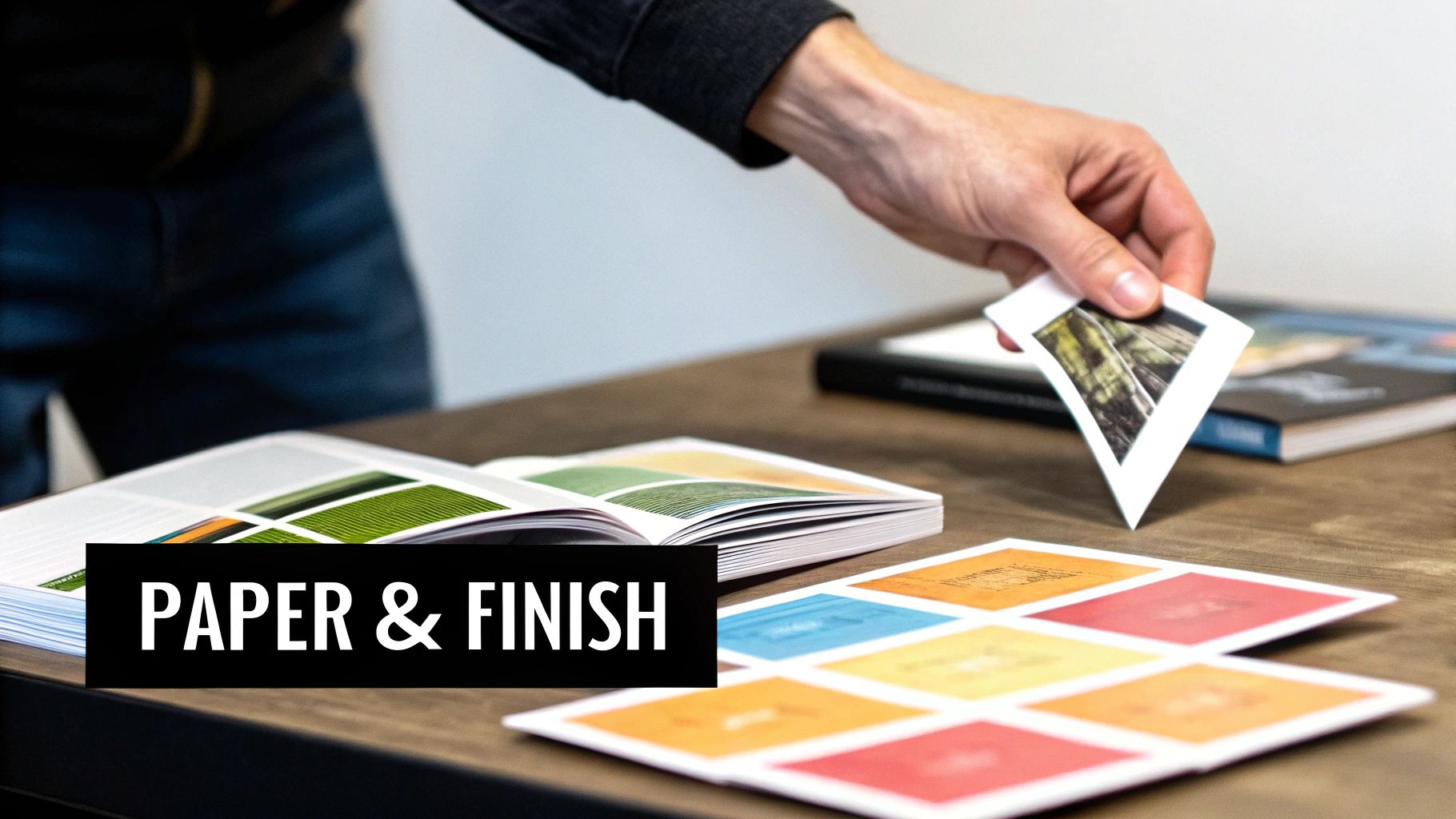
A great design is just the start. The real magic happens when your customer pulls that postcard from their mailbox. The weight of the paper and the texture of the finish create an instant impression, long before they even read a single word.
Think about it like a handshake. A flimsy, weak one feels forgettable, while a firm, confident one commands respect. Your postcard's physical feel works the same way, telling a story about your brand's quality. This isn't just a finishing touch; it’s a core part of your message.
Selecting Your Postcard Size
The size of your postcard is one of the first decisions you'll make, and it directly impacts both your budget and how much attention you grab. While we can print just about any custom size you dream up, most campaigns benefit from sticking to one of two proven standards.
- Standard 4" x 6" Postcards: This is the workhorse of postcard marketing. It’s classic, familiar, and the most budget-friendly option, especially for large-scale mailings. Perfect for quick announcements, event reminders, or simple, punchy promotions.
- Jumbo 5" x 7" Postcards: Need more room to make your case? The jumbo size gives your design more breathing room for stunning visuals and compelling copy. It feels more substantial and is guaranteed to stand out in a crowded mailbox.
So, what's the verdict? Go with the standard size for broad, cost-effective outreach. When you need to make a bigger impact or share more details, the jumbo size is well worth the investment.
Understanding Paper Stock and Weight
Paper weight, also called stock, is all about the thickness and sturdiness of your postcard. In the print world, we measure this in points (pt)—the higher the point number, the thicker and more rigid the paper.
Trust me, nobody is impressed by a flimsy postcard that arrives bent and battered. Investing in a decent paper stock is non-negotiable.
Here are the two most common choices for professional postcard printing:
- 14pt Cardstock: This is the industry go-to for a reason. It’s a solid, reliable stock that feels professional and holds up beautifully in the mail. You really can't go wrong with it for most marketing campaigns.
- 16pt Cardstock: If you want to signal premium quality, 16pt is the way to go. That extra thickness gives it a noticeably more substantial, high-end feel. It’s a subtle upgrade that communicates luxury and importance.
The right paper does more than just carry your message; it becomes part of the message itself. A thick, high-quality cardstock subtly tells your customers that you care about the details and are invested in quality.
Choosing the Perfect Finish
The finish is the final layer that protects your postcard and defines its look and feel. Each option creates a completely different experience for the person holding it.
- High-Gloss UV: This is your "wow" factor. A super shiny, protective coating that makes colors explode off the page and gives images a vibrant, almost wet look. It’s tough, durable, and perfect for designs that are all about eye-catching visuals.
- Matte Finish: For a more understated, modern vibe, matte is the answer. It has a smooth, satin-like feel with zero glare, which makes text easy to read. It feels sophisticated and is fantastic for elegant or minimalist designs.
- Uncoated: Just pure, natural paper with no coating at all. The slightly textured surface is perfect for writing on, making it the ideal choice for appointment reminders, reply cards, or any piece that encourages your customer to grab a pen.
By thinking through these three elements—size, paper, and finish—you ensure every piece of the puzzle works together to create a postcard that not only looks great but feels like your brand.
Getting Your Postcards Into the Right Hands
You’ve designed and printed the perfect postcard. Now what? The final piece of the puzzle is distribution—getting those cards from the print shop into the mailboxes of your future customers. Don't overlook this step; a brilliant postcard that never finds its audience is a wasted effort.
Think of your distribution strategy as choosing between a shotgun and a sniper rifle. One casts a wide net, while the other is all about precision. Which one you choose depends entirely on what you want to achieve.
Blanketing a Local Area with EDDM
Is your business all about location? Think restaurants, retail shops, or local service providers. If so, your goal is to reach as many people as possible within a specific geographic area. For this, the U.S. Postal Service’s Every Door Direct Mail (EDDM) program is a game-changer.
EDDM lets you hit every single mailbox along a chosen mail carrier route. You don't need a list of names or addresses—you just pick the neighborhoods, and your postcard goes out to everyone. It's an incredibly effective and affordable way to announce a grand opening, promote a local event, or drive foot traffic with a special sale.
EDDM is the simplest way to dominate a local market. It cuts out the complexity of mailing lists and puts your message directly into the hands of the people living and working right around the corner.
Zeroing In with Targeted Mailing Lists
If you need a more surgical approach, a targeted mailing list is the way to go. This strategy goes beyond just "where" and lets you focus on "who"—connecting with people based on specific demographics, interests, or even their past interactions with your business. Personalization is key here, and it’s something a broad campaign can't replicate.
There are a couple of ways to do this effectively:
- Your Own Customer List: Why not talk to people who already know and like you? Sending special offers, loyalty rewards, or a simple "we miss you" card to your existing customer base is a fantastic way to drive repeat business. These people are already warm leads, so you'll often see a much higher response rate.
- A Purchased List: If you're trying to find new customers, you can get a list tailored to your ideal client profile. You can filter by all sorts of criteria, like income, age, or buying habits, ensuring your message only goes to people who are likely to be interested.
This is where working with a full-service print shop like Camelot Print & Copy Centers really pays off. We don't just print; we can help you find the right list and handle the entire mailing process for you—addressing, sorting, and delivering everything to the post office. It takes the hassle off your plate and makes sure it's done right.
And don't forget to think outside the mailbox! Your postcards can also be powerful tools as in-store handouts, inserts in shipping boxes, or takeaways at trade shows and events.
Tracking Your Campaign and Measuring Success
Sending out a stack of beautiful postcards feels great, but how can you tell if it’s actually moving the needle for your business? The real magic of a postcard campaign isn't just in the design; it's in knowing what came back from it. If you can’t measure your return on investment (ROI), you’re essentially marketing with a blindfold on.
The trick is to build a simple bridge from your physical mailer to a digital action. Think of the postcard as the starting line. Your job is to see how many people not only see it but actually take that next step—whether it's buying something, scheduling a consultation, or just checking out your website.
Creating Trackable Calls to Action
To really understand what’s working, you need to give your customers a specific path to follow. A generic "Visit our website" is a dead end for tracking. Instead, you need to bake a unique, trackable call to action right into the postcard itself.
Here are three simple and highly effective ways to do this:
- Unique Discount Codes: Create a special promo code that lives only on that postcard, like "POSTCARD20" or "MAILER15." When that code pops up in your sales data, you know for a fact the postcard did its job.
- Custom Landing Pages: Don't just send people to your homepage where they can get lost. Build a dedicated page just for this offer (e.g.,
yourwebsite.com/special-offer). Using basic web analytics, you can see exactly how many people visited that page directly from your mailer. - QR Codes: Nothing connects the physical and digital worlds faster than a QR code. A quick scan can take someone to your landing page, a product video, or a digital coupon, giving you instant, trackable engagement data.
The goal isn't just to send a message; it's to start a conversation. By giving your audience a clear, easy, and trackable way to respond, you transform your postcard from a simple piece of mail into a data-driven marketing tool.
Proving the Value of Print
Focusing on these tracking methods is what gives print its power today. It provides cold, hard proof that your campaign is worth the investment. It’s no surprise that direct mail and postcard campaigns continue to deliver a strong ROI for businesses that take the time to measure their efforts.
U.S. brands spent an estimated $37 billion on direct-mail ads in 2024, and weekly mail volumes have climbed nearly 50% since 2019. Those aren't small numbers. They show that postcard printing is still a vital tool for businesses chasing predictable growth. You can dive deeper into the data on the future of direct mail and its impressive returns.
By putting these simple tracking strategies in place, you can fine-tune your campaigns, figure out what your audience really wants, and turn your investment in postcard printing into a reliable machine for generating revenue.
Answering Your Postcard Printing Questions
Even with a perfect plan, you’re bound to have a few questions as you get ready to print. That's completely normal. Getting the right answers upfront is the key to avoiding those little "gotchas" down the road and making sure your project runs smoothly.
Here are some of the most common questions we field every day.
"How Many Postcards Do I Have to Order?"
This is probably the number one question we get. Many people assume they need to commit to a massive print run of thousands, but that’s not the case anymore. Whether you need a small, targeted batch of just 50 for a special event or a broader campaign of 5,000, modern printing can handle it. Your order size should fit your goal, not the other way around.
"How Fast Can I Get My Postcards?"
Once you give us the final "okay" on your proof, the actual printing process is surprisingly quick—usually just a few business days for a standard job.
Of course, timing can shift a bit depending on the details. A straightforward 14pt matte postcard will typically be ready faster than a 16pt gloss card with a custom shape that needs die-cutting. It’s all about the complexity.
The biggest hold-up we ever see? It’s almost never the printer. It’s files that aren't quite ready for print. Taking a few extra minutes to double-check that your design has the right bleed, resolution, and color settings is the single best thing you can do to keep your project on schedule.
A quick file check on your end saves a ton of back-and-forth and ensures what you see on your screen is what you get in your hands.
"Can You Mail Them for Me?"
Absolutely. We can handle everything from start to finish. Once your postcards are printed, we can take care of addressing, sorting, and getting your campaign delivered to the post office. It's a huge time-saver and lets you focus on your business instead of wrestling with postage and USPS regulations. We'll make sure everything is done by the book for a smooth delivery.
Ready to turn your postcard idea into a reality without all the guesswork? The team at Camelot Print & Copy Centers has seen it all and is here to guide you. Get a quote for your project today and let's get started.