Picture this: you have a digital design, and you need to turn it into a physical graphic that's tough, colorful, and can stick to just about anything. That’s exactly what vinyl printing does. It’s the magic behind everything from small, intricate product labels to the giant, eye-catching wraps you see on company vans, bringing your brand’s vision to life.
What Is Vinyl Printing and Why Does It Matter for Your Business?
At its heart, vinyl printing is a sophisticated process that uses wide-format inkjet printers to transfer specialty inks onto large rolls of self-adhesive vinyl. Think of it as a super-powered sticker machine, but one that creates high-resolution, full-color graphics that are built to last.
This isn't your average paper print job. Paper gets soggy and fades, but vinyl is a resilient plastic. That means your message stays sharp and professional whether it's on a storefront window braving a Nor'easter or on a tradeshow display inside. It's working for your brand 24/7, which is precisely why it’s the go-to choice for any project that needs to hold up against the elements and everyday wear and tear.
The Growing Demand for Vinyl Graphics
The sheer flexibility of vinyl has made it a non-negotiable tool for modern businesses. A local café can announce its new hours with a clean, professional window decal. A construction company can brand its entire fleet of trucks, turning them into mobile billboards. In both cases, vinyl delivers a high-impact solution without breaking the bank. Its applications are everywhere, often hiding in plain sight.
This widespread use is fueling some serious market growth. Valued at $9.3 billion in 2025, the global printed vinyl market is on track to hit $14.8 billion by 2034, growing at a steady clip of 5.3% each year. This boom is all thanks to demand in advertising, vehicle wraps, and interior décor—areas where businesses need powerful visuals that last. For companies right here in New York's Capital Region, it shows that vinyl printing isn't just another service; it's a smart way to get noticed without a massive budget. You can explore more about these market trends and what they mean for businesses like yours.
Think of vinyl not just as a piece of marketing material, but as a long-term investment in your brand’s physical presence. A single, well-designed vehicle wrap can generate tens of thousands of local impressions every day, offering unmatched ROI compared to many other forms of advertising.
To give you a clearer picture, here’s a quick rundown of what makes vinyl printing such a valuable tool for any business.
Vinyl Printing at a Glance
| Feature | Benefit for Your Business |
|---|
| Exceptional Durability | Your graphics stay vibrant and professional for years, resisting water, scratches, and UV fading. |
| Vibrant, High-Res Quality | Modern printers create photo-realistic images with sharp details and rich, accurate colors. |
| Unmatched Versatility | Apply it to almost any smooth surface: windows, walls, floors, vehicles, and more. |
| Cost-Effectiveness | Considering its long lifespan, vinyl offers an excellent return on investment for advertising and branding. |
Ultimately, vinyl printing combines longevity, visual punch, and adaptability in a way few other mediums can match. It’s a practical, effective way to put your brand directly in front of the people who matter most.
Choosing the Right Vinyl for Your Project
Picking the right vinyl for your project is a lot like choosing the right tires for a car. You wouldn't put racing slicks on a dump truck, and the same thinking applies here. The material you select directly impacts the look, durability, and cost of your graphics, so getting a handle on your options is the first step to getting it right.
At the heart of it, not all vinyl is created equal. The two main players you'll hear about are cast vinyl and calendared vinyl. The real difference comes down to how they're made, and that manufacturing process dictates everything from how well they bend around corners to how long they’ll last out in the sun.
To make things a bit clearer, here's a quick visual guide to help you match your project’s needs with the best material for the job.
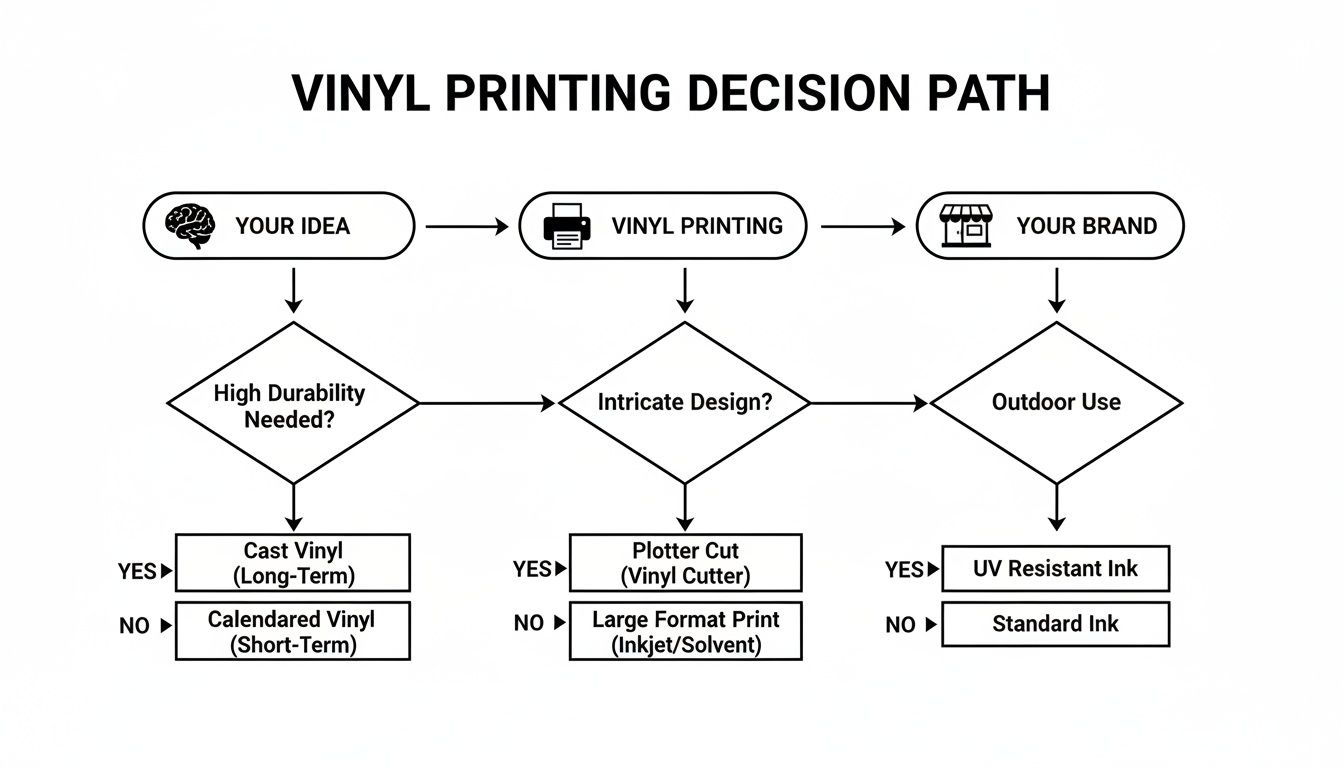
This decision tree shows how factors like the application surface, how long you need it to last, and your budget all point toward the perfect vinyl choice for your brand.
Cast Vinyl: The Premium, Flexible Option
Think of cast vinyl as a liquid plastic that’s poured into a thin sheet and then baked. This process creates an incredibly durable and flexible film that’s the gold standard for projects that demand top-tier performance and longevity. Because it's "cast" without any tension, it has no memory of a previous shape, which means it won’t shrink or pull away when you apply it to tricky, curved surfaces.
This is exactly why it's the undisputed champion for vehicle wraps. When you’re wrapping a contractor’s van full of rivets, indentations, and corners, you need a material that can stretch and conform perfectly without peeling back or distorting the graphic.
Use Cast Vinyl For:
- Full Vehicle Wraps: Its incredible flexibility delivers that smooth, paint-like finish over every contour of a car, truck, or van.
- Corrugated Surfaces: Got a textured wall or a shipping container? Cast vinyl is the only way to go for a clean application.
- Long-Term Outdoor Signage: It’s built to withstand brutal weather, UV rays, and temperature swings for up to 10 years, making it a fantastic long-term investment.
Calendared Vinyl: The Cost-Effective Workhorse
Calendared vinyl, on the other hand, is made by pushing a heated plastic mixture through a series of rollers, essentially squishing it flat. It’s a faster and cheaper process, but it produces a thicker, less flexible material that remembers being flat. Because of this "memory," it has a slight tendency to shrink back over time.
But don’t count it out—far from it. For thousands of jobs on flat surfaces, calendared vinyl is the perfect sweet spot between performance and price. It’s the ideal choice for a retail store announcing a seasonal sale with a big window graphic or for creating stunning indoor wall murals on smooth drywall.
When your project involves a simple, flat surface and doesn't need to last for a decade, calendared vinyl delivers professional results without the premium price tag. It's the practical, smart choice for most everyday business needs.
Beyond the Basics: Finishes and Specialty Vinyl
Once you've landed on either cast or calendared, you can dial in the final look with different finishes and specialty materials. The finish doesn’t just affect the appearance; it also impacts readability and the overall feel of your graphic.
- Gloss Finish: This shiny, reflective surface makes colors absolutely pop. It's fantastic for vibrant, photo-realistic images and creates a high-impact look perfect for promotional banners and vehicle graphics.
- Matte Finish: A non-reflective, flat surface is your best friend for reducing glare. This makes it ideal for indoor wall art, trade show displays, or any sign that will be viewed under bright lights. Text is often much easier to read on a matte surface.
- Satin Finish: Right in the middle, a satin finish offers a subtle sheen that gives you rich color without the high-gloss reflection, resulting in a sophisticated, modern look.
You can also find specialty vinyls to solve unique problems. Perforated vinyl, for example, is covered in tiny, uniform holes that create a one-way vision effect. You can display a full-color graphic to the outside world on your storefront windows, but from the inside, you can still see out and let natural light pour in. It’s a brilliant way to turn your windows into prime advertising real estate.
Understanding the Vinyl Printing and Cutting Process
Ever wondered how a digital design on a computer screen gets turned into a tough, vibrant graphic you see on a storefront window or a company van? It’s a pretty cool mix of high-tech precision and practical know-how. It all boils down to two main ways of producing vinyl graphics, each suited for very different business needs.
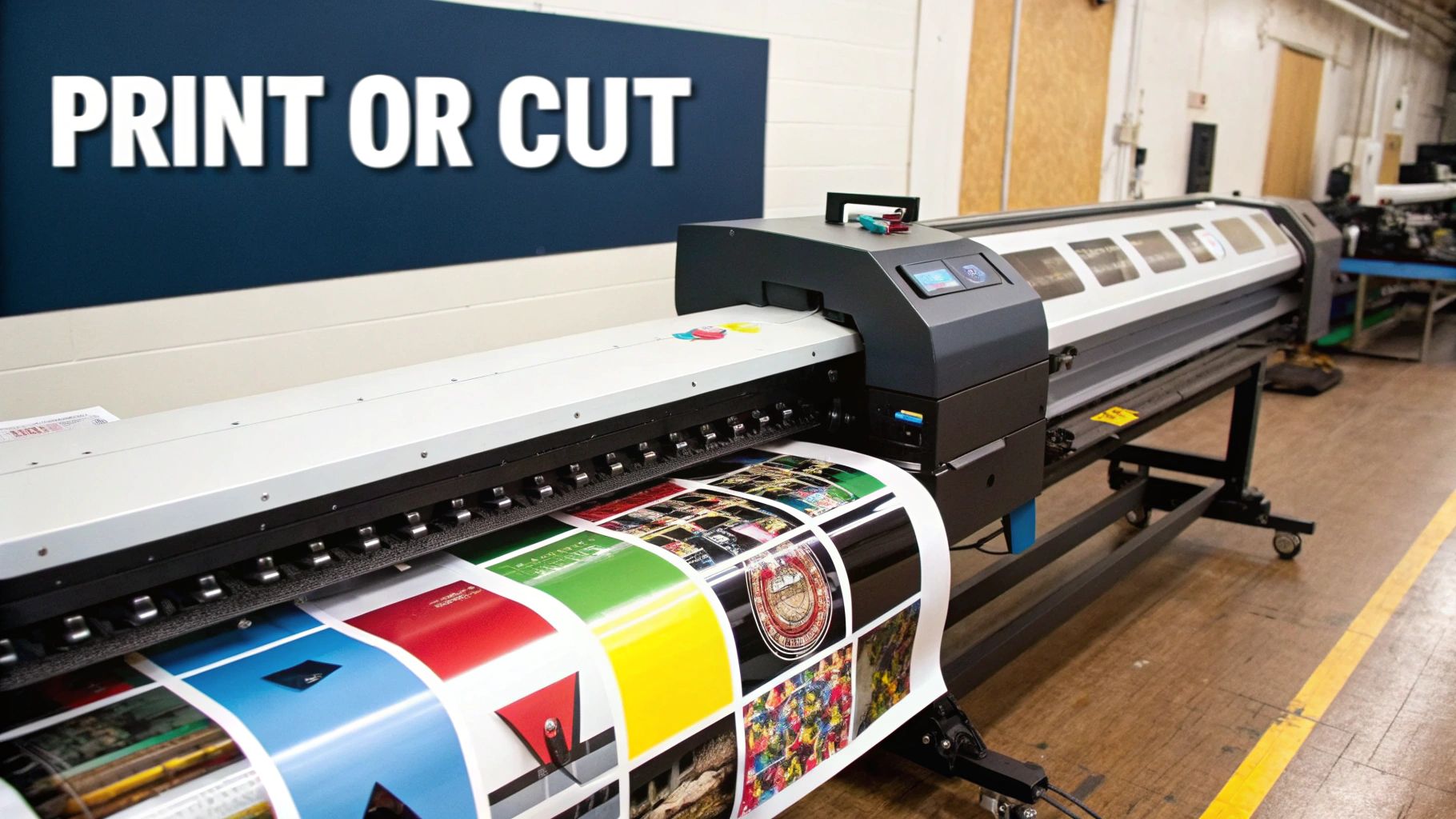
Getting a handle on these two methods is the first step in making sure your design comes out just right. Knowing which process to use guarantees your final product has the professional punch your brand deserves.
The World of Full-Color Printed Vinyl
The first method is full-color vinyl printing. The easiest way to think about it is like using a massive, highly specialized inkjet printer. But instead of printing on paper, these machines lay down ink directly onto huge rolls of adhesive-backed vinyl. The result? Stunning, photo-realistic graphics.
This is your go-to process for any design that's complex. It’s perfect for reproducing detailed logos, brilliant photos, and smooth color gradients. If your design has more than a handful of solid colors or includes any kind of detailed imagery, this is the only way to bring it to life with incredible clarity.
When to Choose Full-Color Printed Vinyl
- Detailed Logos and Branding: If your company logo uses gradients, shadows, or lots of overlapping colors, you’ll need it printed.
- Photographic Imagery: This is a must for banners, wall murals, or vehicle wraps that feature high-quality photos.
- Complex Illustrations: Any design with fine details, shading, or a broad color palette will look its best when printed.
There's another big advantage to this method: protection. After the design is printed, we usually apply a clear laminate over the top. This acts like a shield, protecting the ink from UV rays, moisture, and everyday scuffs. This is especially important for outdoor projects like vehicle wraps or permanent signage, as it drastically extends the life of your investment.
The Precision of Cut Vinyl Graphics
The second approach is cut vinyl, which you might also hear called vinyl lettering or plotter-cut vinyl. This is a completely different ballgame. Instead of printing an image onto the vinyl, a computer-guided blade—called a plotter—cuts shapes and letters directly out of a roll of solid-colored vinyl.
Think of it as a super-accurate robotic X-Acto knife that follows the vector lines of your design perfectly. No ink is used here. The color is the vinyl itself, which makes it ideal for creating sharp, bold graphics in one or more solid colors.
For clean, crisp text and simple logos, cut vinyl is often the superior choice. It produces exceptionally sharp edges and a bold, professional look that is ideal for communicating essential information clearly and effectively.
A great example is the hours of operation you see on a glass door, or a simple one-color logo on a work truck. These are classic uses for cut vinyl. The final result has a clean, "painted-on" look because there's no background—just the individual letters and shapes you want.
The technology behind this isn't just for signs; it's part of a huge shift in manufacturing. Vinyl plotters are a key piece of the broader CNC machine industry, which is projected to grow from $101.2 billion in 2025 to $196 billion by 2032. It’s a reflection of the massive demand for automated, precise tools in almost every sector. You can explore more about these global manufacturing trends to see just how much this technology is evolving.
So, how do you choose? It all comes down to your design. A colorful, photo-heavy banner needs the detail of printing, while bold, simple lettering demands the sharp precision of a vinyl cutter. By understanding these two core processes, you can make smarter decisions and set your vinyl project up for success.
Powerful Business Applications for Vinyl Graphics
Knowing the nuts and bolts of vinyl printing is a great start, but the real "aha!" moment comes when you see how it works in the real world. Vinyl graphics aren't just for decoration; they're workhorse tools that solve everyday business problems for companies of all stripes. From catching the eye of a potential customer on a busy street to keeping a construction site safe, vinyl delivers practical, high-impact results.
This incredible versatility is exactly why vinyl graphics have become such a marketing staple. The global market for vinyl stickers hit an impressive $4.5 billion in 2024 and is on track to reach $7.1 billion by 2033. That growth is fueled by businesses who need affordable, weatherproof marketing that actually delivers a return. You can discover more insights about the booming vinyl sticker market and its applications.
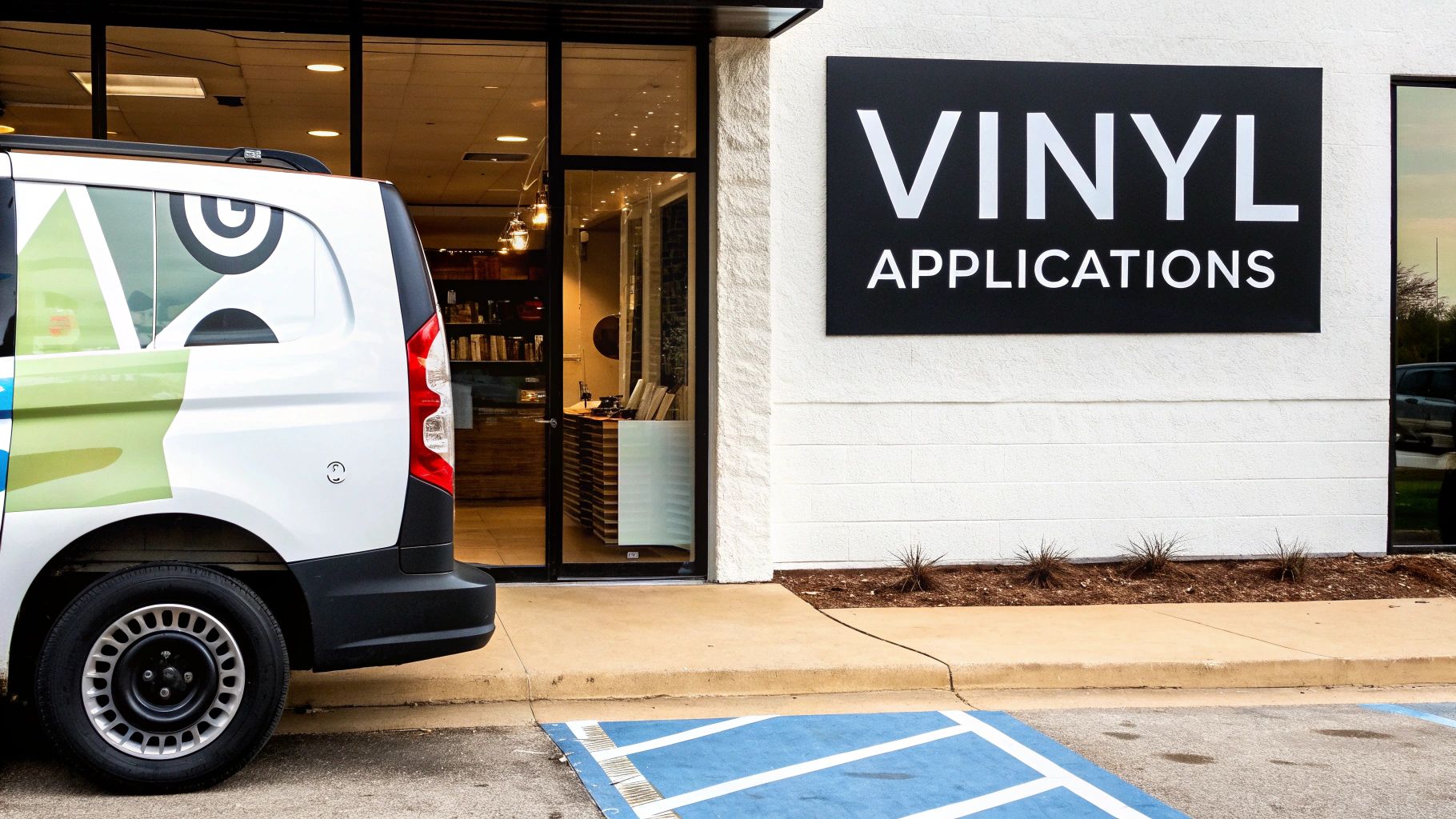
So, let's get specific and look at how different businesses are putting vinyl to work.
Retail and Hospitality Solutions
If you run a customer-facing business, your two biggest challenges are getting people in the door and making their experience memorable. Vinyl graphics are a shopkeeper’s secret weapon for turning a window shopper into a paying customer.
- Vibrant Window Displays: Why have a plain glass window when you can have a billboard? Full-color printed vinyl can transform your storefront to shout about your latest sale, a seasonal special, or just your brand's personality. Perforated vinyl is a fantastic choice here, giving you stunning graphics on the outside without sacrificing the natural light and view from inside.
- Promotional Floor Decals: Lead the way! Durable, anti-slip floor graphics can guide customers straight to a clearance rack, highlight a new product line, or simply reinforce your brand with every step they take.
- Point-of-Sale (POS) Graphics: Use smaller, strategically placed cut-vinyl decals at the checkout counter to promote your loyalty program or spark a last-minute impulse buy. It's a small touch that makes a big difference.
For restaurants and cafés, vinyl wall graphics and even menus are a game-changer. They look great, enhance the atmosphere, and are incredibly easy to wipe clean after a busy day.
Mobile Advertising for Service Businesses
Is your business always on the go? If you’re a plumber, electrician, landscaper, or contractor, that plain white van in your driveway is a huge missed opportunity. It's a blank canvas waiting to become your best marketing tool.
A single vehicle wrap can generate between 30,000 to 70,000 impressions per day, depending on where you drive. It turns a work vehicle into a 24/7 mobile billboard, building local brand recognition every time you head to a job or stop for gas.
When you break it down, vehicle wraps have one of the lowest costs-per-impression of almost any advertising you can buy. Whether it's a simple, clean logo and phone number in cut vinyl or a full, head-turning printed wrap, you're actively marketing your services to the very people in your community who need them.
Professional Office and Corporate Branding
Vinyl has a powerful role to play inside the office, too. It’s a fantastic way to shape company culture and create a more professional, welcoming environment for your team and visiting clients. A generic, beige office doesn't do much to inspire anyone.
- Lobby and Reception Areas: Make that first impression count. A large, precision-cut vinyl logo on the wall behind your reception desk looks sharp and instantly establishes your brand.
- Branded Glass Walls: Add a touch of class and privacy to glass conference rooms with frosted or etched vinyl. You can subtly incorporate your logo or other brand patterns for a high-end look without the high-end cost.
- Inspirational Wall Murals: Got a company mission statement or a set of core values? Put them on the wall! A full-wall printed mural in a breakroom or common area is a constant, visible reminder of what your company stands for.
These applications make your workspace feel more cohesive and engaging, all without the mess, cost, and commitment of a full renovation.
AEC and Healthcare Applications
In more specialized fields, vinyl steps in to solve very specific problems. For Architecture, Engineering, and Construction (AEC) firms, clear, tough signage isn't just nice to have—it's a critical part of a safe and efficient job site.
- Durable Worksite Signage: Weather-resistant vinyl banners and signs are perfect for marking safety zones, displaying project renderings, and identifying different contractors on-site. They can take a beating and still look professional.
- Hard Hat and Equipment Decals: Custom vinyl stickers are the go-to for branding tools, machinery, and hard hats, making sure everyone and everything is easily identifiable.
In healthcare, where cleanliness and clear communication are non-negotiable, vinyl is the perfect material. Because it's non-porous and easy to sanitize, it’s used everywhere from wayfinding graphics that help patients navigate confusing hospital corridors to informational decals that can be wiped down to maintain a sterile environment.
4. Preparing Your Design Files for Flawless Printing
A brilliant idea for a vinyl graphic can fall flat if the digital file isn’t set up correctly. Think of your design file as the architectural blueprint for your project; a small error in the plan can cause a big headache in the final build. A few simple pre-flight checks are all it takes to make sure your vision comes to life exactly as you imagined, saving you time, money, and frustration.
This entire process starts with understanding the two basic kinds of image files: vector and raster. Honestly, getting this one thing right is probably the most critical step toward getting a professional-looking vinyl print.
Vector vs. Raster: The Foundation of a Great Print
Imagine a simple digital circle. If that circle is in a raster file (like a JPG or PNG), it's really just a grid of thousands of tiny colored squares, called pixels. When you try to blow up that image for a big sign, all you're doing is making those squares bigger. The result? A blurry, jagged, pixelated mess. Raster files are perfect for photographs, but they’re a disaster for graphics that need to be scaled up.
Now, a vector file (like an AI, EPS, or SVG) creates that same circle using math. It doesn't see pixels at all; it sees points connected by lines and curves. Because of this, you can stretch a vector graphic to any size imaginable—from a tiny product sticker to a massive building wrap—and it will stay perfectly sharp and clean every single time.
For any logos, text, or illustrations you plan to use in vinyl printing, vector files are an absolute must. They are the only way to guarantee your brand looks crisp and professional, no matter how big the final graphic is.
Key Steps for a Print-Ready File
Once you've got your vector graphics sorted out, there are just a few more technical details to nail down. They might sound a bit like jargon, but they’re essential for a smooth and accurate production run.
Convert All Text to Outlines: Your computer has a whole library of fonts installed, but there's no guarantee our printing systems have the exact same ones. When you convert text to outlines (or curves), you’re basically turning the letters into permanent vector shapes. This locks in your chosen font, so it prints exactly as you see it on your screen, with no weird font substitutions.
Set Up a Proper Bleed: Does your design have color or an image that runs right to the very edge? If so, you need to add a "bleed." This just means extending that background color or image about 1/8 of an inch past the final trim line. That little bit of extra space acts as a safety margin, preventing any ugly unprinted white slivers from showing up after we cut the vinyl to its final size.
Use CMYK Color Mode: The screen you're looking at creates color with light, using the RGB (Red, Green, Blue) model. Professional printers, however, create color with ink, using the CMYK (Cyan, Magenta, Yellow, Key/Black) model. Before you send your file, converting it to CMYK helps ensure the colors you see on screen are a much closer match to what will actually be printed, avoiding any nasty surprises with color shifts.
We've put together a handy checklist to walk you through these final steps. Following this before you submit your files is the best way to ensure a perfect print every time.
Print-Ready File Checklist
| Checklist Item | Why It's Important | Recommended Format/Setting |
|---|
| Use Vector Files | Guarantees graphics stay sharp and clear at any size, preventing pixelation. | AI, EPS, PDF (vector-based), or SVG |
| Convert Text to Outlines | Locks in your font choice so it doesn't change during printing. | In your design software, select text and choose "Create Outlines" or "Convert to Curves." |
| Embed All Images | Ensures linked images (like photos in a larger design) are included in the file. | Check your software’s "Links" panel and select "Embed Image." |
| Add a Bleed | Prevents unprinted white edges on designs that go to the edge of the vinyl. | Extend your background 1/8" (.125 in) beyond the final cut line on all sides. |
| Set to CMYK Color | Provides a more accurate preview of how your colors will look when printed with ink. | Change your document’s color mode from RGB to CMYK. |
| High-Resolution Rasters | If you must use a raster image (like a photo), it needs to be high quality. | 300 DPI (dots per inch) at the final intended print size. |
Taking a few minutes to run through this list is like doing one last quality check before production begins. Of course, if you get stuck, the team here at Camelot Print & Copy Centers is always ready to help review your files and make sure they’re optimized for a fantastic result.
5. Getting It Done Right: Why a Professional Partner is Your Secret Weapon
Knowing what vinyl can do is one thing, but actually turning that idea into a finished product is where the magic happens. While the DIY route can seem like a good way to save a few bucks, partnering with a professional print shop is the only way to guarantee a result that looks truly polished and lasts.
Think of it like this: anyone can buy a can of paint, but it takes a pro to get those perfectly clean lines and a finish that doesn't chip in a year. The difference is immediately obvious. A professional printer brings specialized equipment, premium materials, and years of hands-on experience to the table, ensuring your colors are vibrant, your details are sharp, and your graphics can stand up to whatever the world throws at them.
What to Expect When You Work With Us
We’ve seen it all, and we've built our process to be as straightforward and collaborative as possible. You don't need to be a vinyl expert—that's what we're here for. Our goal is to guide you through the options and make sure the final product is exactly what you envisioned.
Here’s a quick look at how we get it done:
The Initial Chat: We'll start with a simple conversation about what you want to accomplish. We’ll talk about your goals, where the final product will live, and any design ideas you have. This helps us point you toward the right materials and printing methods for your specific needs and budget.
File Check & Proofing: Once you have a design, our team will give it a thorough once-over. We check for things like image resolution and color setup to make sure it will print beautifully. Before we print a single inch, you’ll get a digital proof to approve, so you know exactly what you’re getting.
Printing & Production: After you give us the green light, our production team takes over. Using top-of-the-line printing and cutting equipment, we bring your graphics to life with an almost obsessive focus on detail.
Finishing Touches: Finally, we'll finish your project—adding laminate for protection, cutting it to shape, and getting it ready for pickup or delivery right here in the Capital Region.
The Real Value of a Print Partner
Choosing the right printer is one of the most important decisions you'll make. A great partner does more than just hit "print"; they're an advisor who can help you sidestep common mistakes and get the most bang for your buck. They’re the ones who know which material will perfectly hug the curves of a vehicle wrap and which laminate will keep a window graphic from fading in the summer sun.
A professional print shop isn't just another vendor; they're an extension of your marketing team. Their expertise ensures your brand is represented with the quality and consistency it deserves, turning a good idea into a great result.
When you work with a team like Camelot Print & Copy Centers, you're tapping into decades of real-world knowledge. We take care of all the technical details so you can stay focused on what you do best—running your business.
Ready to see what we can create together? Let's talk about your project.
Your Vinyl Printing Questions, Answered
When you're thinking about using vinyl for a project, it’s natural to have a few questions. Getting the right answers upfront is the key to making sure your project looks fantastic and meets your expectations. Let's walk through some of the most common things we get asked by businesses diving into the world of vinyl.
How Long Does Vinyl Printing Last?
That really comes down to two things: the type of vinyl we use and where it's going to live. If you're putting a graphic indoors, like a logo on your lobby wall, it’s going to look great for years and years without any trouble.
Outdoor projects are a different story. A top-of-the-line cast vinyl wrap on a company truck, finished with a protective laminate, can easily last up to 10 years. On the other hand, if you're using a more budget-friendly calendared vinyl for a short-term sale banner, you can expect it to hold up for one to three years before the sun and weather start to take their toll.
The bottom line is this: matching the right material to the right job is the most critical decision for ensuring your graphic lasts. A quality vinyl, installed by an expert, is a powerful, long-term investment in your brand's visibility.
Is Vinyl Printing Waterproof?
Yes, 100%. The vinyl material itself and the specialized inks we use are built to be completely waterproof and weather-resistant. It’s exactly why vinyl is the perfect choice for things that live outside—think vehicle wraps, outdoor banners, and storefront window graphics that have to stand up to rain, snow, and humidity.
For an extra layer of defense against moisture, UV rays, and even minor scratches, we almost always recommend adding a clear laminate over outdoor graphics.
Can Vinyl Graphics Be Removed?
They sure can, and that's one of vinyl's biggest perks. Unlike a permanent paint job, a vinyl graphic can be removed without harming the surface underneath, as long as it was applied to a clean, solid surface in the first place.
While you can do it yourself, we usually suggest professional removal for bigger jobs like a full vehicle wrap. We use a bit of heat to gently soften the adhesive, which lets the vinyl peel away cleanly. This leaves your surface looking good as new and ready for its next design.
Ready to turn your vision into a high-impact reality? The team at Camelot Print & Copy Centers is here to guide you through every step of the vinyl printing process, from choosing the right material to flawless production. Get in touch with us today to start your project