Ever wonder how companies create those perfectly shaped custom boxes, intricate wedding invitations, or unique promotional flyers? The secret isn't a team of people with scissors and a whole lot of patience. It's a process called die cutting.
Think of it like a cookie cutter, but for paper and other materials. A sharp, custom-shaped blade—the "die"—is used to cut a specific shape out of a sheet of paper, cardstock, or even vinyl. It’s the go-to method for breaking free from the standard rectangles and squares of traditional printing.
Beyond the Rectangle: What Die Cutting Actually Is
At its heart, die cutting solves a fundamental problem: How do you create thousands of identical, complex shapes quickly and perfectly? A standard paper guillotine is great for straight lines, but it's useless for curves, windows, or custom silhouettes. That's where die cutting shines. It automates the cutting process, delivering precision and speed that manual cutting could never match.
The process itself is straightforward. A custom-made steel die is pressed into the material with enough force to slice through it cleanly. This simple action can transform a flat, printed sheet into something far more interesting—a pocket folder with a unique flap, a business card shaped like a company logo, or a product box with a clear window.
Key Components of the Process
Breaking down the process into its core parts makes it much easier to understand how a digital design becomes a physical object.
The Die: This is the star of the show. It’s a sharp steel blade, carefully bent into the exact shape needed for the cut, then mounted on a sturdy wooden base.
The Material: While we often think of paper and cardstock, die cutting is incredibly versatile. It can handle everything from adhesive vinyl and corrugated cardboard to thin plastics and textiles.
The Press: This is the muscle. The press is a machine that applies thousands of pounds of even pressure, forcing the die through the material to create a crisp, perfect cut every single time.
Die cutting is all about precision and consistency. It ensures that the first piece off the press is an exact replica of the ten-thousandth. This uniformity is absolutely critical for branding, especially in packaging and marketing materials where every item needs to look identical.
The impact of this technology is massive. Die cutting is a cornerstone of modern packaging and print production. In fact, the global automatic die-cutter market is projected to hit $2.5 billion by 2025, fueled by the booming demand for custom labels and packaging. You can read more about the growth of this technology and its market trends.
To boil it all down, here’s a quick look at the main ideas.
Die Cutting at a Glance
This table breaks down the essential components of die cutting into simple terms.
| Concept | Simple Explanation | Common Example |
|---|
| The Die | A sharp, custom-shaped "cookie cutter" for paper. | A heart-shaped die for Valentine's cards. |
| The Press | A machine that stamps the die onto the material. | The machine creating custom pocket folders. |
| Dieline | The digital blueprint that guides the die's shape. | An Adobe Illustrator file showing cut lines. |
With these three elements working together, printers can produce an incredible variety of custom-shaped materials efficiently and accurately.
How a Design Becomes a Custom Shape
Every custom-shaped product you see, from a uniquely shaped business card to an elaborate product box, starts its journey as a simple line on a computer screen. This digital blueprint is called a dieline, and it’s the most critical piece of the entire die-cutting puzzle. It’s a precise vector path that dictates exactly where the machine will cut, crease, or perforate the paper.
Think of it like a pattern for a master tailor. Before a single piece of fabric is cut, the tailor meticulously draws out every shape. The dieline does the same thing for your printed piece, mapping out its final silhouette with absolute precision before any physical work begins.
From Digital Blueprint to Physical Die
Once the dieline is finalized and approved, it’s sent off to a specialist who builds the physical die. For most printing projects, this means creating a steel-rule die. It's a fascinating process where sharp steel ribbons are bent—either by hand or with a machine—to perfectly match every single curve and angle of the dieline.
These custom-bent steel rules are then set into a sturdy wooden board, usually a high-grade plywood. The result is a tool that looks a lot like a very sharp, industrial-strength cookie cutter. This die is the crucial link that translates the digital design into a tangible tool ready for the production floor.
This diagram breaks down the simple three-step flow, from the initial design concept to the finished, custom-cut product.
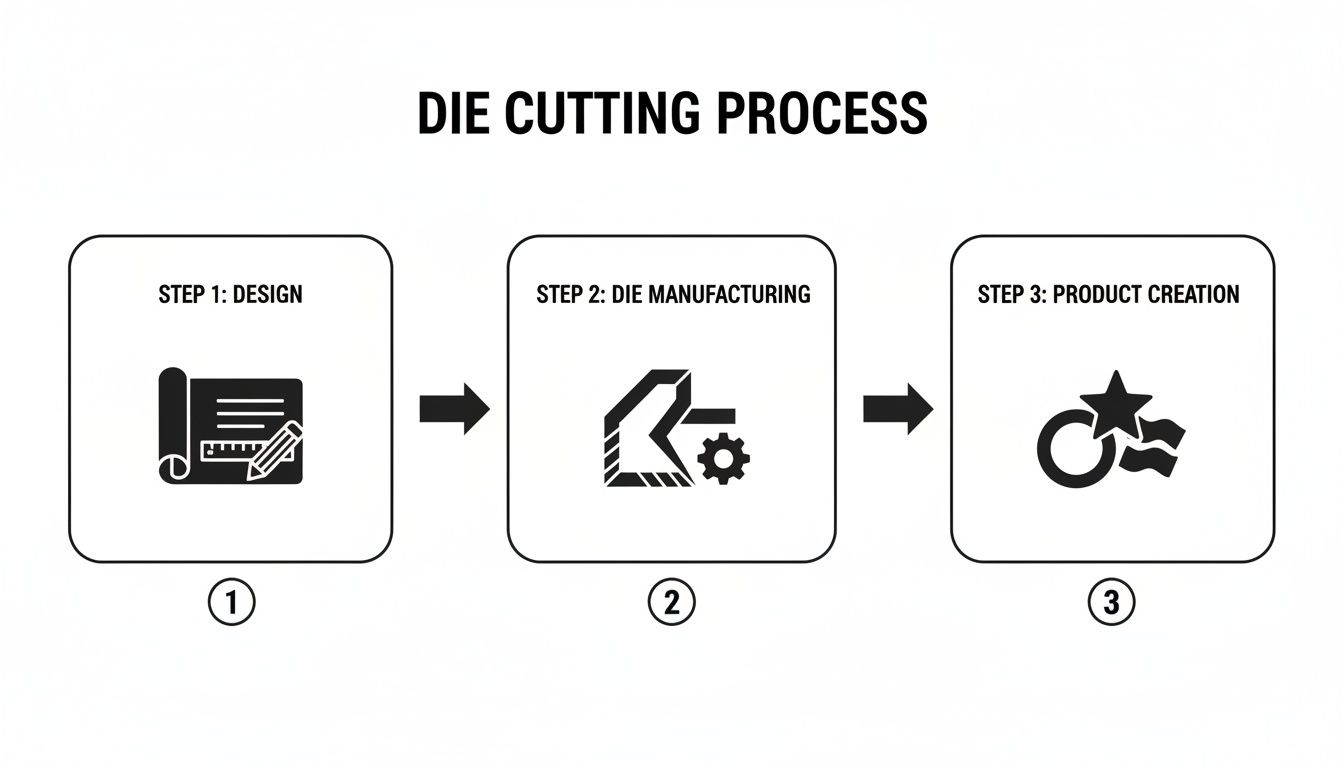
As you can see, a precise digital plan is the foundation for manufacturing the physical tool that ultimately brings the custom shape to life.
The Action on the Production Floor
With the custom die built, it's time to head to the press. Here, sheets of your chosen material—which have already been printed with your graphics—are fed into a die-cutting machine. The steel-rule die is mounted inside, carefully positioned to align perfectly with the printed artwork on each sheet.
The machine then applies an immense amount of even pressure, stamping the die onto the sheet. This force drives the sharp steel rules clean through the material, cutting out the shape with crisp, professional edges. Any excess material, called the "matrix," is then stripped away, leaving behind the perfectly formed final pieces.
The real magic of die cutting is its incredible consistency. Whether we're producing 100 custom pocket folders or 10,000 product boxes, the process ensures every single piece is an identical match to the original dieline. It’s all about guaranteeing brand consistency at scale.
Understanding Die Cutting Machinery
Not all die-cutting machines are created equal. In the world of commercial printing, you’ll mainly encounter two types: flatbed and rotary cutters. Each one is a specialist, suited for different kinds of jobs.
Flatbed Die Cutters: Picture a powerful stamping press. The die is laid flat, and the machine presses it straight down onto the material. This method offers exceptional precision, making it perfect for thicker stocks and shorter-to-medium production runs. Think custom packaging, presentation folders, and intricate designs.
Rotary Die Cutters: Now, imagine a high-speed industrial rolling pin. The die is actually a curved cylinder that rolls over the material as it zips through the machine. This continuous motion is incredibly fast, which is why rotary cutters are the workhorses for high-volume jobs like labels and stickers, where millions of cuts are needed in a hurry.
Each machine gives us a different advantage, allowing a good printer to select the right tool for the job based on the project's complexity, the material being used, and the sheer volume required. This flexibility is what makes die cutting such a versatile and powerful tool in printing.
The Tools and Materials of Die Cutting
To really get what die cutting is all about, you need to look at the two key players: the die itself and the material it's cutting. Think of it as a partnership. A great die paired with the right material is what makes creating custom shapes not just possible, but clean and efficient.

The die is the custom-made tool that does the actual cutting. While there are a few different kinds out there, commercial printing jobs almost always use one of two main types. Each one is built for a different kind of job, striking a unique balance between speed, cost, and complexity.
The Two Primary Die Types
The most common tool you'll encounter is the steel-rule die. This is the trusty workhorse for most custom marketing pieces and packaging. It’s made by bending sharp steel blades into a specific shape and then setting them into a flat wooden base. This type hits the sweet spot between precision and cost-effectiveness, making it perfect for short-to-medium production runs.
At the other end of the scale, you have the rotary die. This is a heavy-duty cylindrical die used for high-speed, massive-volume jobs—think millions of product labels or stickers flying off a production line. Rotary dies are much more expensive to make upfront, but they operate at a speed that flatbed dies just can't match.
Choosing the right die is a strategic decision. A steel-rule die is perfect for 1,000 custom presentation folders, but a rotary die is the only practical choice for a run of 5 million bottle labels. It's about matching the tool to the scale of the job.
So, how do you decide which one is right for your project? This table breaks down the key differences to help you see where each one shines.
Comparison of Common Die Types
The choice between a flatbed (steel-rule) die and a rotary die really comes down to the specifics of your project—namely, how many you need and how complex the shape is.
| Die Type | Best For | Speed | Cost |
|---|
| Steel-Rule Die | Custom packaging, folders, intricate shapes, and lower-volume jobs. | Slower to moderate | Lower initial die cost. |
| Rotary Die | Labels, stickers, and extremely high-volume production runs. | Very fast | Higher initial die cost. |
Ultimately, a good printer will guide you, but understanding these basics helps you know what's possible and what makes the most sense for your budget and timeline.
Materials Far Beyond Paper
One of the best things about die cutting is just how many different materials it can handle. Sure, paper and cardstock are the usual suspects, but the process is way more versatile than that. This opens up a ton of creative doors for businesses.
Here are just a few of the materials that can be die cut:
Corrugated Cardboard: This is how you get sturdy, custom-shaped shipping boxes and product packaging that protect items in transit.
Adhesive Vinyl: The go-to for custom stickers and decals, letting brands create shapes that perfectly outline their logos or designs.
Magnetic Sheets: Ever wonder how car magnets and shaped refrigerator promos are made? This is it.
Thin Plastics: Often used for creating unique product overlays, durable tags, or custom stencils that need to hold up over time.
This flexibility means a business can use a consistent and unique branded shape across a huge variety of items, from paper mailers to rugged product boxes.
How Die Cutting Shapes Brand Experiences
When you get down to it, die cutting is about so much more than just cutting paper. It's a way to create a physical, memorable interaction with your brand. Think about it: a custom shape can take a simple piece of marketing from something people glance at to something they actually feel and remember. It's the difference between a functional object and a tactile experience.

You see this most clearly in product packaging. A cleverly placed window on a box gives a sneak peek of what’s inside, building anticipation. Custom inserts that hold products perfectly in place? That creates a premium unboxing experience that screams quality before your customer even touches the product itself.
Standing Out in a Crowded Market
Imagine a pile of business cards on a table. Amidst all the standard rectangles, one shaped like a company’s logo or a key product is going to get picked up first. Every single time. That same idea applies to pretty much any printed material you can think of. Die cutting is your ticket to breaking free from the boring and predictable.
Here are a few ways this plays out in the real world:
Presentation Folders: Ditch the standard square pocket. A die-cut folder could have a curved flap or a cutout that strategically reveals a headline from the documents tucked inside.
Door Hangers: A landscaping company could have a door hanger cut into the shape of a leaf. It’s instantly recognizable and far more likely to be kept.
Business Cards: A coffee shop might use a card shaped like a coffee cup, while a real estate agent could use one that looks like a house key. Simple, but incredibly effective.
Each of these examples uses shape to reinforce the brand's identity and make an impression that a plain old rectangle just can't compete with.
The goal of die cutting in marketing isn't just to be different; it's to be memorable. The unique shape acts as a physical hook that helps a brand’s message stick in the customer's mind long after the initial interaction.
Labels and Stickers That Fit Perfectly
Die cutting also means your labels and stickers don't have to be stuck in boring circles and squares. Brands can create decals that precisely trace the outline of a logo or an illustration. This gives a clean, high-end look that feels integrated with whatever it’s stuck on, rather than just slapped on top.
The possibilities are endless, from product labels on boutique jars to promotional stickers handed out at trade shows. It’s a subtle but powerful way to keep your branding consistent everywhere. The packaging industry, in particular, has exploded with this capability, now making up 41% of all die-cutting applications, a trend fueled heavily by the demands of e-commerce. You can explore more data on the die cutting machine market to see just how big its global impact has become.
When Does Die Cutting Make Sense for Your Project?
So, how do you know if die cutting is the right move for your project? It comes down to weighing its powerful advantages against a few practical considerations. While it’s not the perfect fit for every single job, when the stars align, the results are simply stunning. Die cutting truly shines when precision and consistency are absolute must-haves.
The biggest win here is its incredible accuracy. Imagine cutting out a thousand custom-shaped labels or boxes. With a die, the first one and the last one will be identical twins. This kind of uniformity is essential for professional packaging, branded marketing materials, and any other project where even a tiny mistake would stick out like a sore thumb. Plus, it unlocks a level of creativity that a standard paper cutter could only dream of, letting you bring complex and intricate shapes to life.
The Trade-offs of a Custom Die
Now for the practical side. The creative freedom is amazing, but die cutting does involve an initial setup cost. A custom steel-rule die has to be made specifically for your design, and that’s a one-time investment. For a tiny, one-off project, that upfront expense might feel a little steep. If you just need a handful of custom pieces, the cost-per-item can be high.
But here’s the key: that die is yours to keep and reuse. Once you move into larger quantities or plan on reordering the same design down the road, that initial investment starts to look a lot better. The cost per piece drops dramatically as the order size grows, making it an incredibly efficient method for medium-to-large runs.
Think of it this way: for a small, one-time order, a custom die might be a splurge. But for a signature product line that you'll order again and again, it's an essential—and highly cost-effective—investment in your brand's quality and consistency.
This process is a cornerstone of the modern economy, especially when it comes to packaging. Driven by the e-commerce boom, the market for die-cut boxes was valued at USD 7.94 billion in 2025 and is expected to hit USD 12.09 billion by 2034. You can dig into the numbers in this in-depth market analysis on die-cut boxes.
A Few Design Considerations
It’s also good to keep a few minor design constraints in mind. While die cutting can handle some seriously impressive detail, it does have its limits. Designs with super thin, fragile lines or tiny, isolated pieces might not survive the cutting process or stand up to handling afterward. Really sharp internal corners can also be tricky to get just right.
This is where working with a good print partner makes all the difference. We can look at your design and spot any potential trouble areas, suggesting small tweaks to make sure your final product is both beautiful and sturdy. A little expert advice upfront can guarantee a flawless result.
Bringing Your Custom Die Cut Project to Life
Alright, you've seen what die cutting can do. Now, how do you actually make it happen for your own project? It all comes down to one critical element: the dieline file.
Think of the dieline as the blueprint for your finished piece. It’s a vector-based map that tells our cutting equipment exactly where to make the slice, ensuring the final shape is a perfect match for what you designed.
Creating a dieline isn't as intimidating as it might sound. You'll simply draw the exact cutting path in your design software. This single line is the foundation of the entire job, guiding the machine to create that unique shape you're after.
Preparing Your File for a Perfect Cut
To get that crisp, clean cut you’re picturing, a few small technical details in your file setup make all the difference. Nailing this part of the process helps us avoid delays and guarantees the kind of precision you expect from a professional print job.
Here are a few simple tips that our prepress team always looks for:
Use a Spot Color: Create a new, unique spot color swatch in your design file and name it something obvious, like "Dieline." This keeps it completely separate from the colors you actually want to print.
Set to Overprint: In your program’s settings, make sure the dieline is set to "overprint." This is a crucial step that prevents it from accidentally creating a white gap or "knockout" in the design underneath it.
Closed Paths are a Must: The line you draw for the cut must be a single, continuous, closed shape. If there are any gaps in the path, the machine won't know where to go and will stop, leaving you with an incomplete cut.
The quality of your dieline directly translates to the quality of the final cut. A clean, precise file is the single most important factor in getting a professional product that looks exactly how you imagined it.
At Camelot Print & Copy Centers, we've seen it all. We take the guesswork out of the equation by having our experienced team review every file. We'll catch potential issues before they ever become problems on the press, making sure your project runs smoothly from start to finish.
Partner with Camelot for Your Next Project
We genuinely love bringing creative ideas to life with our die cutting services. Whether you're thinking of custom pocket folders, business cards that break the rectangular mold, or intricate marketing materials that grab attention, we have the tools and the know-how to deliver. Our team is here to help you create printed pieces that truly stand out.
Ready to get started? Let’s talk. Consult with one of our experts today, and we'll help turn your design into a beautifully finished product.
Answering Your Die Cutting Questions
Even after getting the basics down, a few specific questions always seem to pop up. Let's tackle the most common ones we hear from clients.
What's the Difference Between Die Cutting and Kiss Cutting?
Think of die cutting like using a cookie cutter on a single sheet of dough. The blade presses all the way through the paper or cardstock, creating a completely separate, shaped piece. This is how you get things like uniquely shaped business cards or custom pocket folders.
Kiss cutting, on the other hand, is all about a lighter touch. The blade just "kisses" the surface, slicing through the top layer (like a vinyl sticker) but leaving the backing paper perfectly intact. It’s the magic behind sticker sheets, allowing you to peel off individual designs without a fuss.
How Much Does Custom Die Cutting Cost?
The cost usually breaks down into two main parts: a one-time fee to create the custom metal die, plus a running cost for each piece that gets cut. The price for the die itself depends on how big and detailed your design is.
There's an upfront investment to make the die, but the great news is you can use it again and again for future print runs of the same design. This makes it incredibly cost-effective for larger jobs or repeat orders where consistency is everything.
Can You Die Cut Any Design?
Pretty much! But there are a few practical limits. Designs with super-fine, fragile details or sharp, tight inside corners can be tricky. They're not only difficult to cut cleanly, but the final product might not be very durable.
It’s always a good idea to steer clear of elements that are too delicate. A good print partner can look over your artwork and suggest small tweaks that will guarantee a clean cut and a sturdy final piece.
Ready to move beyond the standard rectangle and bring your unique shapes to life? The team at Camelot Print & Copy Centers has the experience to guide you through the die-cutting process and deliver results that truly stand out. Get in touch with us today to start your project!