You printed a short run of booklets for a meeting. The content looks great. The paper feels solid. Then the finishing step goes sideways.
Your office stapler jams, bends the staple legs outward, or leaves the pages loose. What should've been a polished booklet now looks homemade in the worst way.
At that point, book binding staples stop being a tiny detail and start becoming part of the product itself. The right staple, used with the right binding method, affects how your booklet opens, how long it holds together, and whether it feels professional in a client’s hands.
Small business owners run into this all the time with brochures, training packets, catalogs, menus, manuals, and spec books. The confusion usually starts with simple questions that aren’t simple at all. Do you saddle stitch or side stitch? How long should the staple legs be? When does a stapled booklet become too thick to be practical?
If you’re still shaping the piece itself, a good layout resource like this perfect Shopify booklet design template can help you think through page flow before you ever get to binding. Design and binding always affect each other.
Your Guide to Professional Staple Binding
A stapled booklet only looks easy when someone else has already made the hard choices.
Professional staple binding uses staples as structural fasteners, not as a quick office fix. The goal isn’t just to keep pages together. The goal is to create a booklet that opens cleanly, stacks neatly, survives handling, and matches the purpose of the document.
What book binding staples do
Think of a staple like the hinge hardware on a cabinet door. If the hardware is wrong, the door still attaches, but it sags, scrapes, or loosens over time.
Book binding staples work the same way. They need to match:
- The binding style you’re using
- The thickness of the finished piece
- The paper stock inside
- The way the booklet will be handled
A short event handout has different needs than an employee manual. A marketing booklet on glossy stock behaves differently from an AEC spec book that gets opened repeatedly on a job site.
Main takeaway: A staple is never just a staple once page count, fold style, cover stock, and lifespan enter the picture.
Why readers get tripped up
Many assume the paper is the hard part and the fastening is the easy part. In production, it’s often the opposite.
Common points of confusion include:
- Mistaking office stapling for booklet binding. They aren’t the same thing.
- Choosing staples by guesswork. If the legs are too short, they won’t clinch properly.
- Ignoring document lifespan. A booklet meant for quick distribution can use a different standard than one meant to stay in circulation for years.
That last point matters more than many guides admit. A stapled booklet can be the right answer for speed and presentation, but not every project should be optimized only for the day it’s printed.
Choosing Your Binding Method First
Before you choose staple size, choose how the pages will be fastened. That decision controls almost everything else.
Saddle stitching
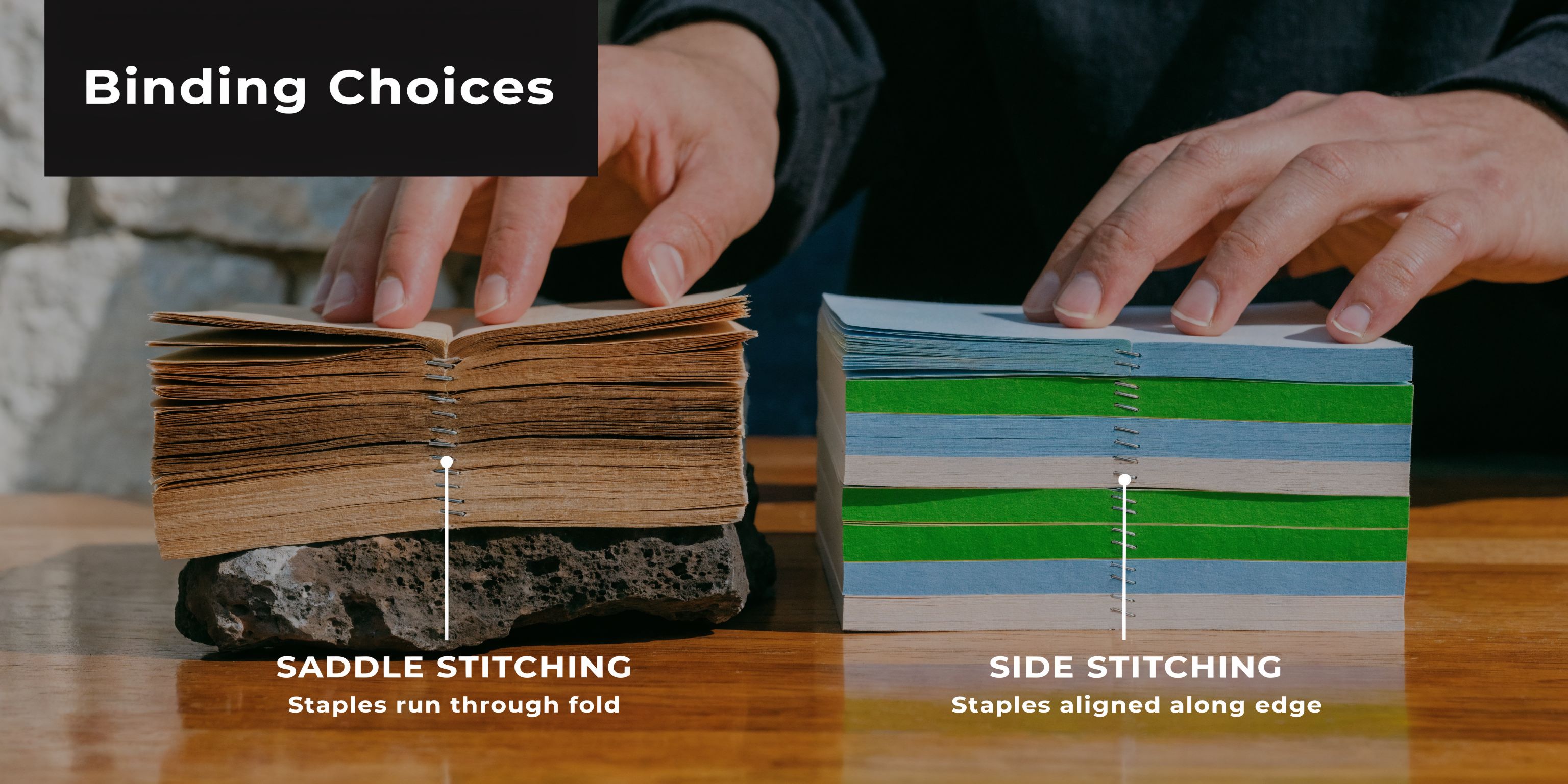
Saddle stitching means the sheets are folded, nested together, and stapled through the fold line at the spine. It’s the structure you see in magazines, event programs, and many product booklets.
This method works well when you want the piece to open naturally and feel like a booklet instead of a packet.
A useful way to think about it is this: saddle stitching is like building with a hinge at the center. The fold does part of the structural work, and the staples lock that fold in place.
According to this guide on how saddle stitch staples are formed from continuous wire rolls and why booklets are typically limited to 64 pages, the machine cuts each staple to size during production. That same source notes an industry limit of 64 pages for saddle-stitched booklets because staples eventually can’t pierce and clinch cleanly through thicker folded stacks. It also reports that using 26/8S galvanized wire on inline stitchers for 20 to 60 page manuals can reduce jamming by 40%, support 5,000+ units per hour, and keep defects under 1%.
Side stitching
Side stitching staples through the front cover and the full stack near the spine edge, rather than through a fold.
This is closer to a report format. It’s useful when the document is thicker, doesn’t need a folded spine, or is being treated more like a practical reference packet than a booklet.
The tradeoff is usability. Side-stitched pieces usually don’t open as gracefully as saddle-stitched ones.
Pick the foundation before the fastener
Think about binding method the way you’d think about a house foundation. You don’t choose the nails first. You decide what the structure has to do, then select the hardware that supports it.
Use saddle stitching when you want:
- A booklet feel
- A cleaner spine fold
- Better casual readability
Use side stitching when you need:
- A thicker stack
- A simple report format
- A more rigid edge fastening
If you want a broader comparison of formats, Camelot’s overview of booklet binding options is a helpful place to compare formats before locking in production specs.
Decoding Book Binding Staple Sizes and Types
The numbers stamped on staple boxes look cryptic until you know what they control.
The three parts that matter most
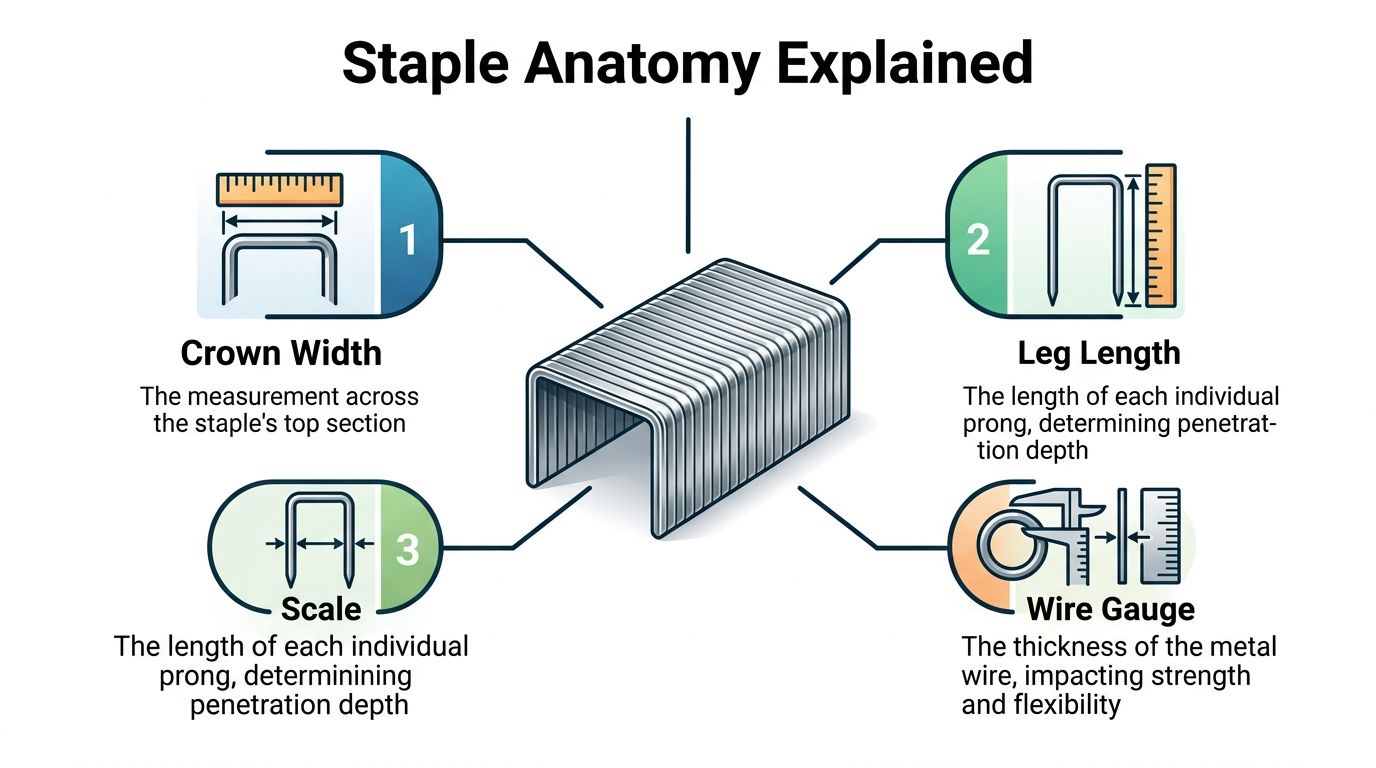
For book binding staples, focus on three specs:
- Crown width. The top bar of the staple.
- Leg length. How far each prong extends downward.
- Wire gauge. The thickness of the metal.
The easiest one to misunderstand is wire gauge. Lower gauge numbers mean thicker wire. It operates similarly to electrical cable names or drill bits, where the numbering doesn’t work as one might expect. Smaller number, beefier material.
Leg length is more intuitive. Longer legs let the staple pass through more paper. But longer isn’t always better. On thin stocks, an oversized staple can create messy clinching or tear the paper near the fold.
Why size affects the finished booklet
A staple has to do two jobs in sequence. First, it must penetrate the full paper stack. Then it must clinch, meaning the legs bend inward and lock.
If the legs are too short, the staple may enter the paper but fail to close correctly. That weakens the bind and creates snagging.
A heavy-duty stapler guide on choosing staple sizes for binding states that 23/13 staples with a 13mm leg are suitable for up to 100 sheets, while 23/24 staples with a 24mm leg can handle 200+ pages in side stapling. The same source says insufficient leg length can reduce tensile strength by 50%, and notes that galvanized or stainless 24/13S staples are useful in high-humidity storage because they resist oxidation.
When people say a staple “didn’t hold,” the root cause is often simple. The legs never had enough length to clinch correctly through the stack.
A practical reading of staple numbers
You’ll commonly see sizes such as 24/6, 26/8S, or 23/13.
Read them as shorthand, not mystery codes. In practical terms:
- The first number relates to wire thickness family
- The second number refers to leg length
- The suffix, when present, often points to a specific staple style or series
For many small business jobs, the decision is less about memorizing every code and more about matching staple behavior to document thickness.
Staple Selection Guide by Page Count
| Page Count | Recommended Staple Leg Length | Common Staple Size |
|---|
| Thin booklet | Short leg length | 24/6 |
| Mid-range booklet | Medium leg length | 26/8S |
| Thick side-stitched document | Longer leg length | 23/13 |
| Very thick side-stapled stack | Extra-long leg length | 23/24 |
This table is intentionally simple because paper weight changes the ideal staple choice. A slick coated stock and a bulky uncoated stock can behave very differently even at the same page count.
Standard clinch versus flatter finishing
You may also hear about flat-clinch staples. The idea is straightforward. Instead of leaving more raised metal on the back side, the clinched legs finish flatter against the paper stack.
That matters when you’re stacking manuals, filing legal packets, or shipping a lot of bound pieces in boxes. A flatter bind usually stores more cleanly and looks more deliberate.
For a broader grounding in terminology and finishing formats, this Camelot resource on book binding is worth bookmarking.
Matching Staples to Your Specific Project
The best way to understand staple choices is to walk through actual jobs.
A short glossy brochure
Start with a 16-page marketing brochure on glossy text stock.
This is classic saddle-stitch territory. The piece is short, visual, and meant to feel quick to handle. You want the spine fold to be clean and the pages to turn easily.
A shorter staple is usually the better fit here because the stack is light and the stock surface can show damage quickly if the staple is oversized. The wrong heavy staple can leave the brochure looking bruised at the fold.
A longer training manual
Now take a 64-page employee training manual on standard office-weight paper.
This is the upper edge of where many stapled booklet decisions get tense. It may still work as saddle stitching depending on stock and layout, but page creep becomes more noticeable and the bind needs more care.
Practical rule: The closer you get to the upper limit of a stapled booklet, the more finishing accuracy matters. Folding, stapling, and trimming all become less forgiving.
For a manual like this, you’d pay close attention to staple leg length, paper bulk, and how often staff will reopen the piece. If this manual will be used repeatedly at desks or in the field, a stapled format can work, but it needs to be chosen intentionally rather than by habit.
The awkward middle ground
Now consider a 90-page AEC spec book with a cardstock cover.
Many buyers encounter conflicting advice in this situation. It’s too thick for a comfortable “simple booklet” mindset, but it may still feel too short for some other binding formats. Existing guidance often leaves this zone fuzzy. One source discussing affordable binding options specifically points out the uncertainty in the 60 to 100 page range, including the example of a 500-copy run of a 75-page product catalog, and notes that factors like mailing and frequent handling are often left out of standard advice in this discussion of the mid-range binding gap.
For a 90-page spec book, I wouldn’t start by asking, “Can staples hold it?” I’d ask:
- Will this be mailed? Flexible spines matter.
- Will people flip through it constantly? Usability matters.
- Will it live for a long time? Durability matters.
- Does the cover stock add bulk? Thickness matters more than raw page count.
In many cases, side stitching or a different binding method becomes the smarter lifecycle choice.
Troubleshooting Common Staple Binding Issues
Binding problems usually leave visible clues. The trick is knowing what those clues mean.
When staples don’t penetrate cleanly
If the staple stops halfway, bends outward, or barely catches the inside sheets, look first at leg length and tool strength.
A common DIY mistake is asking an office stapler to do a production stapler’s job. The staple may be technically the right style, but the device doesn’t drive it with enough force.
Check these causes:
- Too-short staple legs for the thickness
- Weak stapler mechanism for the stack
- Poor alignment at the fold or edge
- Mixed paper stocks that create uneven resistance
When the staple closes badly
Sometimes the staple goes in, but the clinch is ugly. The legs may splay outward, stay partially open, or crush the inside sheet.
That usually points to setup problems, especially the clinching surface or anvil. It can also happen when the staple is too large for a relatively thin document.
Paper tearing near the spine often tells a similar story. The staple may be stronger than the paper needs.
When the booklet looks uneven
Thicker saddle-stitched pieces often show page creep, where inner sheets push outward more than outer sheets. That doesn’t always mean the staple is wrong. It may mean the booklet needed better planning for trimming or a different binding method entirely.
This walkthrough shows the production steps involved in getting the fold and staple placement right:
When short-term savings create long-term problems
The hardest issue to spot is lifespan.
Staple binding is often chosen because it’s efficient and affordable. That makes sense for many brochures, handouts, and shorter manuals. But long-term durability is less discussed than it should be. A preservation specialist cited in this article on the longevity questions around staple-bound books notes that stapled books may eventually need rebinding, especially when preserving the object long term matters.
That’s a serious consideration for legal documents, reference manuals, and spec books that need to stay intact over time.
Some projects are disposable by design. Others become records. The binding choice should reflect which one you’re producing.
When to Partner With a Professional Print Shop
There’s a point where DIY binding stops saving money and starts creating rework.
That tipping point usually arrives before people expect it. The piece may still be small enough to print in-house, but finishing consistency becomes the bottleneck. One batch closes neatly. The next batch shifts at the spine. A few copies trim cleanly. Others show uneven edges or exposed staple legs.
Why production equipment changes the outcome
Staples transformed print because they helped move binding from hand-sewn labor to scalable production. During the Industrial Revolution, that shift supported mass output, and by the late nineteenth century U.S. book production rose from 2,600 titles annually in 1869 to 4,500 by 1890, tied to advances in printing and binding technologies, as described in this history of how staples changed document and book production.
That history still matters because the core value hasn’t changed. The right machinery produces repeatable results at volume.
Professional finishing helps when you need:
- Consistency across the full run
- Clean trimming after stitching
- A better match between stock, page count, and binding method
- Fewer visible defects
The hidden cost of doing it yourself
Most DIY comparisons focus only on material cost. They skip the expensive parts:
- Wasted printed sheets from bad binds
- Staff time spent re-stapling or re-collating
- Brand damage when a leave-behind looks sloppy
- Decision risk in that awkward mid-range thickness zone
If your project needs to look polished in clients, inspectors, staff, or a court, production quality matters as much as the printed content. For businesses comparing finishing approaches, Camelot’s book binding services page gives a useful view of what professional options can cover.
Get Your Binding Right Every Time
Book binding staples look simple until you have to choose them for a real project.
The reliable decision path is short. Choose the binding method first. Accurately measure the document thickness. Match the staple to the paper and the way the piece will be used. That sequence prevents most of the common failures people blame on “bad staplers.”
The bigger insight is lifecycle thinking. A stapled booklet can be the right choice for a brochure, event handout, short catalog, or compact manual. But once the page count rises, the stock gets heavier, or the document needs to survive long-term handling, the best answer may not be the cheapest fastening method at the start.
If you’re making a small internal piece, you can absolutely use these principles to avoid guesswork. If the project is important, high volume, or headed into that 60 to 100 page gray area, it’s worth getting expert input before you print the whole run.
Frequently Asked Questions About Book Binding Staples
Can I use normal office staples for booklet binding
Sometimes, for very small and thin pieces. But office staples and office staplers usually aren’t built for thicker booklet work or clean center-fold fastening. That’s why short test runs can look acceptable while larger jobs start failing.
What’s the difference between booklet staples and regular staples
Booklet staples are chosen for binding performance, not just basic fastening. The differences usually involve leg length, wire thickness, and how the staple clinches through folded or thicker stacks.
Is saddle stitching the same as stapling
In casual conversation, people often treat them as the same thing. In production, saddle stitching specifically means stapling through the folded spine of nested sheets.
How do I know if my booklet is too thick for saddle stitching
Look at the full build, not just the page count. Paper weight, cover stock, and how the pages behave when folded all matter. If the booklet feels bulky at the fold or the inner pages push outward heavily, you may be past the comfortable range.
Are galvanized staples worth it
For documents that may sit in storage, face humidity, or use coated and laminated materials, they can be a smart choice. The goal is to reduce the chance of corrosion weakening the bind over time.
Will stapled booklets last for years
Some do, especially when they’re lightly handled. But if the document needs long-term durability or archival confidence, a stapled format may not be the best final choice.
How many staples should a booklet have
That depends on size and format. Small booklets often use fewer fastening points, while larger formats may need more support along the spine or edge to stay neat and secure.
If you’ve got manuals, marketing pieces, legal packets, catalogs, or spec books that need to look sharp and hold up in practical use, Camelot Print & Copy Centers can help you choose the right finish from the start. For a quote on your next project, contact the team here: https://www.camelotprintandcopy.us/contact-us