Direct mail postcards are one of the most powerful tools in a marketer's kit. They're a tangible, physical message that lands right in your customer's hands, cutting straight through the constant buzz of digital ads. It’s less like an ad and more like a personal invitation to connect with your brand.
Why Direct Mail Postcards Still Win
In a world where we're bombarded with notifications and pop-ups, you might wonder how a simple piece of cardstock still gets so much attention. It’s all about the physical connection. A postcard is something your customer can actually hold, touch, and feel—a multi-sensory experience that a digital ad just can't offer. Think of it as a friendly handshake waiting in the mailbox.
This tangible quality is what makes postcard marketing so effective. It’s not just another notification to swipe away; it's a real object that can sit on a counter or a desk, building brand recall and nudging customers to act.
The Power of a Physical Connection
A well-designed postcard feels personal and far less intrusive than an unsolicited email or an aggressive pop-up. It isn’t fighting for attention in a jam-packed inbox. Instead, it arrives in a much less crowded space—the mailbox—where your message has a real chance to be seen and considered.
This is exactly why direct mailing postcards are a staple for so many businesses. From the local pizzeria announcing a weekly special to a financial firm introducing a new service, they're a versatile and potent tool. Their appeal is simple: they deliver a clear, concise message that's hard to ignore. While direct mail is a star performer, it's often most powerful when integrated with complementary digital marketing strategies.
A postcard is more than just a piece of paper; it's a direct line to your customer's daily life. It sits on their kitchen counter or desk, serving as a constant, physical reminder of your brand and your offer.
A Proven and Growing Channel
The lasting power of postcards isn't just a gut feeling; the data backs it up. The global direct mail advertising market is on track to hit an incredible $74.46 billion by 2030. This growth shows just how much businesses rely on high-impact mailers.
Postcards are leading the charge as the most popular format, with a staggering 66% of U.S. marketers using them in their campaigns. It’s clear they remain a trusted and effective way to reach people. You can find more compelling stats on the growth of direct mail and its role today.
At Camelot Print & Copy Centers, we live and breathe this stuff. We can take your idea and turn it into a high-impact campaign that gets results, managing everything from the initial design and printing to the final postal prep. We make sure your message lands right where it needs to.
Ready to create a real connection with your audience? Get a quote from Camelot today and let us show you how simple and effective direct mail can be.
The Surprising ROI of Postcard Marketing Campaigns
In marketing, it's easy to get lost in a sea of clicks, impressions, and open rates. But what about the results that actually hit the bottom line? This is where direct mailing postcards really prove their worth, delivering a return on investment that frequently rivals—and often beats—digital channels. It's time to look past the vanity metrics and focus on what truly drives growth: response rates, conversions, and how much it costs to win a new customer.
For a lot of businesses, the idea of a physical mail campaign can feel a bit old-school. The data, however, tells a completely different story. In a world overflowing with digital noise, a well-planned postcard campaign is more than just an expense. It's a strategic investment that delivers tangible returns, builds real customer loyalty, and can give your market share a serious boost.
Unpacking the Financial Performance of Postcards
The real test of any marketing campaign is its financial performance. One of the most compelling reasons to choose direct mail postcards is how well they perform in the real world. While digital ads are often praised for their low cost-per-impression, direct mail is a champion at generating high-quality responses that turn into actual revenue.
When you mail postcards to your existing customer list, the results can be staggering. A standout statistic shows that direct mail to house lists achieves an incredible 161% ROI—the highest of any paid marketing channel. Even standard letter-sized mailers bring in a 112% ROI, outperforming SMS (102%) and email (93%). You can dive deeper into these insights on direct mail's powerful ROI to see just how effective it is.
This infographic breaks down which direct mail formats marketers prefer to use.
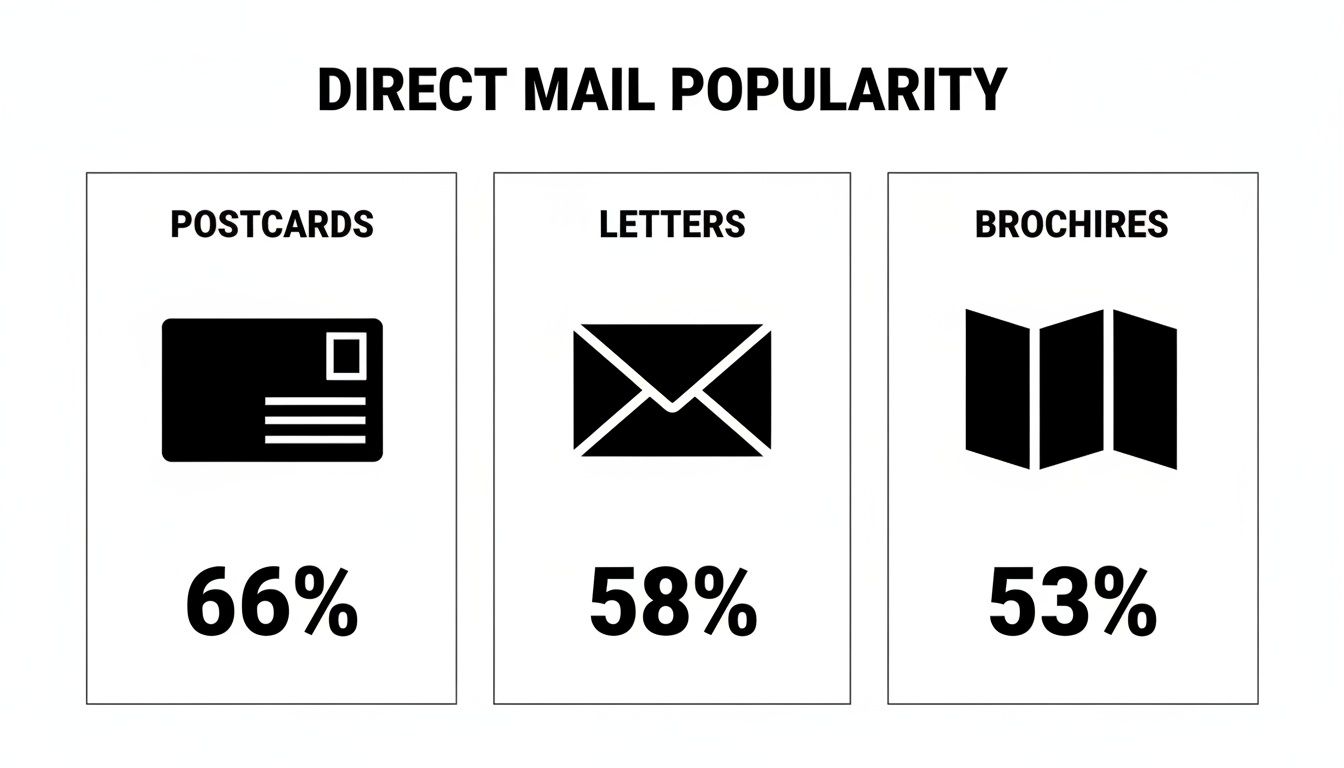
As you can see, postcards are the clear favorite. Most marketers lean on them for their quick, scannable format and immediate visual punch.
Why Postcards Drive Higher Engagement
So, what’s behind this impressive ROI? It all comes down to engagement. A digital ad is fleeting, but a postcard is a real, physical object. Someone has to pick it up, handle it, and look at it, even if just for a moment. That simple tactile experience forges a stronger mental connection and makes your brand far more memorable.
Here’s why that physical presence makes such a big difference:
- It Cuts Through the Clutter: The average office worker gets slammed with over 120 emails every single day. By contrast, most households only receive a couple of pieces of marketing mail daily. Your postcard has a much clearer path to getting noticed.
- It Builds Trust: People tend to see physical mail as more credible and trustworthy than digital messages, which are often dismissed as spam. This is a huge advantage for industries like finance, healthcare, and legal services, where building trust is everything.
- It Has a Longer Shelf Life: A postcard can live on a kitchen counter or get pinned to a bulletin board for weeks, serving as a constant reminder of your offer long after an email has been deleted and forgotten.
The real power of a postcard is its ability to command undivided attention. It lands directly in your customer’s hands, bypassing digital ad blockers and spam filters, making sure your message isn’t just delivered—it’s seen.
Measuring What Really Matters
To truly understand the ROI of a postcard campaign, you have to track the right things. While digital marketing is all about clicks and views, direct mail success is measured by real, tangible actions.
Here are the key performance indicators (KPIs) that show your campaign is working:
- Response Rate: Postcards have an average 5.7% response rate, which blows most digital channels out of the water. Even when mailing to a list of prospects, direct mail averages a 4.9% response—that’s 5 to 9 times higher than email, paid search, or social media.
- Conversion Rate: This metric tracks how many people took the action you wanted, whether it was making a purchase, booking an appointment, or redeeming a coupon online.
- Cost-Per-Acquisition (CPA): By calculating exactly how much you spent to land each new customer, you get a crystal-clear picture of your campaign's profitability.
When you focus on these concrete outcomes, it becomes obvious how direct mail postcards can be a powerful engine for profitable growth, helping you acquire and keep high-value customers.
Ready to see what kind of return a postcard campaign can deliver for your business? The team at Camelot Print & Copy Centers can help you design, print, and mail a campaign that gets real results. Contact us today to get a quote and start connecting with your audience in a meaningful way.
Designing Postcards That Actually Get a Response

Let's be honest, a great postcard does a lot more than just look pretty—it makes people do something. You’ve got about three seconds, the time it takes to walk from the mailbox to the recycling bin, to make your case. Forget generic advice; we're diving into the practical, proven strategies that turn a simple piece of cardstock into one of your hardest-working sales tools.
The whole point is to stop someone in their tracks. We want them to pause, read, and think, "Hmm, this is for me." That's achieved with a smart mix of eye-catching design, powerful images, and words that connect directly with what the reader needs.
Create a Powerful Visual Hierarchy
Think of your postcard as a super-quick conversation. You need to guide the reader’s eyes to the most important bits of information first, and in the right order. This is what we call visual hierarchy. A cluttered, messy design is just visual noise, and it gets tossed without a second thought.
A clean, effective hierarchy creates a clear path for the eye to follow:
- Headline: A big, bold statement that’s impossible to ignore.
- Image: A striking visual that backs up the headline and sparks an emotional connection.
- Offer: The can't-miss details about the value you're providing.
- Call-to-Action (CTA): A crystal-clear instruction telling them exactly what to do next.
You control where the eye goes by playing with size, color, and placement. Make your headline the hero, use a compelling photo to pull them in, and make sure your offer and CTA are dead simple to find. This structured approach makes your message easy to absorb in a single glance.
The Art of the Irresistible Headline and Offer
Your headline is your one shot to make a first impression. It has to be short, punchy, and focused on the benefit to the reader. Don't say "We Sell Premium Coffee." Instead, try something like, "Tired of Bitter Coffee? Taste the Difference." See? The second one hits on a common frustration and promises a better experience.
Once you’ve hooked them, your offer needs to deliver real, tangible value. Vague promises fall flat. Get specific, whether it's a dollar-amount discount, a free consultation, or exclusive early access.
A strong postcard offer isn't just a discount; it's a solution to a problem. It should feel like a special opportunity created just for the recipient, making it difficult to pass up.
This is where the magic really happens. A great headline paired with a specific, time-sensitive offer creates a sense of urgency that gets people off the fence and into action.
Introducing Variable Data Printing for Ultimate Personalization
Now, let’s talk about a true game-changer in the direct mail world: Variable Data Printing (VDP). At its core, VDP is a technology that lets you print thousands of unique postcards in a single run. It allows you to customize text, images, and even offers for every single person on your mailing list.
So, instead of a generic "Dear Resident," a postcard can arrive saying, "Hi Sarah, ready to save on your next project?" That tiny touch of personalization makes the recipient feel seen, not just marketed to, and it can dramatically boost how many people engage and respond.
But VDP goes way beyond just names. You can tailor offers based on a customer's purchase history, switch out images to reflect their specific neighborhood, or even include a personalized URL (PURL) that directs them to a custom-built landing page. It transforms your postcard from a mass advertisement into a genuine one-to-one conversation. We have a detailed guide that further explores the power of effective postcard printing techniques and how they drive results.
Creating a postcard that converts is both an art and a science. It takes thoughtful design, persuasive copy, and a clear call-to-action that makes it easy for people to take the next step. With these strategies—and the power of personalization—you can build a direct mail campaign that doesn’t just get noticed, it gets a real response.
Ready to design a postcard that truly works? The experts at Camelot Print & Copy Centers can help you craft a campaign that captures attention and drives action. Get a quote today to get started.
Targeting the Right Mailboxes for Maximum Impact
You could create the most beautiful, compelling postcard in the world, but if it lands in the wrong mailbox, it’s a total waste. It’s like trying to sell a premium steak dinner to a lifelong vegetarian. The same idea holds true for direct mailing postcards; your success depends entirely on reaching people who actually want what you're selling.
This is where your mailing list and smart audience targeting come in. They’re the strategic blueprint for any successful campaign, transforming your marketing from a shotgun blast into a laser-focused conversation. By zeroing in on the right people, you don't just get a better response—you make your marketing dollars work a whole lot smarter.
Your List: The Foundation of Your Campaign
At the heart of every great postcard campaign is the mailing list. You really have two main paths you can take: you can use your existing list of customers, or you can acquire a new, targeted list built from scratch. Each approach has a very different job to do.
Think of your own customer list as a goldmine. These are folks who already know your brand and have chosen to do business with you before. Sending them a postcard with a special offer or a company update is a brilliant way to drive repeat sales and build some serious customer loyalty.
On the other hand, acquired lists are your go-to tool for prospecting. You can rent or buy these lists from data specialists and filter them based on all sorts of criteria, letting you reach a brand-new audience that looks just like your ideal customer.
Below is a quick breakdown to help you decide which path makes the most sense for your next campaign.
Mailing List Options For Your Postcard Campaign
Ultimately, many businesses find success by using a mix of both. They nurture their existing customers while simultaneously reaching out to find new ones.
The Power of Sending the Right Message to the Right Person
Just having a list isn't the whole story. The real magic happens when you start segmenting it—breaking your audience down into smaller, more defined groups based on what they have in common. Instead of blasting one generic postcard to everyone, segmentation lets you fine-tune your message so it really connects with each group.
Here are the most common ways to slice and dice your audience:
- Geographic Targeting: This is a no-brainer for local businesses. You can mail to specific zip codes, neighborhoods, or even draw a radius around your location. A new coffee shop, for instance, might hit every single household within a two-mile radius.
- Demographic Targeting: This means sorting people by tangible traits like age, income, gender, or whether they have kids. A financial advisor might target households with a certain income, while a toy store would naturally focus on families with young children.
- Psychographic Targeting: This gets into the "why" behind people's decisions, looking at their interests, hobbies, and lifestyle choices. A travel company could build a list of people who have shown an interest in adventure travel or luxury cruises.
Segmentation transforms your campaign from a generic announcement into a personal invitation. It tells the recipient, "This offer was chosen specifically for you," which dramatically increases the likelihood of a positive response.
The real pros know how to layer these targeting methods for incredible precision. For example, an upscale restaurant could target high-income households (demographic) in a few specific affluent zip codes (geographic). This kind of focus is what separates a wildly successful postcard campaign from a pile of junk mail.
This data is also the fuel for making each postcard feel personal. You can learn more about how this works by checking out our guide on what variable data printing is and the technology behind it.
Keeping Your Data Clean is a Must
Finally, a mailing list is only as good as the information in it. People move, get married, and their data gets stale over time. That’s why data hygiene—the process of cleaning and updating your list—is absolutely critical.
Scrubbing your list regularly prevents you from wasting money on printing and postage for postcards sent to the wrong address. It ensures your message actually lands in the right hands, protecting your investment and maximizing your campaign's impact.
Ready to build a targeted list that gets real results? The team at Camelot Print & Copy Centers can help you acquire the perfect list for your business and keep it clean for maximum performance. Get in touch for a quote today and let's get started.
From Print to Post Office Without the Headaches
So, you've got your postcard design polished and the mailing list locked in. Now what? This is where the real magic happens, turning that digital file into a tangible piece of marketing that actually lands in someone's hands.
It’s easy to think this part is just about hitting "print," but there's a whole world of logistics that follows. Getting it right involves precise printing, professional finishing, and navigating the often-tricky postal system to make sure your message arrives looking great and on time. A full-service partner makes this entire process feel effortless.
Choosing the Right Materials and Finishes
First things first, let's get that design onto paper. The paper stock and finish you choose say a lot about your brand before the recipient even reads a word. A flimsy postcard feels cheap and disposable, but a thick, high-quality cardstock immediately signals professionalism and value.
Here's what to consider:
- Paper Stock: This is all about the paper's thickness and weight. You’ll want something sturdy, like a 14 pt. or 16 pt. cardstock. It not only has a more premium feel but also survives the journey through the postal system without getting mangled.
- Finishes and Coatings: Think of this as the final polish. A UV gloss coating makes colors vibrant and gives the card a slick, high-shine look. On the other hand, a matte finish provides a more modern, understated elegance.
These choices create a tactile experience that screens just can't replicate. If you want to get into the weeds of how different printing methods affect the final look, our guide on the differences between digital and offset printing is a great place to start.
Navigating Postal Preparation and Bulk Mail
Once your postcards are printed, you can't just drop them in a mailbox and call it a day—at least, not if you want to be cost-effective. To get the best postage rates, your mail has to be prepared according to strict United States Postal Service (USPS) rules. This is where you’ll hear terms like "bulk mail" and "indicia."
Bulk mail is essentially the USPS's way of giving you a discount for doing some of the sorting work for them. By presorting large quantities of mail by ZIP code, you save the post office time and money, and they pass those savings back to you. The catch? You need a special mailing permit to do it.
An indicia is that little printed box in the top-right corner that takes the place of a stamp. It’s a permit imprint that shows the USPS you've prepaid for postage, which is a must for sending mail at bulk rates.
Think of a professional mail house as an expert logistics team for your campaign. They handle the complex sorting, bundling, and paperwork required by the USPS, ensuring your direct mailing postcards qualify for the best postage rates and are delivered efficiently.
The Full-Service Advantage
Trying to manage printing, finishing, and postal compliance on your own can feel like a full-time job. A true full-service partner like Camelot Print & Copy Centers takes all of that off your plate. We guide you through picking the perfect paper, print your postcards beautifully, and make sure every single piece meets USPS regulations for a smooth, headache-free delivery.
In a world of overflowing inboxes, the physical nature of a postcard has never been more powerful. The resurgence of direct mail post-pandemic isn't an accident; it's a trusted channel. Most households receive just 1-2 marketing pieces daily compared to hundreds of emails a week. That means your message gets noticed.
We handle the entire workflow from start to finish, saving you time, money, and stress. You get to focus on running your business, knowing your direct mail campaign is in expert hands.
Ready to launch a direct mail postcard campaign without the logistical stress? Contact Camelot Print & Copy Centers for a quote today!
How to Measure and Improve Your Campaign Success
So, you've sent out a beautiful batch of postcards. Now what? How do you actually know if they worked? A great campaign isn’t just about getting mail into hands; it’s about getting a measurable return on that effort. Tracking your results is the only way to prove the value of your spend and find out exactly what you need to do to make the next campaign even stronger.
The trick is to build your tracking right into the postcard itself. This creates a clear, undeniable bridge between the physical mailer sitting on someone's counter and the digital (or in-person) action you want them to take. If you don't build that bridge, you're just guessing at what drove your sales.
Essential Tracking Methods for Postcards
Making your direct mail trackable is surprisingly straightforward. It's all about giving your recipients a unique way to respond, so you can credit every single action directly back to your postcard campaign.
Here are four simple but incredibly powerful ways to do it:
- Unique Promo Codes: Create a discount code that's exclusive to the postcard, like "POSTCARD20". When a customer uses that code at checkout, either online or in your store, you know with 100% certainty the postcard brought them in.
- Dedicated Landing Pages: Print a simple, easy-to-type URL on your postcard, something like
YourWebsite.com/Special. This page is built just for the campaign, allowing you to track every visit, form submission, and purchase that came directly from your mailer. - Trackable Phone Numbers: Services are available that can generate a unique phone number just for your postcard. All calls to this number forward seamlessly to your main business line, but the service tracks precisely how many calls your campaign generated.
- QR Codes: In a world of smartphones, a QR code is a fantastic tool. It gives people an instant, scannable link to your landing page or special offer. It removes all friction and gives you data on every single scan.
These methods are the key to connecting your physical marketing to hard data. They move you from guesswork to a concrete understanding of how your audience is responding.
Calculating Your Campaign's True Impact
Once your tracking is live and the responses start coming in, you can calculate the numbers that truly matter. These are the metrics that tell the real story of your campaign's performance.
The goal isn't just to be seen; it's to inspire action. By measuring response rates and cost per lead, you shift from thinking about marketing as an expense to seeing it as a direct driver of revenue and growth.
Start by digging into these fundamental metrics:
- Response Rate: This is simply the percentage of people who took any action after getting your postcard. Just divide the total number of responses (landing page visits, code redemptions, etc.) by the total number of postcards you mailed.
- Conversion Rate: This takes it a step further. It measures how many of those responders actually became paying customers. To get this, divide the number of sales or completed sign-ups by the total number of responses.
- Cost Per Lead (CPL): How much did it cost you to get each person to respond? Divide your total campaign cost by the number of leads you generated. This tells you how efficient your spending was.
- Return on Investment (ROI): This is the bottom line. It's the ultimate measure of whether your campaign was profitable. Calculate the total revenue from the campaign, subtract your costs, and then divide that net profit by the costs.
Analyzing this data shows you what worked and what didn't. It gives you the power to fine-tune your messaging, offers, and targeting for all your future direct mailing postcards.
Ready to launch a campaign that you can actually measure? Request a no-obligation quote and let's talk about building a campaign that's set up for success from day one.
Got Questions About Direct Mail Postcards? We Have Answers.
Jumping into direct mail for the first time? It’s natural to have a few questions. To clear things up and help you feel confident about launching your campaign, we’ve put together some straightforward answers to the questions we hear most often.
How Much Do Direct Mail Postcards Cost?
There's no single price tag for a postcard campaign—it really depends on a few moving parts. The final cost is shaped by the size of your mailing list, the postcard's dimensions and paper stock, how complex your design is, and the postage class you choose.
While sending an email is cheap (often just $0.01-$0.05), direct mail’s higher engagement rate frequently delivers a much stronger return on your investment. A good ballpark for a single postcard, including both printing and postage, is anywhere from $0.50 to $3.00. Working with a pro like Camelot means we can help you find that sweet spot between making an impact and staying on budget.
How Long Does It Take to See Results?
Direct mail plays the long game compared to the instant gratification of a digital click. From the moment we start printing to the day your postcards land in mailboxes, you’re typically looking at a three to ten business day window.
The real magic of a postcard is its staying power. An email can be deleted in a blink, but a postcard might hang out on a fridge or a kitchen counter for days, even weeks. This means responses can keep coming in long after the initial mailing.
Most of our clients see the biggest wave of responses within the first two weeks after their campaign has been delivered.
Is Postcard Marketing Still Effective?
You bet it is. In a world where everyone is fighting inbox fatigue and scrolling past digital ads, a physical piece of mail really stands out. Postcards boast an incredible open rate—think 90% or higher—simply because there's nothing to "open." You can't miss the message.
Just for comparison, the average email open rate hovers around a mere 15-25%. The tangible feel of a postcard builds stronger brand recall and often feels more trustworthy to people. It’s a tried-and-true way to cut through all the digital noise and make a genuine connection.
At Camelot Print & Copy Centers, we’re here to walk you through the entire process, from brainstorming a design to getting your postcards into the mail stream. Our team is focused on making your direct mail campaign simple, effective, and perfectly aligned with your business goals.
Ready to see what direct mail can do for you? Request a no-obligation quote and let's build a campaign that gets people talking.