Think of your event signage as the silent, tireless host of your party. It's the first thing your guests see and their constant companion throughout the day, welcoming them, pointing them in the right direction, and making sure everything runs smoothly. It’s your first impression and your continuous guide, all rolled into one.
Why Effective Event Signage Is Your Silent Host
Imagine walking into a conference or festival with no signs. Where do you park? Where is registration? Is this the right breakout room? The confusion and frustration would build instantly. Now, picture that same space filled with clear, helpful, and beautifully designed signs. It’s like a built-in GPS for every attendee, creating a seamless journey that builds confidence from the start.
This is the real power of great event signage. It takes a potentially chaotic environment and makes it feel intuitive and welcoming. It manages crowd flow, shares vital info, and subtly reinforces your brand at every turn. It’s not just a logistical tool; it’s a core part of the attendee experience. Many of these principles are borrowed from the world of visual merchandising in retail, where silent communication is used to guide and influence customer behavior.
To put it simply, signage does the heavy lifting so you and your team don't have to. The table below breaks down the main jobs your signage performs to create a stellar event experience.
Key Functions of Event Signage at a Glance
Each of these functions works together to make attendees feel comfortable, informed, and engaged from the moment they walk in the door.
More Than Just Directions
While helping people find their way is crucial, modern event signage does so much more. It tells your brand’s story, sets the atmosphere, and can even become a shareable, memorable part of the event itself.
- Shapes Brand Perception: High-quality, consistent signage communicates professionalism and attention to detail. It shows you care about the attendee experience.
- Drives Engagement: Clever signs that prompt social media posts, feature QR codes, or point to interactive displays can dramatically increase participation.
- Enhances the Attendee Experience: By answering questions before they're even asked, great signage removes friction and lets your guests focus on why they came—the content and the connections.
This isn’t just a hunch; it’s a trend backed by serious market growth. The global signage market, valued at USD 52.7 billion in 2025, is on track to hit USD 97.3 billion by 2035, growing at a strong 6.3% compound annual rate. This boom shows that industries everywhere are recognizing that smart signage is a critical investment, not an afterthought. You can find more details about the signage market growth from Future Market Insights.
An event without clear signage is like a website without a navigation menu. No matter how great the content is, if people can’t find their way around, they’ll leave frustrated.
Ultimately, great event signage works quietly in the background to make your event a success and leave a lasting positive impression. Ready to put your signs to work? Our team at Camelot can help you design and produce signage that truly guides and impresses. Get a quote.
Building Your Complete Event Signage Toolkit
Think about how a great chef sets up their kitchen. There's a station for prep, another for cooking, and a final one for plating. It's a system designed for a smooth workflow. The same logic applies to planning your event's signage. It’s not about just printing a bunch of signs; it’s about creating a complete toolkit where every piece has a specific job to do for your attendees.
To make things simple, we can break down all event signage into three core jobs: welcoming people, guiding them around, and getting them involved. Each one tackles a different part of the attendee journey, and together, they create a seamless, professional experience from start to finish.
This visual helps show how these functions all work together.
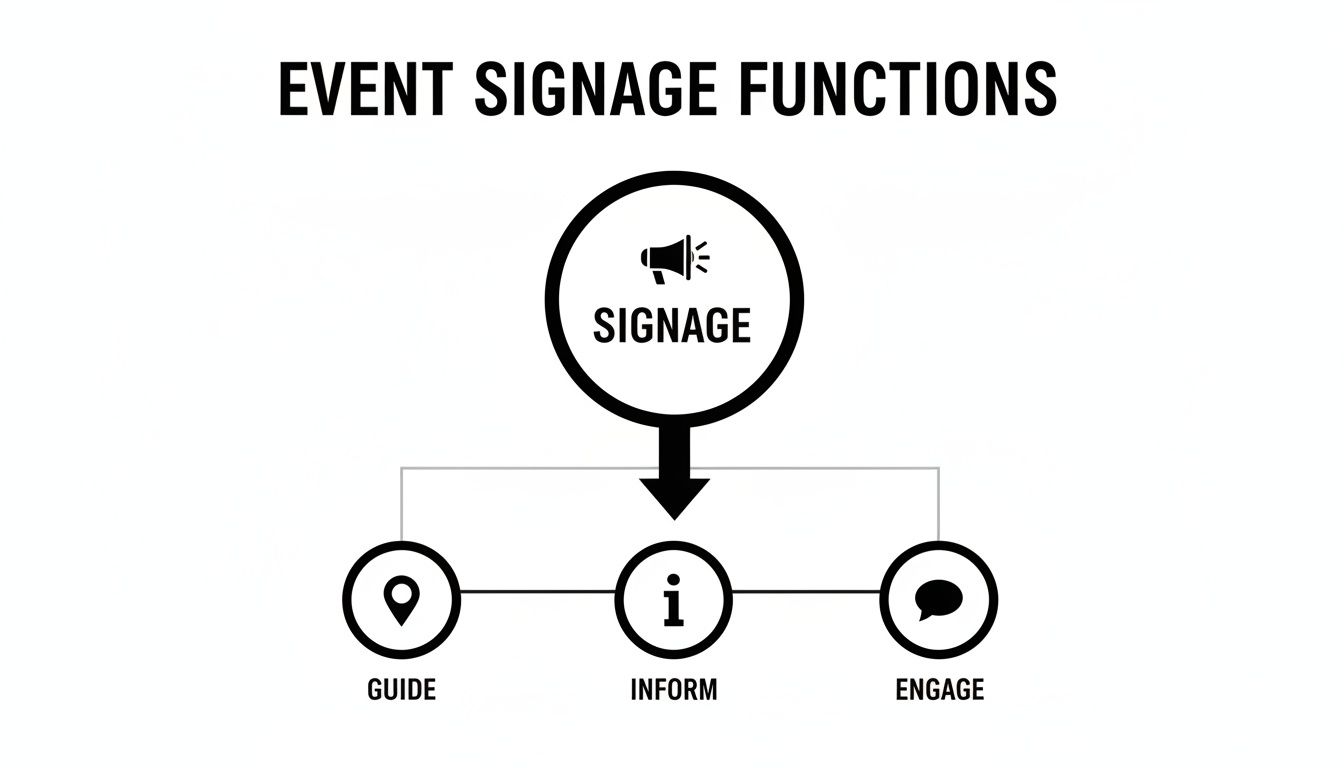
As you can see, every sign you create should aim to guide, inform, or engage. Let's look at how that plays out in the real world.
Welcome and Branding Signage
This is your event’s first handshake. Welcome and branding signs are the first thing people see, instantly making them feel expected and excited to be there. They confirm attendees have arrived at the right place and immediately immerse them in the atmosphere you want to create.
Here are a few must-haves:
- Large Entrance Banners: These are your big, can't-miss welcome mats. They should be bold, feature your event name and branding, and set the stage right away.
- Step-and-Repeat Backdrops: You've seen these on red carpets for a reason. They're perfect for photo ops, featuring your logo (and your sponsors'), and they generate a ton of shareable social media content.
- Registration Desk Signage: Branded signs at the check-in tables keep the experience looking professional and help manage that initial rush of arrivals.
These signs are all about making a big impact. They're meant to be seen from a distance, establish a polished vibe, and kick things off with a burst of energy. You’ll want them at venue entrances, in main lobbies, and anywhere people gather. For more ideas on creating impactful first impressions, you can explore our full range of event display options.
Directional and Informational Signage
Okay, your guests are in the door and feeling welcome. Now what? They need to know where to go. This type of signage is your event's built-in GPS, answering questions before anyone even has to ask. Clear directions are the secret to good crowd flow and a stress-free experience, especially in a big or confusing venue.
A study found that the average person wastes 17 hours a year just searching for a parking spot. Good signage can eliminate that kind of frustration before your event even starts.
Key signs in this group include:
- Wayfinding Signs: These are your bread and butter—arrows, floor plans, and "You Are Here" maps pointing people to restrooms, breakout rooms, and the exhibit hall.
- Agenda and Schedule Boards: Post large, easy-to-read schedules in high-traffic spots. This ensures everyone knows what’s happening, where, and when.
- Room and Session Identifiers: A simple sign outside each room with the session name or speaker is a small detail that prevents a lot of confusion and wandering.
For this signage, function beats flair every time. The top priority is clarity and readability. Place them at every decision point: hallway intersections, near elevators, and right outside every important room.
Promotional and Engagement Signage
The final category of signage goes beyond just giving information—it sparks interaction. These signs are your tools for encouraging attendees to get involved, connect with sponsors, and share their experiences. They help turn passive attendees into active participants.
Some effective examples include:
- Sponsor Recognition Walls: A dedicated wall or a series of banners is a fantastic way to thank sponsors and give them the visibility they paid for.
- Social Media and Hashtag Signs: Get creative with signs that display your event hashtag. They remind people to post their photos, which generates a great online buzz for your event.
- QR Code Displays: Signs with QR codes can instantly link attendees to digital programs, speaker bios, special offers, or other exclusive content, bridging your physical event with the digital world.
These signs are all about boosting engagement and delivering more value to your attendees and partners. The trick is to make the call-to-action simple, clear, and maybe even a little fun.
Choosing the Right Materials for Your Event Signage
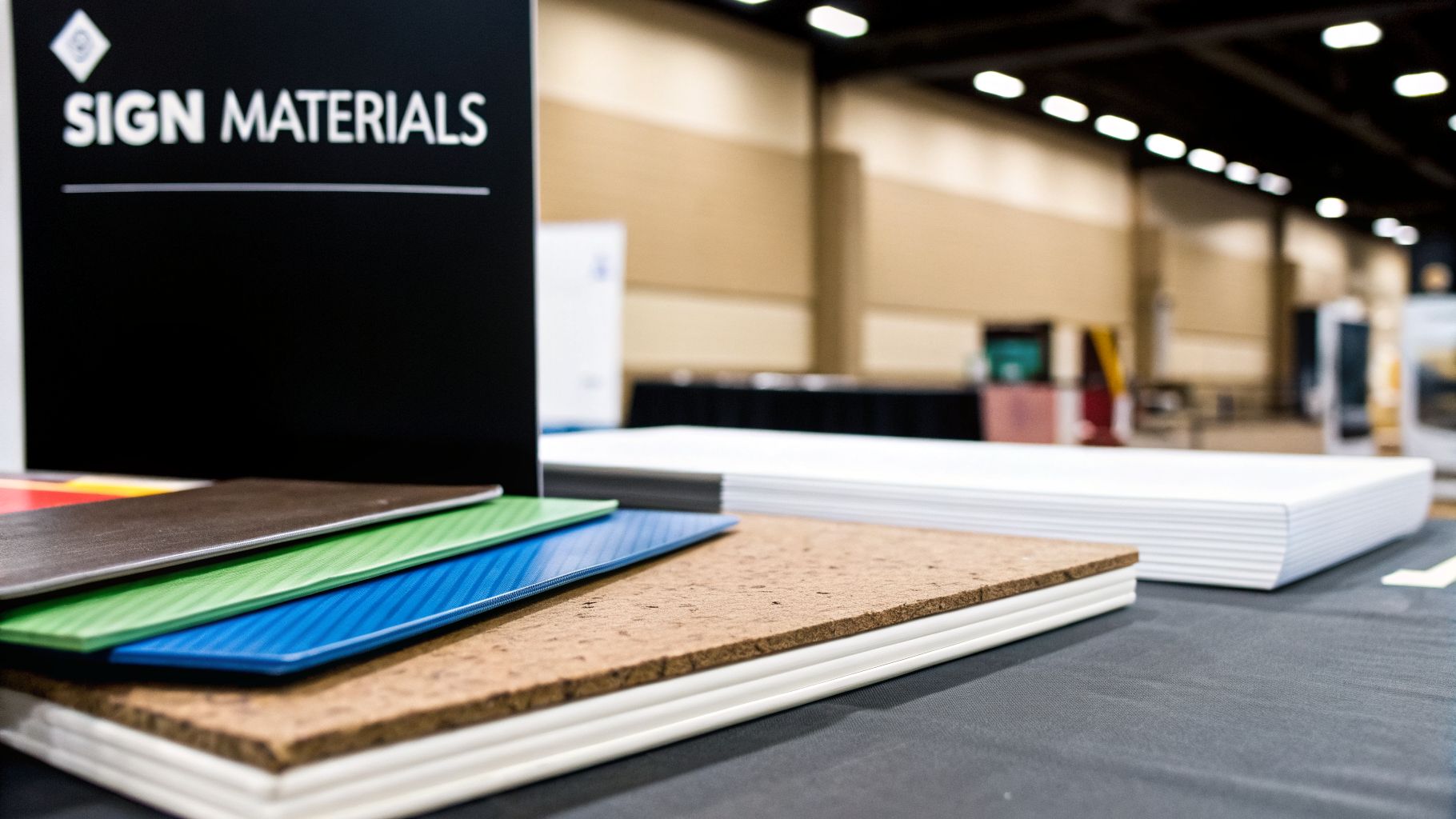
Think of picking a sign material like choosing an outfit. You wouldn’t show up to a beach bonfire in a tuxedo, right? The same logic applies here. Using a delicate, indoor-only sign at a windy outdoor festival is a recipe for disaster. The material you choose is a huge deal—it affects everything from your sign's look and lifespan to your budget.
This isn't just about what looks good; it’s about making a practical choice. A heavy, rigid sign might be perfect for a permanent wall display but an absolute nightmare to haul around for a one-day conference. On the flip side, a feather-light material that's easy to move could get wrecked in a busy hallway. Getting this right from the start means your investment actually pays off.
Common Materials for Indoor Event Signage
When you're indoors, you don't have to worry about the weather. The focus shifts entirely to visual pop and how easy the signs are to handle. People will be seeing these up close, so you want a smooth, professional finish that makes your brand look sharp.
- Foamcore: This is a classic for a reason. It’s incredibly lightweight and affordable, making it the perfect choice for easel signs, presentation graphics, and any temporary signs you want to mount on a wall. It’s basically a light foam core pressed between two smooth paper sheets.
- Fabric: If you want a premium, glare-free look that photographs beautifully, fabric is your answer. It's often used for big backdrops and retractable banners. Best of all, it's light, simple to transport, and can be folded or rolled without getting permanently creased.
- Acrylic: For that sleek, high-end feel, nothing beats acrylic. It brings a touch of class to any upscale corporate function or gala. We often use it for premium welcome signage, elegant plaques, and dimensional logos that really stand out.
Foamcore is especially handy for short-term events. You can take a look at our guide on high-quality foam board printing options to get a better idea of how it can work for you.
Durable Materials for Outdoor Event Signage
When you take your event outside, the game changes completely. Durability becomes your number one priority. Your signs have to be tough enough to handle whatever Mother Nature throws at them—wind, rain, and sun—without tearing, fading, or falling over.
Outdoor signs aren't just signs; they're brand ambassadors that have to stand their ground. Choosing a flimsy material for an outdoor banner is like sending a spokesperson out into a storm with a paper umbrella—it just won’t end well.
Here are the heavy hitters for outdoor use:
- Vinyl: The undisputed champion of outdoor banners. Vinyl is waterproof, UV-resistant, and tough as nails. It's the go-to for large entrance banners, fence wraps, and any other sign that needs to survive an entire festival weekend, come rain or shine.
- Corrugated Plastic (Coroplast): Ever seen a real estate or political yard sign? That's Coroplast. It's waterproof, surprisingly light, and super cost-effective, which makes it perfect for directional signs and other temporary notices you need to stake into the ground.
- Aluminum Composite (Dibond): When you need a more permanent or high-end outdoor sign, this is the way to go. Aluminum composite gives you a rigid, perfectly smooth finish that holds up beautifully in any weather. It's fantastic for long-term venue branding or parking signs.
The Growing Importance of Sustainable Materials
More and more, the events industry is waking up to sustainability, and signage plays a big role in that shift. Opting for eco-friendly materials isn't just good for the planet; it shows your attendees you’re a responsible brand. This trend is a huge factor in the printed signage market, which is expected to climb from USD 38.38 billion in 2026 to USD 44.06 billion by 2030, driven by the boom in trade shows and exhibitions.
Consider these greener alternatives for your next event:
- Recyclable Cardboard: For indoor use, materials like Falconboard offer a sturdy, printable, and 100% recyclable option.
- Fabric Banners: Many polyester fabrics are now made from recycled materials, and their reusability means less waste event after event.
- Digital Integration: A great way to cut down on waste is to use smaller, recyclable signs with QR codes that link attendees to digital programs, maps, and schedules.
Ready to find the perfect material for your next event? We can help you navigate the options to find the best fit for your vision and budget. Get a quote.
Designing Event Signage That Captivates and Communicates
You’ve got your materials picked out. Now comes the part that really makes or breaks your event signage: the design. Anyone can print a sign, but great design turns that piece of foamcore or vinyl into a silent ambassador for your event. It’s what separates a sign that gets ignored from one that actually helps people and makes your brand look sharp.
Effective design isn’t about just slapping a logo on and calling it a day, or trying to cram every last detail onto one banner. It’s about being smart and intentional. By focusing on a few core principles, you can make sure your signs don't just exist—they work.
Guiding the Eye with Visual Hierarchy
Think about how you read a newspaper or a website. Your eyes naturally jump to the biggest, boldest text first, right? That’s visual hierarchy in action. You're subconsciously being told what's most important. Your event signage should do the exact same thing.
The whole point is to give your attendees' eyes a clear path to follow so they can instantly absorb the most critical information. They need to know where the keynote stage is or where to register in the split second they have while navigating a crowded hall.
For a simple directional sign, a good hierarchy looks like this:
- Main Message: The biggest and boldest element (e.g., "BREAKOUT SESSIONS").
- Supporting Details: Smaller text with secondary info (e.g., "Rooms 201-205").
- Directional Cue: A big, can't-miss-it arrow pointing the way.
This simple structure cuts through the chaos and gets your message across without a hint of confusion.
Choosing Fonts for Maximum Readability
This is a big one. I’ve seen countless event signs that fail because of one simple mistake: the font is impossible to read from a distance. Fancy, thin, or overly decorative fonts might look great up close on a computer screen, but they become a blurry mess from across a busy lobby.
Here are a few tips I always give my clients for crystal-clear text:
- Stick with Sans-Serif: Fonts like Helvetica, Arial, and Open Sans are your best friends. They're clean, modern, and don't have the little decorative feet (serifs) that can blur together from far away.
- Follow the 10-Foot Rule: This is a fantastic rule of thumb. For every 10 feet of viewing distance, your text needs to be at least one inch tall. If you expect people to see a sign from 30 feet away, your main headline better be at least three inches high.
- Don't Overdo It: Stick to one or two font families, tops. Using a bunch of different fonts makes a sign look messy and amateurish.
A sign that can't be read is just expensive decoration. Communication is its primary job, and that starts with absolute clarity.
If you’re feeling out of your depth with fonts and layouts, don't hesitate to bring in an expert. Getting professional help can make all the difference, and you can learn more about how we approach this by checking out our graphic design services for your business.
Using Color to Grab Attention and Align with Your Brand
Color isn’t just for making things look pretty; it's a workhorse. The right colors will make your signage pop out of a crowded environment, create a specific mood, and tie the whole event together with a cohesive brand feel. The trick is to use it with purpose.
First and foremost, aim for high contrast. Dark text on a light background (or vice-versa) is always a winner. Steer clear of combinations like yellow text on a white background—they're practically invisible from more than a few feet away.
Beyond that, think about your brand. Your event signage should feel like it belongs to your company.
- Brand Consistency: Weave your organization's primary and secondary brand colors into the designs. This reinforces who you are and makes the entire venue feel polished and professionally managed.
- Action Colors: Use a single bright, attention-grabbing accent color for the most important bits of information, like arrows, calls-to-action ("Register Here!"), or a big "Welcome!" message.
By being thoughtful with your design—focusing on hierarchy, readability, and color—you can ensure your event signage not only looks fantastic but also does its job flawlessly for you and your attendees.
The Future Is Interactive: Digital and Hybrid Signage
For years, we've relied on static posters and banners to guide and inform attendees. They do the job, but let's be honest—they're one-way conversations. The real magic happens when your signage starts a dialogue, and that's exactly where technology is taking us. We're now blending the tangible, high-impact presence of physical signs with the dynamic power of digital interaction.
This hybrid approach creates a far richer, more engaging experience for everyone at your event.
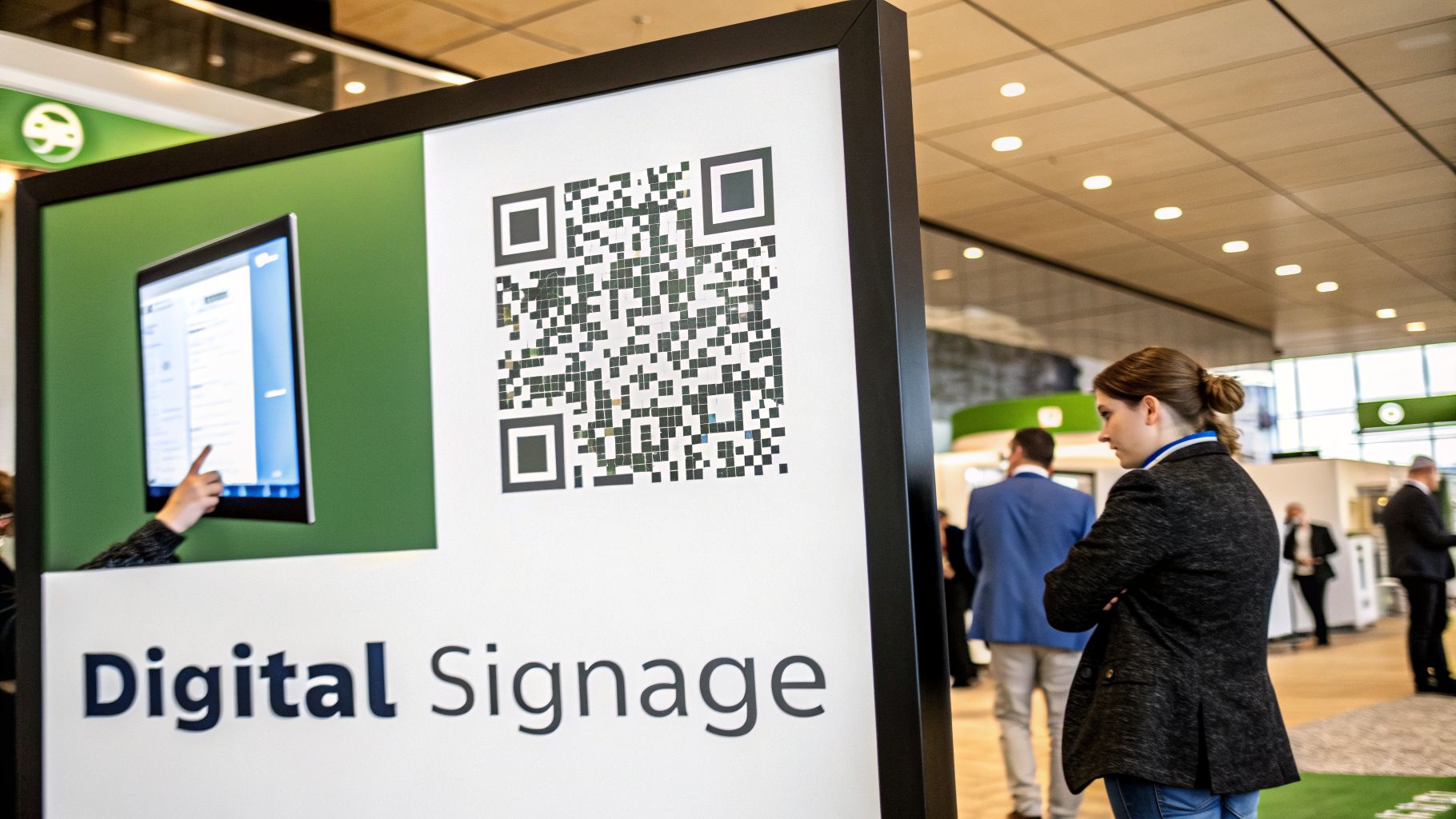
Think about it: a beautifully printed banner is great for grabbing attention. But add a QR code, and suddenly that banner is a gateway. A quick scan can pull up a detailed session schedule, an interactive venue map, or even exclusive video content right on an attendee's phone. That static sign just became a two-way engagement tool.
Bridging Print and Digital
The idea isn't to ditch print for screens; it's to make your printed materials work smarter. A well-placed digital display can show a live social media feed, a countdown to the next keynote, or instant updates to the day's schedule. This offers a level of flexibility that traditional signs just can't match. Imagine a sponsor’s logo on a screen that, when touched, launches a video showcasing their latest product. That's an interaction, not just an impression.
Looking ahead, this fusion is only getting more sophisticated. We're seeing more touchless interfaces like gesture and voice controls become mainstream, driven by a greater focus on hygiene and accessibility. Technologies like augmented reality (AR) and projection mapping will continue to blur the lines between the physical and digital worlds, turning a simple wall into an interactive product demo. Plus, with digital signage, we can finally measure what works by tracking audience engagement and fine-tuning content on the fly.
Benefits of a Hybrid Signage Strategy
So, what does this actually mean for your event? Adopting a hybrid model gives you some powerful advantages that lead directly to a better event and a stronger ROI.
- Unmatched Flexibility: We all know last-minute changes are part of the job. With digital displays, you can update room assignments, speaker times, or urgent announcements instantly, without the stress and cost of a reprint.
- Boosted Attendee Engagement: Interactive elements invite people to participate. QR codes for lead capture, AR filters for social sharing, and live polls all turn passive attendees into active participants.
- Valuable Interaction Analytics: A poster can't tell you how many people looked at it. A digital touchpoint can. You can track exactly how many people scanned a QR code or interacted with a touch screen, giving you real data on what's resonating with your audience.
Integrating digital elements with your printed signs is like adding a live tour guide to your event map. It provides dynamic, real-time context that makes the journey more engaging and valuable for every attendee.
As you start navigating this territory, it helps to be familiar with the latest in strategic hybrid event best practices. A modern print partner can be your guide, helping you seamlessly merge the quality of traditional print with these powerful new technologies.
Ready to see how a hybrid signage strategy could transform your next gathering? Get a quote and let's start creating a more interactive experience together.
Your Essential Event Signage Planning Checklist
Let's be honest: ordering signs for an event can quickly spiral into chaos. It's not just about getting a few banners printed. It’s a full-blown project with its own timeline, budget, and logistical headaches. A "we'll figure it out later" approach is a surefire recipe for last-minute panic, surprise costs, and signs that just don't deliver.
To sidestep that stress, you need a solid game plan. Think of this as your project management playbook for signage. We’ll walk through the entire process, step by step, so every detail is buttoned up and your signs are ready to make an impact on event day.
The Project Management Phase
The biggest mistake people make is treating signage as an afterthought. From day one, it deserves the same attention as your catering or A/V. That means getting organized with timelines, a firm budget, and clear communication between your team and vendors.
- Set Your Budget: First things first, figure out what you can realistically spend. This number will guide every decision you make, from the materials you choose to the sheer number of signs you can order.
- Calculate Lead Times: Work backward from your event date. You need to account for design revisions, getting quotes, production, and shipping. A good rule of thumb is to start this process at least 4-6 weeks out from the event.
- Assign Roles: Put one person in charge of signage. Having a single point of contact is the best way to prevent mixed signals, missed deadlines, and general confusion.
Getting this foundation right from the start takes all the guesswork and stress out of the equation.
Sample Event Signage Ordering Checklist
To help you manage your event signage from the first idea to the final teardown, we've put together a comprehensive checklist. This is your roadmap to make sure nothing falls through the cracks.
Here’s a step-by-step checklist to guide you through the process of planning and ordering your event signage.
This kind of structured approach forces you to think about the entire lifecycle of your signs, not just the moment they come off the printer.
Sample Ordering Specifications
When it's time to talk to your printer, clarity is everything. Vague requests like "we need a banner" lead to follow-up questions and potential mistakes. Instead, be as specific as possible. Here’s a great example of what to send for a simple retractable banner.
Item: Retractable Banner (x2)
Size: 33" W x 81" H
Material: Standard 13oz Matte Vinyl
Hardware: Standard Aluminum Base with Carrying Case
Artwork: File "Welcome-Banner-Final.pdf" attached
Deadline: Must be delivered by [Date]
Delivery Address: [Venue Name and Address]
Providing this level of detail leaves no room for error and ensures you and your print partner are on the same page from the get-go.
Planning your event signage with this much care transforms a potentially overwhelming job into a smooth, manageable process. You’ll be able to work more effectively with your printer, stick to your budget, and get the polished, professional results your event deserves.
Ready to turn your checklist into reality? Let’s talk about your project. Get a quote and our team will help you get started.
Let's Bring Your Event Signage to Life with Camelot
You've got the strategy down. Now comes the fun part: turning those plans into physical, high-impact signage. But getting from concept to a finished product can feel like a massive undertaking, especially when you're juggling a dozen other event-planning tasks. That's where a trusted partner makes all the difference.
For businesses and organizations throughout New York’s Capital Region and the Hudson Valley, Camelot Print & Copy Centers is that local, hands-on partner. We’re here to handle the execution so you can focus on the big picture.
All Your Signage Needs, All in One Place
Event planning is all about speed and precision. We get it. We’ve built our reputation on fast turnarounds for even the tightest deadlines, making sure you get the high-impact event signage you need, exactly when you need it. The process should be smooth, not stressful.
We're equipped to handle every touchpoint of your event, from massive welcome banners and sharp retractable displays to custom-cut vinyl lettering and weather-resistant outdoor signs. Think of us as your one-stop shop, ensuring consistency and quality across every single piece.
Not a design pro? No problem. Our in-house graphic design team can jump in to refine your ideas or build stunning visuals from the ground up. We'll make sure every sign is on-brand, easy to read, and looks completely professional.
With over 25 years of experience, we've helped countless businesses, non-profits, and event organizers create signage that truly captures attention. We know what works, what doesn't, and how to sidestep those common last-minute headaches.
The Advantage of a Local Partner
Working with a local printer is about more than just convenience—it’s about accountability. We’re part of your community, so your success is a reflection on us. You get to talk to real people, right down the road, who are personally invested in your project.
This means faster deliveries, clearer communication, and the peace of mind that comes from knowing your project is in capable hands nearby.
Let us take the stress of signage production off your plate. We live and breathe this stuff—meticulous quality, friendly service, and a genuine commitment to making sure you have everything you need to host a fantastic event.
Ready to get your signs in motion? The team at Camelot Print & Copy Centers is here to make it happen. Get a quote.