You need print materials for a real job, not a warehouse. Maybe it's a few hundred brochures for a trade show, a batch of training manuals for new hires, or event handouts for a local fundraiser. The problem starts when many print quotes seem built around large-volume orders that make sense for national campaigns, not for a business trying to stay lean.
That's where short run printing earns its place. It gives you professional output without forcing you to buy far more pieces than you can use. For local businesses, that matters. Waste ties up budget, outdated materials pile up fast, and last-minute changes are common.
A smart print order matches the project, the deadline, and the shelf life of the content. If the piece is time-sensitive, likely to change, or aimed at a narrow audience, smaller runs often make more business sense than a big offset job.
Your Smart Choice for Smaller Print Jobs
Short run printing solves a common problem. You need enough pieces to look prepared and professional, but you don't need thousands. Ordering too many brochures, flyers, booklets, or manuals usually creates two headaches: wasted money and outdated inventory.
For a small business, the wrong print quantity can cause problems long after the job is delivered. A menu changes. A sales sheet gets revised. A price list becomes obsolete. A seasonal event ends, and half the stack is still sitting in a box. Short run printing helps you avoid that trap by producing a quantity that fits the actual use.
Why smaller runs often make better business sense
Short runs are useful when your project has a clear audience and a defined purpose. Think:
- Event collateral: Programs, flyers, table cards, and handouts for conferences, open houses, and fundraisers.
- Sales materials: Presentation folders, leave-behind sheets, and product brochures for meetings.
- Operational documents: Training manuals, onboarding packets, forms, and internal guides.
- Targeted campaigns: Mailers or inserts aimed at one neighborhood, client segment, or account list.
Practical rule: If the content could change before you'd realistically use a large stack, don't print a large stack.
This approach also gives you more control. You can test a version, gather feedback, adjust the design, then order another batch instead of living with a costly mistake. That's especially helpful when you're refining messaging, launching a new service, or producing materials for a one-time event.
A local print provider can also help you make project-level decisions that online calculators usually miss. Paper choice, folds, binding, coating, and finish all affect the practical value of the order. The cheapest quote on paper isn't always the least expensive decision once waste, speed, and usability are factored in.
What Exactly Is Short Run Printing
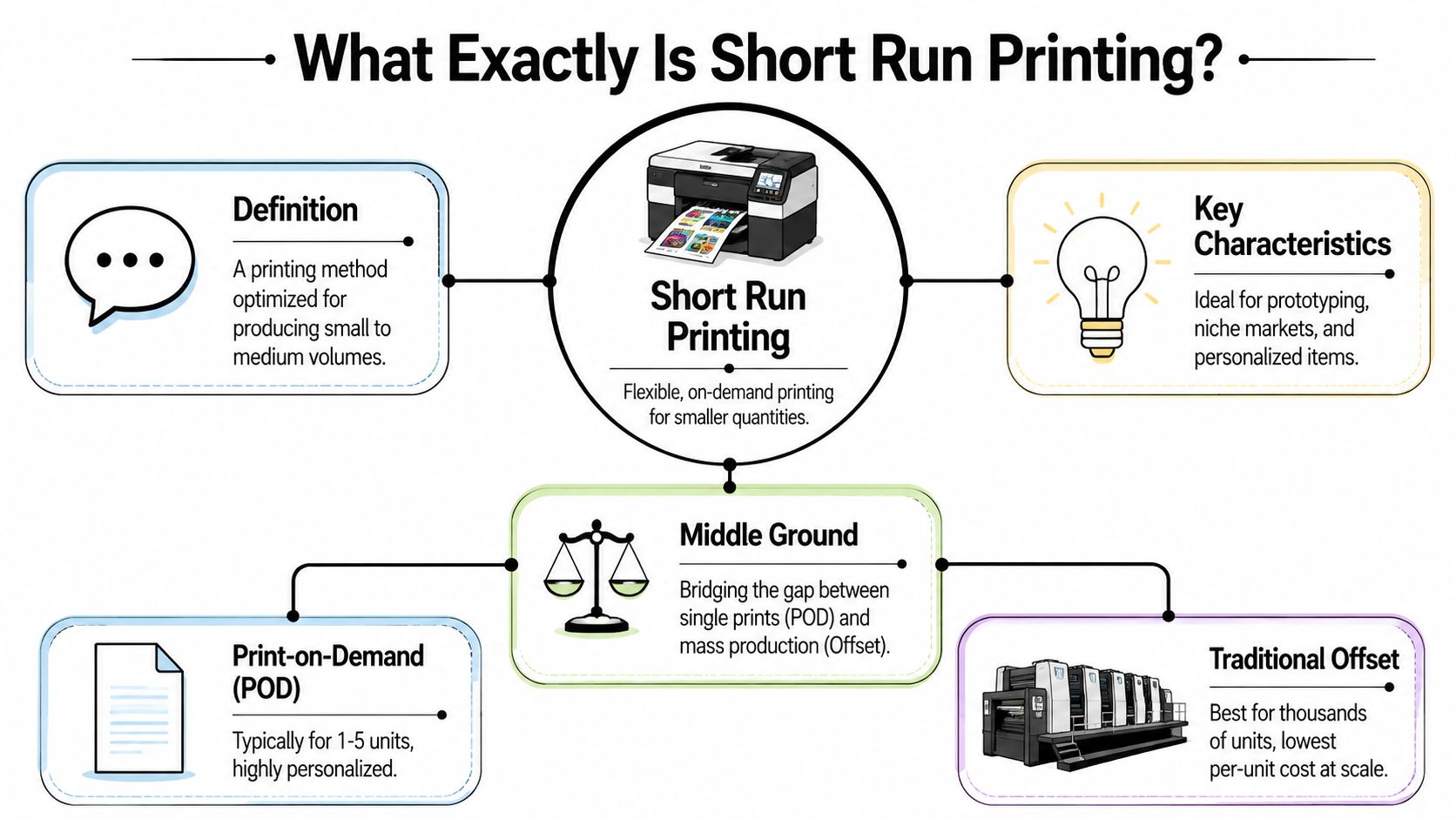
Short run printing sits between print-on-demand and traditional offset printing. It covers the middle ground where you need more than a handful of pieces, but not enough to justify a large press run.
Industry definitions vary a bit, but one published reference says short-run book production generally covers more than 50 units and can extend to 1,000+ units, while print-on-demand is typically 1 to 50 copies, filling the gap before large offset runs take over. The same source links that shift to digital printing technology, noting that digital output represented about 1.7% of North American book print volume in 2004, rose to about 2.7% in 2006, and was projected to reach nearly 6% by 2011 in Riso's short-run printing research.
The simplest way to think about it
A useful analogy is the craft brewery versus the macro brewery. Offset printing is built for big volume. Print-on-demand is built for one-off production. Short run printing is the controlled middle batch. It gives you flexibility, solid quality, and enough quantity to support a real campaign or internal need without committing to mass production.
For many business projects, that middle ground is exactly where the job belongs. A company handbook, a product booklet, a real estate packet, or a set of event programs usually needs more than one copy at a time. But it often doesn't need a giant offset run either.
What makes it possible
The key is digital production. Instead of building plates and going through a longer setup process, the press works directly from digital files. That changes the economics and the timing.
If you're still sorting out where print-on-demand fits in the bigger picture, this guide to print on demand gives a helpful plain-English overview of the one-at-a-time model and how it differs from batch printing.
Short run printing works best when you need a manageable batch, reliable quality, and room to update the job later.
That's why local businesses use it for projects that need to look polished but stay flexible. It isn't a compromise category. It's a practical production method for work that lives in the real world, where details change and timing matters.
Understanding the Cost and Technology
The cost question usually comes down to one issue: setup.
Offset printing has strong economics at scale, but it starts with higher fixed setup work. Digital short run printing avoids much of that setup, which is why it makes sense for smaller batches. One industry source places the cost-effective zone for short runs at roughly 25 to 2,000 copies in this overview of short-run printing economics. That break-even point can shift based on paper, page count, trim size, and finishing.
Why digital and offset behave differently
With digital production, the file goes to press with minimal prep. That makes short jobs easier to launch and easier to repeat in updated versions. You're not paying for a large setup burden just to produce a modest quantity.
Offset works differently. Once the job is set up, the per-piece cost can become attractive on larger runs. But if you only need a few hundred pieces, the setup can outweigh the savings.
That's why buyers get confused when they hear two statements that both sound true:
- Offset is cheaper per piece at high volume.
- Short runs are more economical for smaller quantities.
Both are true. They apply to different volume ranges.
Printing method comparison
| Factor | Short Run (Digital) | Long Run (Offset) | Print-on-Demand (POD) |
|---|
| Best fit | Small to mid-size batches | Large-volume production | One-offs and very small quantities |
| Setup cost | Lower because the workflow is digital | Higher because setup is more involved | Very low for one-at-a-time fulfillment |
| Unit cost trend | Practical for moderate quantities | Improves as quantity rises | Usually highest per piece |
| Flexibility | Strong for updates and versioning | Better when the content is locked | Strong for individual orders |
| Inventory risk | Lower than large-run offset | Higher if demand is uncertain | Lowest because pieces print as needed |
| Finishing options | Often strong, but project-dependent | Broad, especially at scale | More limited, provider-dependent |
| Turnaround | Generally faster for shorter jobs | Often slower due to setup and scheduling | Varies by platform and fulfillment model |
If you want a deeper side-by-side on production methods, Camelot has a useful page on digital vs offset printing that helps frame the trade-offs for business print work.
Where buyers misjudge the real cost
The most common mistake is comparing only the quote total or only the unit price. That misses the larger business cost.
A cheaper unit price doesn't help if half the order becomes obsolete. A bigger run isn't efficient if it fills a storage room with pieces your team won't use. And a bargain isn't a bargain if your staff has to reorder because the first version had errors that could have been caught in a smaller test batch.
This same logic shows up in other print categories too. If you've ever looked at apparel decoration choices, this kind of process comparison feels familiar. For example, businesses evaluating garment printing often need to compare DTF to DTG because the right method depends on run size, material, and production goals rather than one universal winner.
The right print method isn't the cheapest method in isolation. It's the method that fits the job without creating waste, delay, or avoidable rework.
When to Choose a Short Print Run
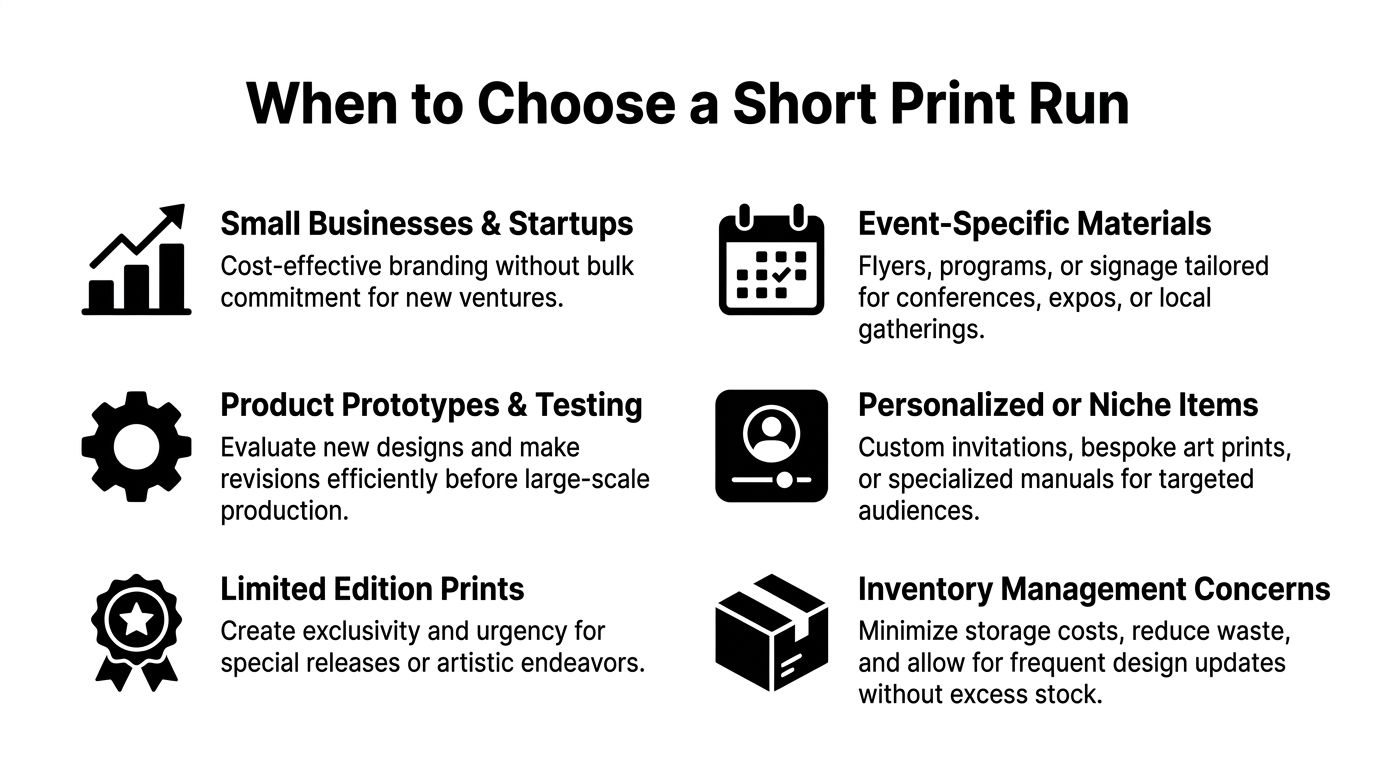
Choose a short print run when the project has a clear use window, limited audience, or a good chance of revision. That's the practical test.
If your team is ordering materials for one event, one sales push, one office rollout, or one client segment, smaller quantities usually give you more control. You can print what you're likely to use, not what a pricing chart tempts you to overbuy.
Strong use cases for a short run
Short run printing is a smart fit when you're dealing with projects like these:
- Event materials: Programs, agendas, tent cards, speaker sheets, and registration packets for a fixed attendance count.
- Frequent updates: Menus, price sheets, training documents, policy manuals, and spec books that may need revision.
- Targeted outreach: Mailers and brochures aimed at a narrow prospect list instead of a broad public distribution.
- Design testing: Two versions of a brochure, booklet, or leave-behind where you want feedback before committing to a larger run.
- Seasonal promotions: Pieces tied to a date, campaign, or temporary offer that won't stay relevant long.
One useful operational advantage is speed. Because short run jobs bypass plate-making, they move faster. A published guide notes typical turnaround of about 2 weeks for a softcover book project, with the same process reducing waste and storage burden, as explained in this summary of short run versus other print methods.
A quick decision filter
Ask these questions before you place the order:
- Will the content change soon? If yes, avoid overprinting.
- Do you know the exact audience size? If the distribution list is finite, match the quantity to it.
- Is the deadline tight? Faster setup often favors a short run.
- Will storage become a problem? Extra boxes are a cost, even if they don't appear on the quote.
- Do you need a polished piece, not a one-off? That's where short runs often land best.
If the project is time-bound, version-sensitive, or audience-specific, a short run is usually the safer business decision.
What doesn't work well is using short run printing for a piece with stable content and broad, ongoing demand where you already know you'll burn through a large quantity. In that case, the economics may point elsewhere. The point is to match the run to the reality of use, not to a generic rule.
Popular Projects for Short Run Printing
The easiest way to understand short run printing is to look at the jobs that come through a local shop every week. Most aren't glamorous. They're practical pieces that need to be accurate, presentable, and ready on time.

Marketing pieces that need flexibility
Small businesses often use short runs for brochures, flyers, postcards, rack cards, and sales sheets. These pieces change more often than people expect. Staff titles get updated. Offers change. Photos get refreshed. Event dates come and go.
A local provider such as Camelot Print & Copy Centers can handle those shorter marketing batches while also helping with folds, paper stocks, and finishing decisions that affect how the piece feels in hand.
For direct mail, short runs are especially useful when the audience is selective. A premium prospect list, a neighborhood campaign, or a follow-up piece after a trade show rarely needs a giant quantity. It needs the right quantity.
Manuals, packets, and document-heavy jobs
Operational printing is another strong fit. Training manuals, employee handbooks, client intake packets, healthcare information sheets, school handouts, and legal document sets all benefit from shorter batches when the content changes regularly.
AEC firms also use short runs for updated spec books, bid sets, and presentation documents. If revisions are likely, it's usually better to print the current version in a controlled quantity than to overproduce and throw away outdated sets later.
A buyer question that matters here is finishing. Jane Friedman notes that short-run book printing is often most economical from 25 to 2,000 copies, with typical turnaround of about 2 weeks for softcover and 5 to 6 weeks for hardcover, while also pointing out that finishing choices can change the break-even point in her guide to short-run printing pros and cons.
Common finishing choices include:
- Saddle stitching: Good for thinner booklets and event programs.
- Coil or comb binding: Useful for manuals that need to lie flat.
- Perfect binding: Better when you want a more polished booklet or book-like look.
- Lamination or coating: Helpful for menus, reference sheets, and pieces that get handled often.
- Custom folds: Important for brochures, maps, and sales leave-behinds.
A short visual overview can help if you're weighing format and presentation choices:
Short run doesn't mean low grade
That's a common misunderstanding. Smaller quantity doesn't automatically mean lower quality. What it usually means is tighter control. You choose a quantity that matches the job, then build the piece with the paper, binding, and finish that support the way people will use it.
Good short-run work feels intentional. The quantity is controlled, the finish fits the purpose, and the piece doesn't outlive its usefulness.
How to Order from a Local Print Provider
A smooth order starts with a clear file and a clear purpose. Tell the printer what the piece is for, who will use it, how many you think you need, and when you need it in hand. That context affects paper, finishing, packaging, and production method.
What to prepare before you send the file
A print-ready PDF is usually the safest starting point. Make sure the page size is correct, images are high enough quality to reproduce cleanly, and any bleeds or trim needs are built into the file if the piece prints to the edge.
It also helps to flag details that often get missed:
- Final quantity: Give your realistic need, not a guess inflated for “just in case.”
- Use case: Say whether the piece is for mailing, hand distribution, binding, display, or repeated handling.
- Deadline: Share the actual in-hand date, not just the date you'd like the order to leave the shop.
- Finishing needs: Mention folding, drilling, tabbing, binding, lamination, or padding up front.
Why local guidance matters
Working with a local printer is useful because you can ask practical questions before the job goes to press. You can compare paper stocks in person, review a physical proof when the piece is sensitive, and catch issues that don't stand out on a monitor.
If you're deciding between local providers, this article on finding printing near me is a solid reminder that convenience matters less than communication, proofing, and job accuracy.
One final piece of advice. Don't ask only, “What's the cheapest way to print this?” Ask, “What's the smartest way to print this for how it will be used?” That question usually leads to better decisions.
If you're planning manuals, mailers, brochures, event pieces, or other smaller-batch projects, Camelot Print & Copy Centers can help you sort out quantity, finishing, and file prep before you commit. To discuss your job and request pricing, use the quote request form.