Picking the right print poster size can feel a bit overwhelming, but it's the first decision that sets your project up for success. You’ll find that standard dimensions vary quite a bit, from a compact 11x17 inches perfect for posting around town to a commanding 24x36 inches designed for trade show backdrops and movie promotions. Getting familiar with these common sizes is the key to making sure your design looks great and fits your budget.
Your Quick Guide to Standard Poster Sizes
To make things easier, we've put together a straightforward reference chart. It breaks down the most common U.S. and international poster dimensions we handle every day here at the shop. Think of it as a cheat sheet to match your project's goal with the perfect size.
After all, the last thing you want is a poster that's too small to grab attention or one that’s too big for the wall space you have. An 11x17 inch poster, for instance, is ideal for taping up on community bulletin boards or in a shop window. For smaller, hand-held promotions, our guide to flyer printing has some great tips. But when you need to make a big impression in a busy retail space, you'll want to go with something like a 24x36 inch format.
Standard Print Poster Size Quick Reference Chart
Here’s a quick-lookup table comparing common US and International (ISO A-series) poster sizes, their dimensions, and their most frequent uses.
With the right size in mind, you're ready to tackle the next steps, like prepping your artwork and picking out the perfect paper stock to make your design pop. When you're ready to bring your vision to life, our team is here to help. Get a quote today and let's get started.
Why Posters Still Pack a Powerful Marketing Punch
In a world saturated with digital ads, it's easy to overlook the power of a well-designed physical poster. But there’s a reason they’ve stuck around: a poster gives your message a physical presence, creating a connection that fleeting online ads often miss. Think about it—a great poster doesn't just get seen; it becomes part of a storefront, an event space, or a community bulletin board, building brand recall right in your customer's environment.
The numbers back this up. The commercial printing market isn't just surviving; it's thriving, with projections showing growth from USD 531.51 billion in 2025 to a staggering USD 886.61 billion by 2035. Large-format printing, the engine behind most posters, is one of the fastest-growing areas in the industry. You can dig into more data on the commercial printing market to see just how significant this trend is.
Matching the Size to the Mission
Of course, a poster’s impact starts with choosing the right size. This isn't just about aesthetics; it's about strategy. A small flyer is perfect for handing out directly to people, while a massive banner is designed to stop traffic and command attention from a distance. Each size has a specific job to do.
This visual guide gives you a quick sense of how different poster sizes relate to their most common uses, helping you picture where your own project fits in.
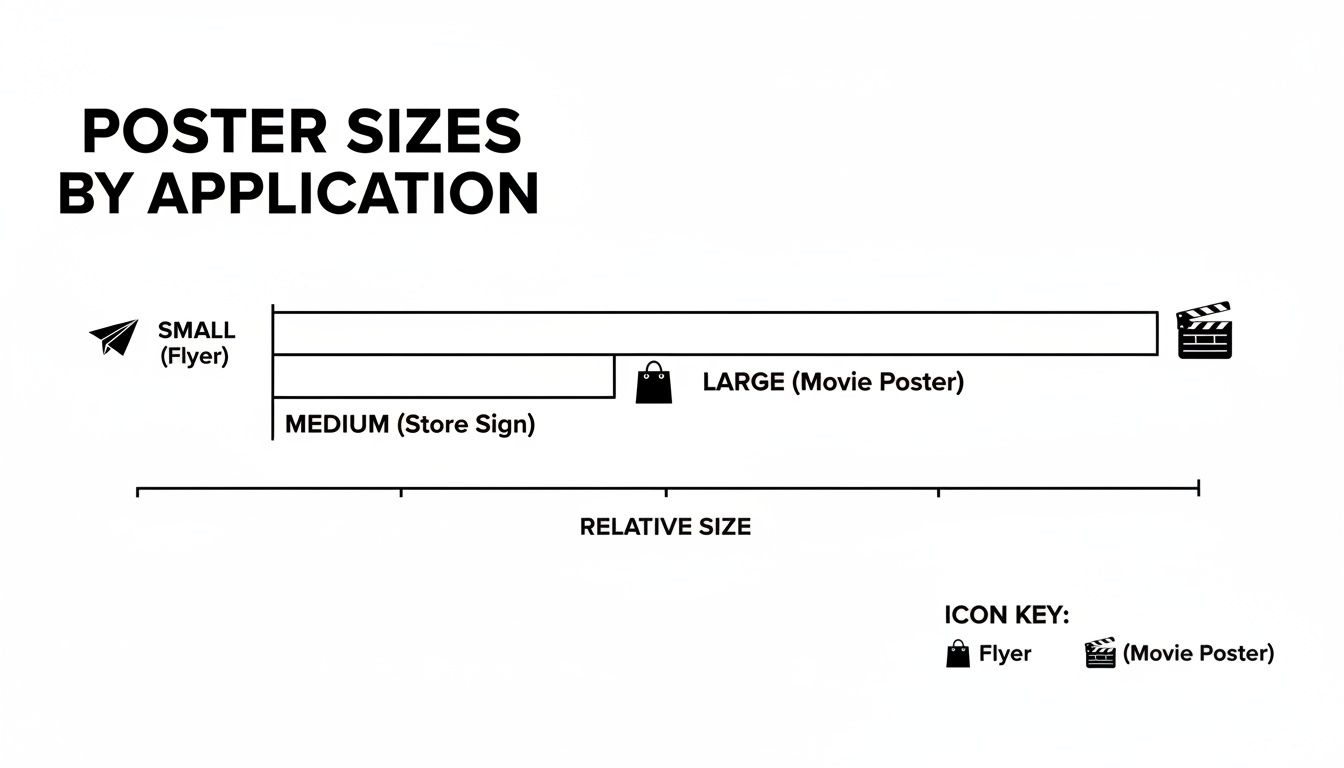
Ultimately, the size you pick is the foundation of your design. It dictates visibility, influences placement, and sets the stage for how your audience will interact with your message.
By bringing your marketing into the real world, a poster delivers a focused, high-impact message that cuts right through the digital clutter. It's more than just paper and ink—it's a strategic tool designed to grab attention and drive action.
From promoting a local sale to launching a major brand campaign, the right poster is a smart investment. Ready to make an impression? Let's talk about what you have in mind and get a quote from our team.
Choosing the Right Poster Size for Your Project
Picking the right poster size is about more than just what fits on the wall. It's about matching your design to its environment and your message to its audience. The perfect dimensions ensure your poster accomplishes its mission, whether that’s informing people up close or making a bold statement at a huge event.
So, the first questions to ask are always: Where will this poster live, and who needs to see it? A small 8.5x11 inch poster is perfect for detailed information viewed from just a few feet away, like a spec sheet in a showroom or a menu in a window. Bump up to an 11x17 inch poster, and you have a cost-effective workhorse for community bulletin boards and in-store ads where you need to get noticed without taking up too much real estate.
Small and Medium Formats for Targeted Impact
Smaller formats are your go-to when you need to get your message out effectively without a massive budget or a ton of wall space. They’re all about precision and placement.
- 8.5 x 11 inches (Letter Size): This is the standard paper size we all know. It’s an economical choice for flyers, notices, and any information-heavy handouts where people will be holding it or standing right in front of it.
- 11 x 17 inches (Tabloid): Giving you double the real estate of a letter-size sheet, this is a crowd favorite for event posters on telephone poles, small-scale retail promotions, and internal announcements. It’s big enough to grab attention but still manageable enough to place almost anywhere.
- 12 x 18 inches: This size offers just a bit more breathing room than a tabloid. That extra space makes it a fantastic option for art prints or promotional materials that feature strong visuals and need a slightly more premium feel.
Large Formats for Maximum Visibility
When you need to command attention and be seen from a distance, it's time to go big. These sizes are made for high-traffic areas where you have to cut through the visual noise. You can explore these applications more in our overview of large format printing.
A versatile mid-range choice, the 18x24 inch poster is a staple for everything from political campaign signs to announcing a big retail sale. For trade shows, academic conferences, and impactful in-store graphics, the 24x36 inch poster is the undisputed industry standard. It gives you plenty of canvas for powerful visuals and legible text. And for that true cinematic feel, the 27x40 inch “one-sheet” movie poster size brings a level of presence that’s impossible to ignore.
The choice between a standard or custom size often comes down to a trade-off: efficiency versus brand impact. Standard sizes are budget-friendly and a breeze to frame. A custom dimension, on the other hand, can help you create a truly unique and memorable piece.
The demand for custom-printed posters is growing fast, with the global market valued at USD 1,377.0 million in 2024 and projected to hit USD 2,430.3 million by 2030. This boom shows just how much businesses rely on custom prints for unique advertising and events. For a great real-world example of how size and design come together, this guide to choosing the perfect Formula 1 poster breaks it down beautifully.
Essential File Specs for Flawless Poster Printing
From my years in the print industry, I can tell you one thing for sure: a beautiful print begins with a well-built file. Sending us properly prepared artwork is the single most important thing you can do to guarantee the poster you hold in your hand looks just as good as it did on your screen. This checklist will walk you through the essential technical specs, so you can send your files with confidence.
Getting these details right from the start helps you sidestep common headaches like pixelation, weird color shifts, or having important details trimmed off. A few minutes spent on a pre-flight check now will save you the time, money, and stress of a reprint later.
Nail Your Resolution (DPI)
Resolution, which we measure in DPI (Dots Per Inch), directly impacts the sharpness and clarity of your printed poster. For any professional print job, the gold standard is 300 DPI at the final, full poster size. Web images are often 72 DPI, which looks fine on a screen but will print as a blurry, pixelated mess.
Think of your image as a mosaic built from tiny squares (pixels). A higher DPI means more tiles are packed into every inch, creating a crisp, detailed picture. Trying to print a low-DPI file for a large poster is like stretching a small mosaic to cover a giant wall—the image simply falls apart. To make sure your design is sharp, it's worth taking a moment to learn more about the importance of DPI for printing in our guide.
To make this simple, here’s a quick reference table. Just find your poster size and make sure your file's pixel dimensions meet or exceed these minimums for a high-quality 300 DPI print.
Minimum Pixel Dimensions for High-Quality 300 DPI Prints
Remember, you can't just artificially increase the DPI on a low-resolution file and expect good results. The quality has to be there from the original image or design file.
Set the Right Color Mode: CMYK vs. RGB
Your monitor uses the RGB (Red, Green, Blue) color model to display images with light. It’s an additive process. Our professional printers, on the other hand, use the CMYK (Cyan, Magenta, Yellow, Black) color model, which is a subtractive process of applying ink to paper. This difference is why colors that look bright and electric on your screen can sometimes appear dull or shifted when printed.
To avoid any unwelcome surprises, you should always design and export your files in CMYK color mode. This gives you a much more accurate on-screen preview of the final printed colors. It's the best way to prevent a vibrant RGB blue from turning into a muted purple on paper. My best advice? Set your document to 300 DPI and CMYK before you even start designing.
Add a Bleed and Set Your Safety Margins
Ever wonder how we print right to the very edge of the paper? The secret is the bleed. This is a small, extra margin—typically 0.125 inches (or 3mm)—that extends your design beyond the final trim line. We print on oversized sheets and then cut them down, and this bleed area ensures there are no accidental white slivers along the edges if the cutter shifts by even a fraction of a millimeter.
Just as important is the safety margin. You’ll want to keep all your critical elements, like text and logos, at least 0.25 inches inside the final trim line. This "safe zone" guarantees that nothing important gets accidentally clipped off during the final cutting and finishing stage.
Choose the Best File Format for Printing
Finally, the file format you save your design in really matters. For the best, most reliable results, we always recommend submitting your artwork in one of these formats:
- PDF (Press Quality): This is the undisputed champion for print. A properly saved Press Quality PDF embeds all your fonts, images, and color settings into one neat, predictable package. It's what we love to see.
- TIFF: An excellent choice for raster artwork (like photographs). TIFF files use lossless compression, which means they maintain 100% of the original image quality without any degradation.
- AI (Adobe Illustrator): If your poster is made of vector graphics, sending the native .ai file is a great option. Just be sure to outline your fonts first to ensure perfect scalability and sharpness.
Selecting the Best Paper and Finish for Your Poster
You’ve nailed down the perfect size for your poster and your design file is ready to go. Now for the fun part: choosing the paper that will truly make it shine. This decision is every bit as important as the design itself, since the paper stock and finish determine the final look, feel, and even the lifespan of your print.
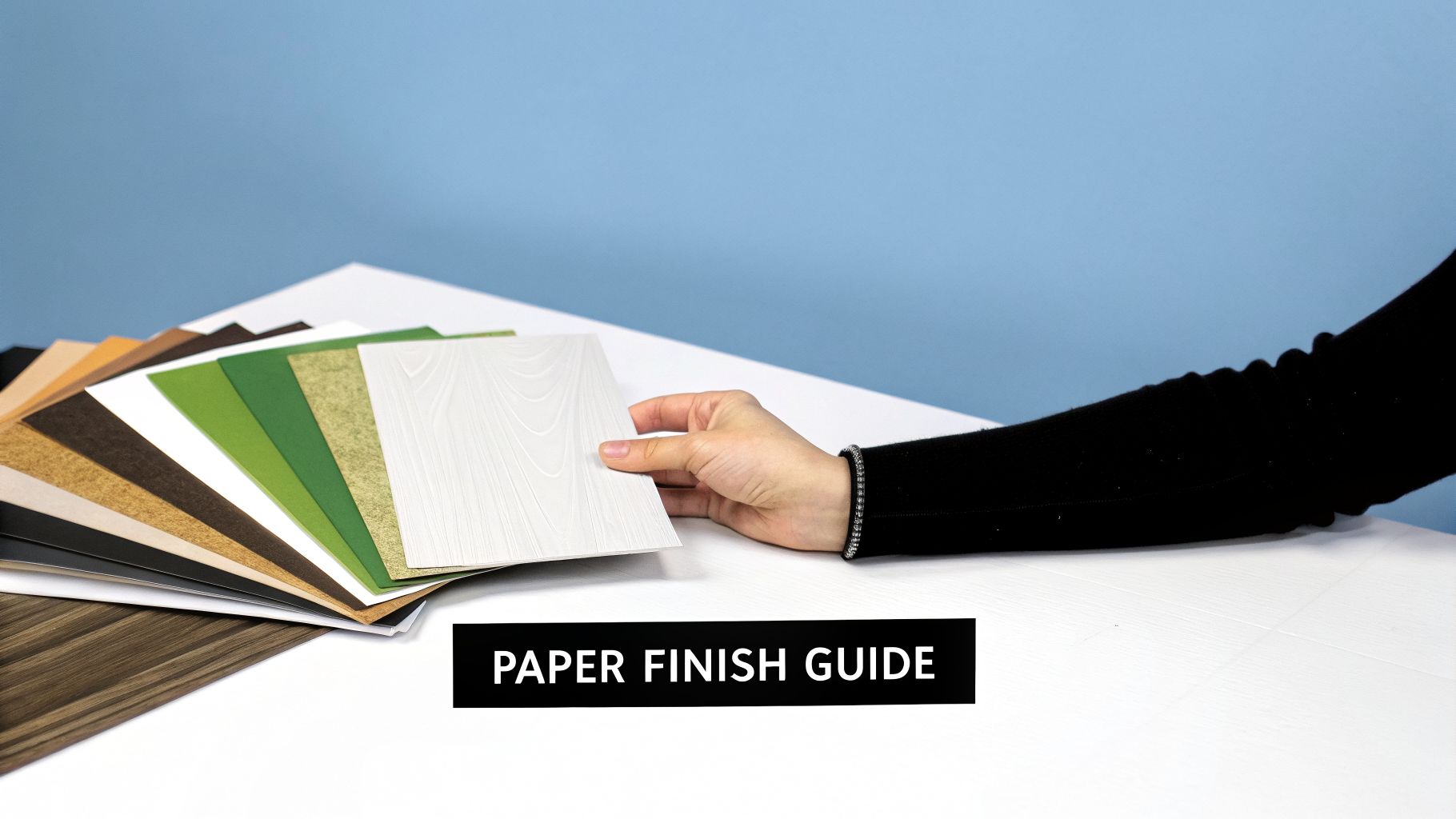
Putting a brilliant design on the wrong paper can make it feel lifeless, so it’s a choice worth considering carefully. In the print world, we call these different paper options substrates. Each one has a unique weight, texture, and brightness that can completely change the character of your poster. Let's walk through the most popular choices to find the perfect one for your project.
Comparing Popular Paper and Finish Options
Understanding the strengths of each finish makes picking the right one much easier. Here’s a breakdown of what we work with every day and where they work best.
Glossy Finish: If you need your colors to pop with intense vibrancy, a glossy finish is your go-to. Its highly reflective surface makes images look sharp and rich, giving them a classic, high-impact feel. Just be mindful that this same reflectivity creates significant glare under direct light, so it’s not always the best choice for brightly lit spaces.
Matte Finish: For a more understated, artistic look, you can't go wrong with a matte finish. This non-reflective surface completely eliminates glare, which is ideal for posters with a lot of text or fine details that need to be easily legible. It also adds a sophisticated, tactile quality that invites people to take a closer look.
Satin or Lustre Finish: This is the perfect middle ground between the two extremes. A satin finish (often called lustre) delivers the beautiful color saturation of glossy paper but with far less reflection. It’s a fantastic all-rounder that works for nearly any poster, from event promotions to high-quality photo prints.
Think of the finish as part of the poster's function. A glossy finish grabs attention from across the room with vibrant color, while a matte finish ensures readability and a refined look up close.
Specialty Materials for Unique Applications
Sometimes, a standard paper poster just won't cut it. That's when we turn to specialty substrates, which provide unique visual effects and serious durability for specific situations.
For example, printing on canvas gives your design a textured, gallery-wrapped appearance that’s perfect for fine art reproductions or high-end decor. If your poster needs to survive the great outdoors or a high-traffic hallway, vinyl is a tough, weather-resistant option that is built to last.
Ultimately, the right material comes down to your poster's purpose and where it will live. A glossy band poster looks great in a dim club, but a matte finish would be far better for a detailed map in a sunny visitor center.
Need a hand figuring out which material is right for your project? Our team can show you samples and talk you through the pros and cons of each. Get a quote today and we'll help you make the perfect choice.
Alright, you’ve picked out the perfect poster size and prepped your files. Now for the best part: getting your project printed. We’ve made our ordering process as simple as possible so you can get exactly what you need with a quick turnaround. Let's walk through how to submit your files and get your posters into production.
The first thing we need is some basic information about your order. Think of it as the blueprint for your print job. The more details you can give us upfront, the faster and more accurate your quote will be.
Submitting Your Project for a Custom Quote
When you're ready to go, the best way to kick things off is by requesting a custom quote. This gives our team a chance to look over your specific needs and nail down the pricing and timeline right away.
To get the ball rolling, have this key info on hand when you reach out:
- Quantity: How many posters are you looking to print? Knowing the exact number helps us choose the most cost-effective printing method for your project.
- Poster Size: Let us know the final dimensions, whether it’s a standard 18x24 inches, a large-format 24x36 inches, or a custom size.
- Paper Type and Finish: Do you have a finish in mind? Tell us if you want a glossy, matte, or satin paper, or if you’re considering other materials like canvas.
- Your Artwork: Make sure your print-ready file (PDF or TIFF is best) is ready to upload or send over.
Don’t sweat it if you’re not sure about every little detail or need a hand creating the artwork. Our in-house graphic design team is here to help turn your concept into a polished, professional design that’s ready for print.
Once we have your project details, our team gets straight to work. We pride ourselves on fast turnarounds and even offer convenient local delivery to get your finished posters in your hands without delay. The whole process is designed to be seamless, letting you focus on your business while we handle the printing.
Ready to see your design come to life? Get a quote from our team today, and let's get started.
Common Questions About Poster Printing
When it comes to poster printing, it's normal to have a few questions. From picking the right size for your budget to making sure your files are print-ready, getting the details right from the start is key. We've put together answers to the questions we hear most often to help you feel confident about your next poster order.
Think of this as your quick-start guide, pulling from our decades of experience helping clients create the perfect prints.
What Is the Most Cost-Effective Print Poster Size for a Small Business?
For small businesses trying to make a big impact without breaking the bank, the 11x17 inch (Tabloid) and 18x24 inch sizes are your best bet. We see clients get a ton of mileage out of these two formats.
They’re large enough to get noticed but are significantly more economical to produce than the bigger movie-poster sizes. They work great for:
- Announcing in-store sales and special promotions.
- Advertising local events on community bulletin boards.
- Showcasing new products or services in a window or on an easel.
They hit that sweet spot of visibility and value, making them a smart choice for any marketing campaign.
Can I Print a Poster From a Photo on My Phone?
Technically, yes, but we almost always advise against it for anything larger than a small print. The problem is resolution. Most phone cameras capture images at 72 DPI (dots per inch), which looks great on a screen but falls apart when enlarged for print. The result is often blurry, pixelated, and just plain disappointing.
For a crisp, professional-looking poster, your image file needs to be 300 DPI at the final size you want to print. If you're not sure about your file, don't worry. Just send it over, and our team will happily check the quality for you before anything goes to press.
What Is the Difference Between a Poster and a Banner?
This one comes down to two things: what they're made of and where they're going. Posters are almost always printed on paper stocks—like glossy, satin, or matte—and are meant for indoor display.
Banners, on the other hand, are built for durability. They're printed on rugged materials like vinyl or heavy-duty fabric, making them tough enough to handle weather, sun, and wind. This makes them perfect for outdoor use or for long-term displays in high-traffic indoor areas.
In short: choose a poster for indoor art and short-term promotions. Go with a banner when you need something that can stand up to the elements and last for a long time.
How Long Does It Take to Print Posters?
Turnaround time depends on the specifics of your order, like the quantity, size, and any special finishes. That said, most of our standard poster jobs are ready within just a few business days.
If you’re on a tight deadline, just let us know. We offer rush printing options to make sure you get what you need, when you need it. The best way to get an exact timeline is to contact us with your project details.
Have more questions or ready to get your project rolling? The expert team at Camelot Print & Copy Centers is here to guide you through every step. Get a quote today and let's bring your vision to life.