Sponsor banners are so much more than just a logo slapped on a piece of vinyl. Think of them as one of your hardest-working marketing tools, actively building brand recognition and sparking real engagement at live events. When you get the design and printing right, they create a powerful first impression that can turn a casual passerby into a genuine lead.
Why a Quality Sponsor Banner is Non-Negotiable
Picture the scene: a bustling trade show, a packed community festival, or a high-energy sports event. Your brand has mere seconds to grab someone's attention. A crisp, vibrant, and professionally designed sponsor banner doesn't just say "we're here"—it shouts professionalism, builds instant trust, and makes your company stick in people's minds long after they've gone home. It’s a crucial touchpoint that speaks volumes about your brand.
I like to think of a good banner as a silent salesperson, working for you 24/7. While your team is busy shaking hands and having conversations, that high-quality banner is constantly reinforcing your message, pulling in foot traffic, and setting you apart from the sea of competitors. That kind of visual persistence is absolutely vital for building brand recall.
From Passive Signage to Active Engagement
The game has changed. Businesses are moving way beyond simple logo placement. The sponsor banners that really work today are designed with a purpose. They might guide attendees to your booth, promote a special offer just for the event, or even feature a QR code that connects the physical display to a digital experience on someone's phone.
This small shift turns a static sign into a dynamic tool that you can actually measure. Instead of just being seen, your banner is now encouraging people to do something. That makes it an essential piece of your event marketing strategy, and the spending trends back this up.
In 2022, brands around the world poured a staggering $97.4 billion into sponsorships, and that number is projected to hit $189.5 billion by 2030. The data shows exactly why this is happening. Post-event surveys have shown 88% of attendees could recall the main sponsor, and there was a 75% jump in product interest. That’s the power of professional visibility in action. You can discover more insights on the future of event sponsorship and see how to position your own business to capitalize on these trends.
Key Takeaway: A professionally printed sponsor banner isn't just another line item on your budget; it's a strategic investment. It acts as a primary marketing tool that boosts brand recognition, drives traffic your way, and generates real, tangible leads that deliver a clear return.
For small and mid-sized businesses, this is a massive opportunity. A well-designed banner lets you punch above your weight, compete for attention, and leave a lasting impression, no matter what your sponsorship level is. It all comes down to making every single visual element count.
Ready to create a sponsor banner that truly commands attention and gets results at your next event? Get a quote from our experts today and let's start designing a professional banner that will put your brand in the spotlight.
Picking the Right Banner for Your Event
Not all sponsor banners are created equal, and honestly, the wrong one can be a waste of money. The best choice always comes down to the specifics: Where is the event? What’s the environment like? And what are you really trying to accomplish? A beautiful indoor banner will get shredded at a windy outdoor golf tournament, so let’s start by matching the banner to its mission.
First, you need to be crystal clear on your main goal. Are you just trying to get your brand name in front of as many eyeballs as possible? Or are you there to capture qualified leads from people who walk by?
This little decision tree can help you visualize how that single choice—brand awareness vs. lead generation—shapes your entire banner strategy.
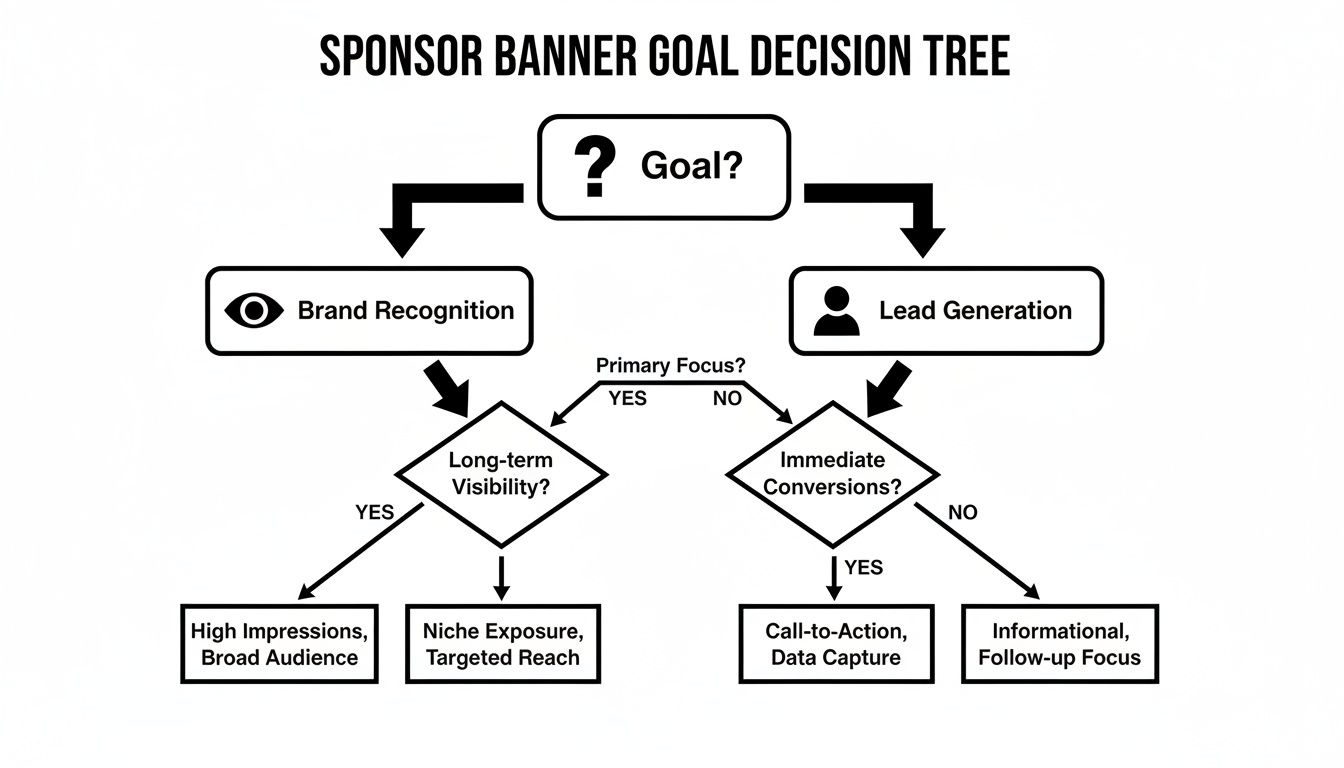
The takeaway here is simple. If you're going for broad recognition, you want high-visibility placement. If you need leads, you need a design that pulls people in and asks them to do something, like scan a QR code.
Getting the Material and Finishing Right
Once your goal is set, we can dig into the nuts and bolts—the materials and finishing options that bring your banner to life. These choices aren't just cosmetic; they determine how your banner looks, how long it lasts, and how easy it is to set up.
To help you sort through the options, here’s a quick-glance table breaking down the most common choices we see for sponsorship events.
Banner Material and Finishing Options at a Glance
Let’s be honest, there’s nothing worse than showing up on event day and realizing you have no way to hang your banner. Thinking about installation before you order is probably the single most important tip I can give.
A Closer Look at Your Options
13oz scrim vinyl is the industry workhorse for a reason. It’s tough, it’s weather-resistant, and it makes graphics pop. This is your default for most outdoor events like community festivals or grand openings.
Planning to hang a huge banner on a chain-link fence? You absolutely need mesh vinyl. The tiny holes let the wind pass right through, so your banner won't turn into a giant sail and tear itself apart.
For anything happening indoors, especially upscale events or trade shows, fabric is the way to go. It has a premium, matte finish that eliminates glare from photos and lighting, making it perfect for step-and-repeat backdrops. This event backdrops guide has some great pointers if you’re creating a major focal point.
When it comes to finishing, grommets (the little metal rings) are the most common choice, giving you plenty of flexibility for hanging with rope or zip ties. Pole pockets, on the other hand, are sewn-in sleeves perfect for sliding a banner onto a pole for a parade or a more structured display.
And for the ultimate in convenience, you can’t beat a retractable stand. The banner comes pre-installed in a base, ready to pull up in seconds. It's a complete, self-contained display that's perfect for anyone who moves between events often.
Sorting through all the banner printing options can feel like a lot, but our team is here to walk you through it and find the perfect combination for your budget and goals.
Getting Your Artwork Ready for Flawless Printing
A great sponsor banner doesn't just happen at the print shop—it starts with a solid design file. Honestly, getting your artwork set up correctly from the get-go is the single best way to avoid those all-too-common printing headaches. Think blurry logos, funky colors, or text getting chopped off at the edges.
The whole point is to create what we in the industry call a "print-ready" file. This is just a file that has all the technical specs dialed in, so our large-format printers can bring your vision to life perfectly. Whether you’re a seasoned designer or just passing along a logo, a little know-how here goes a long way.
The Nitty-Gritty on Artwork Specs
Let's cut through the jargon. There are three key terms you'll hear that can make or break your banner: bleed, resolution, and color profile. Master these, and you’ll save yourself the pain of a costly reprint.
Bleed: This is a safety margin. It’s a bit of extra background image or color that extends beyond where the banner will actually be cut. We add a 0.25 to 0.5-inch bleed because printers can’t print perfectly to the edge. This extra bit gets trimmed off, leaving you with a clean, edge-to-edge design instead of a weird white sliver.
Resolution (DPI): This stands for "dots per inch." While business cards need a crisp 300 DPI, big banners are viewed from much farther away. For a sponsor banner, a resolution of 100-150 DPI at its final print size is the sweet spot. It looks sharp from a distance and keeps your file size from getting ridiculously huge.
Color Profile (CMYK): This one is crucial. Your monitor glows with RGB (Red, Green, Blue) light, but printers lay down CMYK (Cyan, Magenta, Yellow, Black) ink. To avoid a color surprise, your design file must be set to CMYK. This ensures the vibrant colors you approved on screen look just as good in print.
A word of warning from experience: never, ever grab a logo from a website and expect it to work for a large banner. A low-resolution JPG will look pixelated and unprofessional every single time. Always track down the original, high-quality vector files.
Your Pre-Flight Artwork Checklist
Before you hit "send" on that email, take five minutes to run through this checklist. It's a lifesaver.
Check Your File Format. The absolute best formats are vector files like PDF, AI, or EPS. Why? They can be scaled to the size of a billboard without losing an ounce of quality. If you absolutely have to use an image file (like a TIFF or high-quality JPG), make sure it’s saved at the right DPI for the banner's final dimensions.
Outline All Fonts. This is a classic pro move. Converting your text to outlines (or curves) turns the letters into shapes. It guarantees your chosen font prints exactly as intended, even if we don't have it installed on our systems. No surprise font swaps!
Confirm Image Resolution. Take a second to zoom in on any photos or graphics. Do they look sharp? Make sure they meet that 100-150 DPI requirement at full size. If you want to dive deeper, our guide on understanding DPI for printing is a great resource.
Proofread. Then Proofread Again. It sounds so simple, but you'd be amazed how often a typo or a wrong date slips through. Once that banner is printed, it's permanent. Have a second set of eyes give it a final look.
By following these pointers, you’re setting your project up for success. And if you’re ever unsure about anything, just ask! We're always happy to review your file and make sure it’s ready for showtime.
Budgeting for Your Sponsor Banners
Trying to set a budget for sponsor banners can feel a bit like guesswork. The trick is to stop asking, "How much does a banner cost?" and start asking, "What do I want this banner to do for my brand?" This simple shift in perspective turns the banner from an expense into a genuine investment.
Of course, the price tag is shaped by a few key things. Size is the big one—more material and more ink mean a higher cost. The material you choose is another huge factor. A high-end fabric banner for an elegant indoor event will have a different price point than a heavy-duty 13oz vinyl banner designed to withstand the elements for a month. Finally, quantity matters. Ordering a batch of banners at once usually brings down the price per banner, which is a smart move for annual events.
Thinking in Terms of ROI, Not Just Cost
Let's look past the initial price and talk about the return you're getting. A well-designed sponsor banner is more than just a piece of vinyl; it's a workhorse for generating leads and boosting brand recognition.
Think about event sponsorships on a larger scale. At a major trade show, a company might pay anywhere from $5,000 to $20,000 for a supporting sponsorship package. That money doesn't just get their logo printed in a brochure—it secures high-visibility banner placement and booth space that directly leads to new business.
You don't need a massive budget to get the same kind of value. The logic holds true at any scale: visibility drives results. In professional sports, for instance, strategically placed sponsor banners generated an eye-watering $515 million in media value for NBA and MLB brands in a single year. You can absolutely mirror that success locally. Our design team is fantastic at creating visuals that command attention, whether it's for a high school football game or a booth at the weekend farmers market. You can learn more about how large format printing drives brand visibility on our blog.
Pro Tip: When you're building your budget, set aside funds for placement, not just the banner itself. I've seen a smaller banner in a prime, high-traffic spot deliver a much better return than a huge one tucked away in a corner.
How to Make Every Penny Work for You
Here’s a real-world example I see all the time. A local CPA firm sponsors a youth soccer league for $500. Part of that sponsorship fee covers a durable vinyl banner that hangs by the main field for the entire season.
Over the next few months, that single banner gets seen by hundreds of parents—the firm’s ideal customer. If they land just one of those parents as a new client, that $500 investment has paid for itself many times over.
That's how a sponsor banner becomes a long-term asset. It's out there working for you 24/7, building trust and familiarity right where it counts. Ready to talk about how a smart banner investment can help your business? Contact us for a personalized quote, and we'll figure out a plan that delivers real value.
Getting Your Banners Ready: Timelines and Installation
From the moment you hit "send" on your final artwork to hanging the banner at your event, the final steps are where good planning really shines. A perfectly designed banner that shows up a day late is just a rolled-up piece of vinyl. That's why managing your production timeline and planning for installation are every bit as crucial as the design itself.
The smartest way to plan is to work backward from your event date. For a standard vinyl banner, a safe bet is to allow 3-5 business days for production after you’ve given the final art approval. If you're ordering something more complex, like a batch of retractable banner stands or a custom-cut shape, it's wise to tack on a few extra days.
Building in that buffer saves you from last-minute panic. It gives you breathing room for shipping or local pickup without the stress of a looming deadline. Rushing is a recipe for mistakes, so giving yourself a week or two of lead time isn't just cautious—it's professional.
Banner Installation Tips for Maximum Impact
Once the banner is in your hands, how you display it makes all the difference. A sloppy installation can make even the best design look cheap, while a professional setup ensures it stays secure and gets noticed.
Here are a few pointers I’ve learned over the years for different banner types:
- Vinyl Banners with Grommets: Don't skip any grommets! Use every single one with bungee cords, zip ties, or rope to distribute the tension evenly. This is the secret to preventing that dreaded saggy look and helps the banner withstand wind without tearing.
- Retractable Displays: When you pull the banner up from the base, be gentle and slow. Never yank it. Once it's fully extended, make sure that support pole is locked securely in place before you let go. Rushing this is the fastest way to break the retraction mechanism.
- Prime Placement: Think like your attendees. Where will their eyes naturally go? High-traffic spots like entrances, registration tables, or near the coffee station are goldmines for visibility. Avoid tucking your banner away in a dark corner or behind a pillar.
A great banner in a bad spot is an opportunity lost. I always recommend doing a site visit before the event, if possible. You can scout the best high-traffic areas and check what surfaces you have available for hanging your banner.
The Local Printer Advantage
Logistics can be a real pain, but this is one area where working with a local printer like Camelot Print & Copy Centers can be a game-changer. Forget about anxiously tracking a package across the country—you can just stop by and pick up your order.
Going local offers some serious perks:
- Faster Turnarounds: Since we don't have to account for shipping, we can often squeeze in rush jobs that national online printers can't.
- Easy Pickup & Delivery: With locations in Latham and Hopewell Junction, it’s easy to grab your banners on the way to your venue. We also offer local delivery throughout the Capital Region.
- Zero Shipping Damage: Your banner is handed directly to you in pristine condition. No bent corners, no scuffs, no transit damage.
When your event is right around the corner, that local convenience is priceless. Ready to plan your next project without the logistical headache? Get a quote to start your order and let our team handle the details.
The Future of Banners in Sponsorship Marketing
Let's be honest, sponsor banners have been a bit stale for a long time. For years, they were just big logos plastered on a wall—a necessary but often overlooked part of any event. That’s all changing, and fast.
The future of banner marketing isn't just about showing up; it's about creating an interactive experience that bridges the physical event with your digital world. Your banner is no longer just a sign. It’s a centerpiece for a much bigger marketing play.
From Passive Signage to Active Engagement
The smartest banners today are a direct launchpad for customer engagement. Think past the simple logo and website address. By making a QR code a prominent part of your design, you give attendees a reason to pull out their phones and connect with you on the spot.
A quick scan can do so much more than just send someone to your homepage. It can unlock an experience:
- An exclusive landing page with a special event-only offer.
- A sign-up form for a high-value giveaway.
- A fun social media filter or contest they can join right then and there.
This turns a static banner into a powerful, in-the-moment lead generation tool. Imagine a banner at a local 5K. The QR code could take runners to a gallery of their race photos, all branded with your company's logo. You've just provided something they actually want, and in return, you get their contact information in a way that feels helpful, not pushy.
Another approach I've seen work incredibly well is using your banner to tell a story. Instead of just your corporate logo, why not showcase your company’s community involvement or highlight a specific mission you’re passionate about? That kind of emotional connection resonates far more deeply than a simple brand placement ever will.
The market is demanding measurable results, and sponsorship is no exception. By 2026, the pressure for clear ROI will only grow. Banners are evolving to meet that need, shifting from passive logo holders to strategic assets that prove their worth with real data.
Recent events have generated over 200,000 livestream impressions and 3,100 app clicks, proving just how powerful this hybrid model can be. You can dive deeper into how sponsorship strategies are changing to meet future demands to get ahead of the curve.
Key Takeaway: The goal is no longer just visibility, but interaction. Your banner should invite people to do something, turning a passing glance into a meaningful brand engagement that drives real results.
This evolution is letting businesses turn their local event sponsorships into powerful lead-generating machines. A well-designed, professional banner that incorporates these modern strategies can dramatically boost your sponsorship ROI, making it one of the most effective tools in your marketing arsenal.
Ready to design a banner that’s built for the future? Get a quote to start your project today.
Answering Your Top Sponsor Banner Questions
When you're planning an event, sponsor banners are often on the to-do list, and a few common questions always seem to pop up. Let's tackle some of the ones we hear most often so you can get your project started on the right foot.
What’s the Best Material for an Outdoor Banner?
Hands down, for most outdoor situations, a heavy-duty 13oz scrim vinyl banner is the way to go. It’s tough, holds up against the weather, and really makes your graphics pop.
Now, if you know the banner is going to be hung in a particularly windy spot—think open fields or between two buildings—you might want to consider a mesh vinyl banner instead. The tiny holes in the material let the wind pass right through, which takes a lot of stress off the banner and its mounting points.
How Big Should a Sponsor's Logo Be?
This is a fantastic question because visibility is everything. A good rule of thumb I always recommend is the 10-foot rule: make sure the logo is at least one inch tall for every 10 feet of viewing distance.
So, if you expect people to be looking at the banner from about 50 feet away, you'll want those key logos to be at least five inches tall. Anything smaller, and they'll just turn into a blur.
Of course, banners are just one piece of the puzzle. It's often a great idea to explore other forms of sponsor recognition like plaques to show your appreciation in different ways.
Ready to turn your sponsor banner ideas into reality? The expert team at Camelot Print & Copy Centers is here to guide you through every step, from design to the final print. Get a quote to start your project today.